
.svg)
.svg)
%201.svg)
%201.svg)
.svg)

.svg)
.svg)
Rahul Ahluwalia
Rahul Ahluwalia leads the governance work at the Central Square Foundation. Prior to joining CSF he was at the Bill and Melinda Gates Foundation, and before that at NITI Aayog, the Indian government's policy think tank. In both institutions he worked on identifying ways to improve governance in India. He has previously carried out research on economic and social sector policy at Brookings India and the Indian School of Business, and also worked in the corporate sector in consulting and marketing roles. He has an MBA from IIM Calcutta and a Master's in Economics from the University of British Columbia.
.svg)


Phone-based assessment data: Triangulating schools’ learning outcomes
Recent research has shown that schools often report overestimated learning outcomes, as they fear adverse consequences if they report poor performance. In this post, Gupta et al. describe a pilot study to measure reliability and validity of phone-based assessments, in which they tested students in Uttar Pradesh both over the phone and in person. They reveal that students performed similarly in both modes, and put forth some recommendations to state government looking to scale phone assessments and improve data reliability.


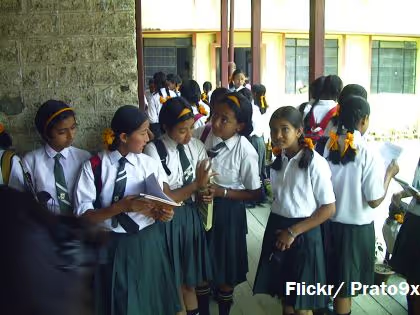
भारत में छात्र मूल्यांकन संबंधी खराब डेटा में सुधार लाना
भारत में छात्रों के शिक्षा के स्तर के बारे में प्रशासनिक डेटा की सटीकता पर मौजूदा प्रमाण को ध्यान में रखते हुए, सिंह और अहलूवालिया चर्चा करते हैं कि छात्र मूल्यांकन की एक विश्वसनीय प्रणाली क्यों मायने रखती है; मूल्यांकन डेटा की गुणवत्ता तय करना भारतीय शिक्षा प्रणाली में औसत दर्जे के दुष्चक्र को रोकने की दिशा में एक कदम है। वे इस बात पर प्रकाश डालते हैं कि कैसे तृतीय-पक्ष द्वारा स्वतंत्र मूल्यांकन और प्रौद्योगिकी एवं उन्नत डेटा फोरेंसिक के उपयोग से शिक्षा के वास्तविक स्तर की गलत व्याख्या को रोका जा सकता है।
Remedying poor student assessment data in India
Taking into account existing evidence on the accuracy of administrative data on student learning levels in India, Singh and Ahluwalia discuss why a reliable system of student assessment matters; fixing the quality of assessment data is a step towards preventing a vicious cycle of mediocrity in the Indian education system. They highlight how independent third-party evaluation, and the use of technology and advanced data forensics can help prevent misrepresentation of true learning levels.