
.svg)
.svg)
%201.svg)
%201.svg)
.svg)

.svg)
.svg)
Rahul Rao
Rahul Rao is an Assistant Professor of Economics at the Amrut Mody School of Management, Ahmedabad University. He completed his PhD in economics from IIM Bangalore, and graduated from IIT Kanpur with a BTech degree in Electrical Engineering.
He studies the role of market imperfections in affecting aggregate outcomes for an economy. His current research work spans the following subfields of macroeconomics: monetary, financial and spatial economics. He employs both empirical and theoretical modelling approaches.
.svg)

सूचना ही शक्ति है : आईसीटी और कृषि उत्पादकता
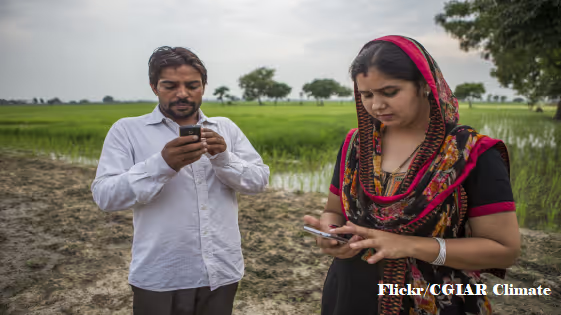
विकासशील देशों में कृषि की कम उत्पादकता का एक कारण यह है कि किसानों के पास आधुनिक कृषि विधियों के उपयोग के बारे में पर्याप्त जानकारी या मार्गदर्शन की कमी है। इस लेख में, बांग्लादेश में किसानों को कृषि प्रथाओं के बारे में विशेषज्ञों से परामर्श करने में सक्षम बनाने वाले कॉल सेंटर सहित सूचना और संचार प्रौद्योगिकी के पहल के प्रभाव की जांच की गई है। यह पाया गया कि हस्तक्षेप के बाद, फोन सेवा तक पहुँच वाले गाँवों में भूखंड स्तर पर कृषि संबंधी अकुशलता में 50% की कमी देखी गई।


Information is power: ICT and agricultural productivity
One reason for low agricultural productivity in developing countries is that farmers lack sufficient information or guidance in the use of modern agricultural methods. This article examines the impact of an Information and Communication Technology initiative in Bangladesh, involving call centres that enable farmers to consult experts regarding agricultural practices. It finds that, post intervention, villages with access to phone service experienced a 50% reduction in agricultural inefficiency at the plot level.

Land misallocation and industrial development
Although a large share of land in India is used for cultivation, large tracts of this are unproductive and produce low crop yields. In this post, Dasgupta and Rao explain their calculations to determine the minimum amount of land that would be required to meet the outputs for a set of crops. They argue that optimising land allocation can release millions of hectares of land for non-agricultural purposes, while also ensuring that food security remains unaffected.