
.svg)
.svg)
%201.svg)
%201.svg)
.svg)

.svg)
.svg)
Rajshri Jayaraman

Rajshri (Raji) Jayaraman is an associate professor (with tenure) of economics. She received her Ph.D. in Economics from Cornell University and worked at Center for Economic Studies (CES) in Munich before joining the European School of Management and Technology (ESMT) in 2007. Raji’s fields of interest are development economics and labour economics. Her research examines how people respond to incentives, using micro data on individuals, schools and firms in India, Germany and Canada. She is currently serving as faculty lead for the full-time MBA programme at ESMT.
.svg)


Analysing worker responses to a contract change
Higher-powered incentives are generally believed to increase worker productivity. In the context of an Indian tea plantation, this column examines a contract change wherein baseline wages were increased and incentive piece rates were lowered or kept unchanged. It finds that output increased by 20-80% in the following month but fell to original levels thereafter. Possible explanations for the observed impact are explored.


Gender Differences in Health Investments: Evidence from Health Care Providers in India
A central feature of many developing countries is the presence of significant gender differentials in health outcomes. One potential factor which can account for this is that females seek treatment later than males.
भारत में महिलाओं का ससुराल वालों के साथ रहने का रोजगार पर प्रभाव
आइडियास फॉर इंडिया के अंतर्राष्ट्रीय महिला दिवस 2023 के महीने भर चलने वाले अभियान के इस आलेख में राजश्री जयरामन का यह मानना है कि भारत में महिलाओं के ससुराल वालों के साथ रहने की उच्च दरों और उनके बीच श्रम बल भागीदारी की कम दरों के बीच नकारात्मक संबंध हैं। वे इन दोनों के बीच एक अनौपचारिक संबंध स्थापित करती हैं और तीन संभावित चैनलों की पड़ताल करती हैं जिसके माध्यम से सह-निवास महिलाओं की रोजगार को प्रभावित कर सकता है, जैसे साझा घरेलू संसाधनों का उपयोग करने के आय पर नकरात्मन प्रभाव, घरेलू जिम्मेदारियों में वृद्धि; और रूढ़िवादी लिंग मानदंड, जो महिलाओं की गतिविधियों को प्रतिबंधित करते हैं।
Living with the in-laws: Effect on women’s employment in India
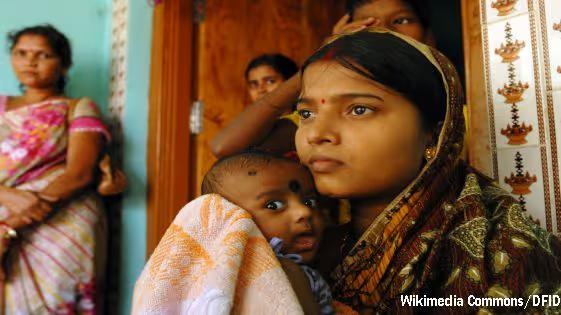
In the fourth post of I4I’s month-long campaign to mark International Women’s Day 2023, Rajshri Jayaraman considers the negative correlation between high rates of co-residence with in-laws and low rates of labour force participation among women in India. She establishes a causal relationship between the two and explores three possible channels through which co-residence could reduce women’s employment – a negative income effect from accessing shared household resources; an increase in domestic responsibilities; and conservative gender norms which restrict women's agency.