
.svg)
.svg)
%201.svg)
%201.svg)
.svg)

.svg)
.svg)
Raymond Fisman
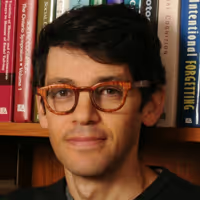
Ray Fisman holds the Slater Family chair in Behavioral Economics at Boston University. Previously, he was the Lambert Family Professor of Social Enterprise and co-director of the Social Enterprise Program at Columbia University's business school. Professor Fisman's research – much of it focussed on global corruption – has been published in leading economics journals including the American Economic Review, Journal of Political Economy, and Quarterly Journal of Economics; his work has been widely covered in the popular press, in such outlets as the New York Times, Wall Street Journal, Financial Times, the Economist, and the Washington Post. His most recent book, Corruption: What Everyone Needs to Know (with political scientist Miriam Golden), was published by Oxford University Press in 2017.
.svg)


Sunlight as disinfectant: Disclosure requirements and corruption in India
It is believed that transparency and free access to information can root out corruption and malfeasance in government. This article finds that the introduction of asset disclosure rules for candidates for political office in India in November 2003 led to weeding out of ‘bad’ politicians by encouraging exit from politics and increasing the likelihood of incumbents being re-elected



Does your cultural background affect your credit profile?
In many economies – both developed and developing – economic transactions tend to cluster by ethnic or social group. Using data from a large, state-owned bank in India, this article presents evidence that social proximity between lenders and borrowers, increases access to credit and reduces default. The findings suggest that the information benefits of social proximity outweigh the effects of taste-based discrimination.