
.svg)
.svg)
%201.svg)
%201.svg)
.svg)

.svg)
.svg)
Reetika Khera
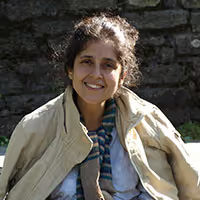
Reetika Khera is an Associate Professor of economics at the Indian Institute of Technology (IIT) Delhi. In the past, she has been Associate Professor at the Indian Institute of Management (IIM) Ahmedabad, and Assistant Professor at the Department of Humanities and Social Sciences, IIT Delhi. She studied at the Delhi School of Economics (M.A. and Ph.D.) and Institute of Development Studies, University of Sussex (M.Phil.). She was a post-doctoral Research Associate at Princeton University where she worked on child nutrition. Before joining IIT-Delhi, she was a visitor at GB Pant Social Science Institute, Allahabad, Centre for Development Economics, Delhi School of Economics and the Planning Unit, Indian Statistical Institute, Delhi.
For her Ph.D., she conducted a primary study in eight villages of Rajasthan. The thesis looked at the effectiveness of public interventions (such as relief works and the public distribution system) to prevent famines. Since then, she has remained involved in various field activities in India including surveys, social audits and "research for action" related to the National Rural Employment Guarantee Act (NREGA), Public Distribution System and others. An important part of her work has been to encourage and train university students to participate in these activities. More than 300 university students from across the country have participated in surveys and other field activities under her guidance. She has published in professional journals, magazines and newspapers on issues of food security, NREGA, education, child nutrition and elections in India.
.svg)

Child development: How are Indian states faring?
The recent release of the ‘Rapid Survey On Children’ report presents an opportunity to take a fresh look at the state of Indian children. Based on a simple Child Development Index constructed for 2005-06 and 2013-14, this column finds that Kerala, Tamil Nadu and Himachal Pradesh are at the top. Other states – even Bihar – can catch up, but only if they learn the right lessons from the leading states.


Food Security Act: How are India's poorest states faring?
The National Food Security Act was passed in 2013. This column reports findings from a recent survey on the status of the Act in six of India’s poorest states. Chhattisgarh, Madhya Pradesh, Odisha and West Bengal are doing quite well - the PDS is in good shape and most people are covered; however, Bihar and Jharkhand are yet to complete essential PDS reforms.
Aadhaar Bill: UID without excessively compromising privacy?
Can something like UID be created without compromising privacy beyond acceptable limits? If so, how should the Aadhaar Bill have been written? What are its specific and avoidable weaknesses?
Aadhaar Bill: Move towards a surveillance State?
Most advanced economies have had some version of UID for a long time, example, the Social Security number in the US, the Social Insurance Number in Canada, etc. This is recorded not only in interactions with the State (example, tax filing) but also in many kinds of non-governmental transactions (example, college admissions or property purchase). Yet, it is arguable that these nations have not become police States, occasional abuse notwithstanding. If privacy concerns in India are justified, is it a reflection of the trust deficit in government specific to India (or poorer countries more generally)? Or do schemes like UID inevitably lead to a surveillance State anywhere in the world?
Aadhaar Bill and government benefits: Risk of increasing exclusion?
Supporters of Aadhaar express the hope that will reduce inclusion errors and corruption by eliminating ghost beneficiaries, say in schemes like MNREGA. Are there substantial benefits to be reaped on this account? Tweet using: #AadhaarBill
Aadhaar Bill and government benefits: Better targeting and reduced corruption?
Supporters of Aadhaar express the hope that will reduce inclusion errors and corruption by eliminating ghost beneficiaries, say in schemes like MNREGA. Are there substantial benefits to be reaped on this account?
Aadhaar Bill: Incremental information-gathering powers for government?
The government already has the means to collect a lot of information on citizens (example, phone conversations and logs, credit card transactions, income tax records, bank account details, etc.). Conversely, there are many activities which happen under the radar (example, cash transactions, informal sector employment, etc.). What kind of information-gathering powers will Aadhaar confer on the State over and above what it already has?
UID project: Does evidence matter?
The Indian government has been pushing to make UID compulsory, and is now moving towards charging for use of authentication services. This article asserts that the three key selling points of UID – corruption control, inclusion and portability – have been achieved in several states in major welfare programmes, by creatively using simpler technology that is free of the hassles attached to UID.
The National Food Security Ordinance: Five misconceptions
The National Food Security Ordinance was promulgated in July 2013. The public debate that ensued, especially the criticism in the business media, has tended to be either devoid of facts or factually incorrect. This article attempts to correct the terms of the debate with relevant facts.
Cutting delays in MNREGA wages
Officials in charge of paying MNREGA wages in the state of Andhra Pradesh can now expect to receive fines if there are delays. This column shows how this move was made possible by a simple automated system, how effective it has been, and how the rest of India should follow suit.
Impact of the Food Security Act on Public Distribution System
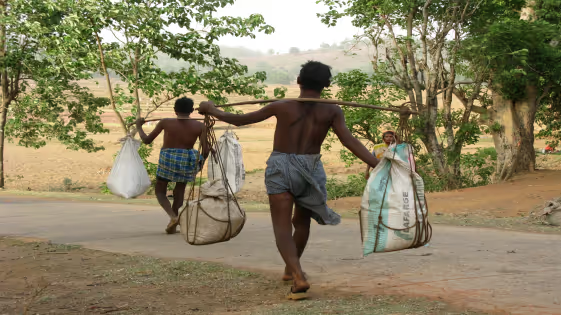
‘Leakages’ from the Public Distribution System – that is, grain released by the Food Corporation of India that fails to reach consumers – stood at around 42% in 2011-12 at an all-India level. Passed in 2013, the National Food Security Act guaranteed food security and mandated PDS reforms. As anticipated, based on data from the Household Consumption Expenditure Survey, Reetika Khera shows that leakages were down to 22% by 2022-23.
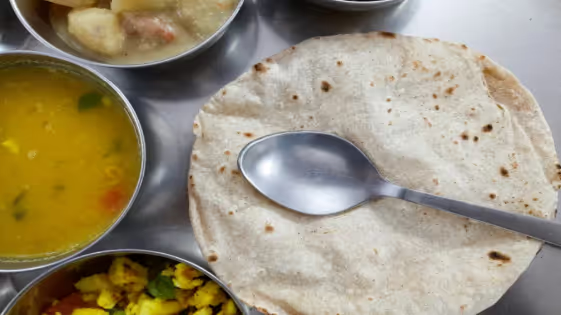
Why are canteens important when 800 million people get free grains?
Over the past decade, canteens have been established in various parts of India to provide subsidised meals and enhance food security. Based on a survey of canteens conducted across three states, Reetika Khera contends that this social policy intervention has helped ensure dignified meals for millions, created jobs, and fostered a sense of oneness and well-being for many. She advocates for more and guaranteed funding for canteens, revamp and expansion of menus, better infrastructure, and fair wages for staff.
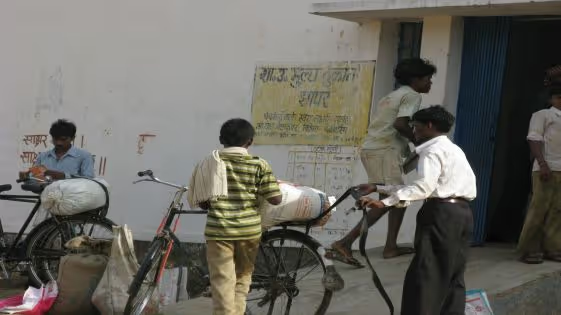
A review of the coverage of PDS
The coverage of the Public Distribution System (PDS) has been of wide interest due to the pandemic and lockdown. Based on government data sources, Khera and Somanchi estimate the state-wise coverage of PDS and map the categories of food support. They find that despite the expansion of PDS with the enactment of the National Food Security Act, and state ‘top-ups’ beyond central support, over 400 million people are excluded from it.
कोविड-19: समाज के कमजोर वर्ग की सहायता तत्काल कैसे की जा सकती है
केंद्र सरकार ने अभी तक इस बात की कोई घोषणा नहीं की है कि भारत में फैले कोविड-19 को नियंत्रित करने के लिए लॉकडाउन के कारण पहले से ही सामना कर रहे आर्थिक आपातकाल से निपटने की उसकी क्या् योजना है। इस पोस्ट में रीतिका खेरा लोगों की तत्काल मदद करने के लिए नकदी से लेकर शहरी क्षेत्रों में प्रवासियों के लिए वस्तुह देकर सहायता तथा स्वास्थ्य संबंधी आवश्यक उपायों के बारे में कुछ सुझाव दिया है।
Covid-19: What can be done immediately to help vulnerable population
With over 80% of India’s workforce employed in the informal sector and one-third working as casual labour, Covid-19's spread and subsequent unplanned lockdowns, have created economic havoc in the lives of millions. In this post, Reetika Khera puts forward suggestions on what can be done to help people immediately, ranging from cash and in-kind assistance to special measures for migrants in urban areas and urgent health-related measures.
MNREGA: Technology vs. technocracy
In this article, Reetika Khera, Associate Professor of Economics at IIT Delhi, argues that for MNREGA to flourish in the future, technologies that empower workers should be encouraged, and the tendency to over-centralise the implementation of the programme should be reversed.
Against the tide: Deaton's economics
In a tribute to Angus Deaton, recipient of the 2015 Nobel Prize in Economics, Reetika Khera, who did her post-doctorate research at Princeton University under Deaton, outlines his India-specific contributions both as a rigorous economist and a public intellectual. She discusses Deaton’s great concern with measurement issues, and the over-reliance on randomised controlled trials as evidence for policymaking; and his support of government action for social policy.