
.svg)
.svg)
%201.svg)
%201.svg)
.svg)

.svg)
.svg)
Rinchan Ali Mirza

Rinchan Ali Mirza is an Assistant Professor of Economics at the University of Kent. His primary research fields are development economics, economic history, and political economy. His research uses applied econometric techniques to investigate the impact of history on long-run development outcomes. In particular, his work has examined the impact of colonial rule, religious and tribal institutions, the partition of British India, and the Green Revolution on long-run development. His work has been published in journals such as the Explorations in Economic History and the Journal of Health Economics.
.svg)

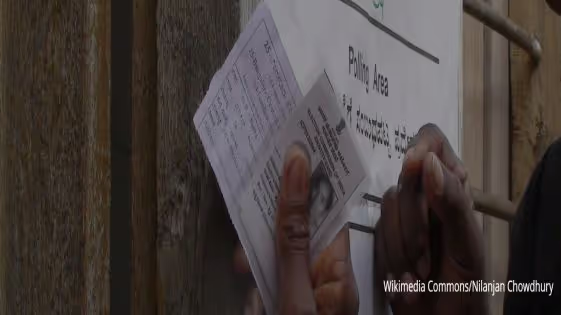
क्या मतदान का अधिकार राजनीतिक व्यवहार को प्रभावित करता है? भारत से ऐतिहासिक साक्ष्य
लोकतंत्र को लंबे समय से बेहतर आर्थिक विकास परिणामों के लिए जाना जाता है। हालांकि यह स्पष्ट नहीं है कि नागरिकों को मतदान का अधिकार देना, राजनीतिक भागीदारी या प्रतियोगिता को प्रभावी बनाए रखने को सुनिश्चित करने के लिए पर्याप्त है या नहीं। एक नए प्रयोग के तहत 1921-1957 के दौरान जिला-स्तरीय डेटासेट को आधार बनाते हुए यह लेख इस बात की जाँच करता है कि भारत में किस प्रकार दो वर्ग-आधारित विस्तार द्वारा राजनीतिक व्यवहार को आकार दिया गया है।


Does the right to vote affect political behaviour? Historical evidence from India
Democracies are known to have better economic development outcomes over the longer run. However, it is not clear whether giving citizens the right to vote is sufficient for ensuring an effective degree of political participation or competition. Creating a novel, district-level dataset from 1921-1957, this article examines how political behaviour is shaped by two class-based extensions of voting rights in India.