
.svg)
.svg)
%201.svg)
%201.svg)
.svg)

.svg)
.svg)
Rishabh Kumar

Rishabh Kumar is an Assistant Professor of Economics at The University of Massachusetts Boston. Previously, he taught at California State University San Bernardino and worked in government for New York City’s Department of Finance. He received his PhD in Economics from The New School for Social Research, New York in 2017.
He is interested in the distribution of income and wealth within, and between, countries; and writes about current and historical inequality/poverty, economic development and political economy.
.svg)

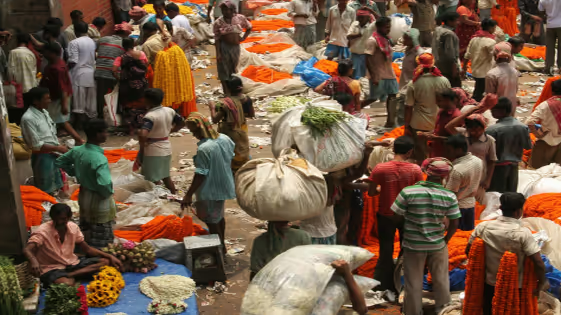
आज कितने भारतीय गरीब हैं?
वर्ष 2022-23 के पारिवारिक उपभोग व्यय सर्वेक्षण के तहत जारी एक तथ्य पत्रक के बाद भारत में गरीबी पर बहस फिर से शुरू हो गई है। इस लेख में घटक और कुमार उल्लेख करते हैं कि शोधकर्ताओं में आम सहमति है कि देश में अत्यधिक गरीबी 5% से कम है। घटक और कुमार इस बात का गहराई से अध्ययन करते हैं कि गरीबी रेखा का निर्धारण कैसे किया जाता है तथा निष्कर्ष निकालते हैं कि गरीबी रेखा की गणना के लिए आवश्यक विस्तृत आँकड़ों के अभाव में, अत्यधिक गरीबी के अनुमानों के बारे में संदेह बना रहेगा।


Determining how many Indians are poor today
Poverty debates in India have seen a revival since the release of a fact sheet from the 2022-23 household consumption expenditure survey. In this post, Ghatak and Kumar note that the general consensus among researchers is that extreme poverty is under 5%. However, they contest this by digging deeper into how the poverty line is determined and conclude that in the absence of detailed data necessary for calculation of an updated poverty line, doubts will remain about the estimates of extreme poverty
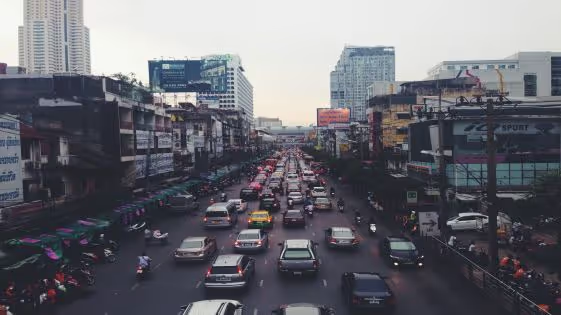
Focussing on inequality of opportunity to sustain India’s growth
India has seen a four-fold increase in average incomes since 1990, which has reduced the share of the population living in absolute poverty from 45% to 20%. Yet, there are large and widening inequalities in incomes and opportunities. Analysing microdata from the National Sample Survey, this article provides estimates of the ‘locational premiums’ that residents can earn merely by belonging to a richer sub-region.

What do we know about the wealthy in India? A pre-liberalisation analysis
Academic attention on the metamorphosis and concentration of wealth has so far excluded poor countries. This column analyses wealth distribution in India, post-independence and pre-liberalisation. It finds that during this period of modest economic growth, the importance of the elite, especially the top 0.01%, declined quite dramatically relative to national income.