
.svg)
.svg)
%201.svg)
%201.svg)
.svg)

.svg)
.svg)
Robin Burgess

Robin Burgess is a Professor of Economics, a Founder and Academic Director of the International Growth Centre, and a Director of the Economic Organisation and Public Policy Programme all at the London School of Economics. He was brought up in Uganda, Tanzania, Malawi, the US, the Philippines and Italy where his father worked as a doctor and his mother as a child nutritionist. He received a B.Sc. in biological sciences from Edinburgh University, a M.Sc. in economics from the LSE and a Ph.D. in economics from Oxford University. His areas of research interest include development economics, public economics, political economy, labor economics and environmental economics.
He has published on a variety of topics – natural disasters, mass media, rural banks, land reform, labor regulation, industrial policy, taxation, poverty and growth. He has been a Visiting Assistant and Associate Professor of Economics at the Massachusetts Institute of Technology, Harvard University, the National Bureau of Economic Research, Ecole Polytechnique, University College London and the University of California at Berkeley. He is Program Director of the Development Economics Program at the Centre for Economic Policy Research (CEPR), a Member of the Board of the Bureau for Research in the Economic Analysis of Development (BREAD), a Faculty Research Fellow at the National Bureau for Economic Research (NBER), a member of the Abdul Latif Jameel Poverty Action Lab (J-PAL), a Fellow of the European Development Research Development Network (EUDN), a member of the Institute for Policy Dialogue (IPR), an Associate Editor of the Economic Journal and is the Founder and Director of the Microeconomics of Growth Research Network. Before joining academia he served as a consultant economist with the World Bank, the European Bank for Reconstruction and Development, and the Government of India.
He lives in North London with his wife Bronwen Burgess and daughters Isla Macbeth Burgess and Romilly Belle Burgess.
.svg)


Lighting Up Bihar: Electrification to Sustain Economic Growth
This project looks at incentivising consumers to pay for the electricity consumed by the area in Bihar. The intervention specifically links the duration of supply to the payment performance of a group against electricity supplied in the previous month. Through a randomised controlled experiment, the researchers measure that doing so improves payment behaviour and reduces the percentage of pilfered power consumption in Bihar. Also, an extension of this project was also undertaken which expands the study sample, at the request of the Bihar government, from a planned 4 districts to 8 districts (increasing the overall sample, while reducing the number of units sampled per district).


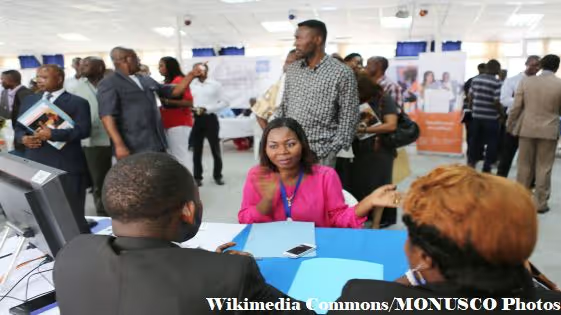
Aiding the search for good jobs: Evidence from Uganda
To design policies that lead young labour-market entrants to good jobs, it is important to understand job search processes and what affects the ability to find gainful employment. Based on an experiment in Uganda involving two interventions – vocational training and matching workers with firms – this article shows that while training enhances optimism about employment prospects, matching causes discouragement and poorer labour market outcomes in the long run.

Should civil servants be allowed to serve in their home areas?
Bureaucrats form an essential part of State capacity. Should they be allowed to serve in their home areas? This article finds that Indian Administrative Service officers assigned to their home states perform worse than comparable officers assigned to non-home states, are perceived to be more corrupt and less able to withstand illegitimate political pressure. This performance gap is particularly pronounced in the later career stages when there is more room for patronage and capture of bureaucracy by local political elite.

Creating entrepreneurs: A big new idea in development
Can the world’s poorest people become entrepreneurs? This column outlines results from an evaluation of the Ultra Poor programme in Bangladesh, a scheme that the NGO behind it claims is a staggering success.

Let Them Buy Light: The Welfare Benefits of Electricity for Rural Households and Enterprises
This project measured the welfare effects of increased access to electricity for rural households and micro-enterprises by letting them buy light. The research design experimentally offers off-grid, solar connections through a randomized - controlled trial and measures both the willingness to pay for connections and the welfare benefits of a connection once adopted, with special focus on the productivity and education effects that bear on economic growth. Findings inform the formulation of sensible rural electrification policies and inform implementation issues.