
.svg)
.svg)
%201.svg)
%201.svg)
.svg)

.svg)
.svg)
Rohini Pande

Rohini Pande is the Henry J. Heinz II Professor of Economics and Director of the Economic Growth Center at Yale University. Prior to this she was the Mohammed Kamal Professor of Public Policy, Area Chair for Political and Economic Development, Co-Director of Evidence for Policy Design (EPoD) and Director of Governance Innovations for Sustainable Development Group at Harvard Kennedy School, Harvard University. She is an Executive Committee member of the Bureau for Research on Economic Development (BREAD), co-chairs the Political Economy and Government Group at Jameel Poverty Action Lab (JPAL) and is a Research Associate at the National Bureau of Economic Research (NBER). Her research examines how the design of democratic institutions and government regulation affects policy outcomes and citizen well-being, especially in South Asia. Her work emphasises the use of real-world evidence to test economic models, often through large-scale field experiments in developing countries. She has worked extensively on the design and impact of electoral accountability and transparency initiatives, financial access initiatives and environmental regulation in low-income settings. Current projects include examinations of: information disclosures via politician report-cards; health and economic impacts of microfinance; the efficacy of environmental regulations in India; and the costs and benefits of an emissions trading market in India. Her research has been funded by National Science Foundation and private foundations, and has been published in several journals including the American Economic Review, Quarterly Journal of Economics and Science. Pande received a Ph.D. in economics from London School of Economics, a M.A. in Philosophy, Politics and Economics from Oxford University and a B.A. in economics from Delhi University.
Rohini Pande also serves as the faculty co-chair of a week-long executive education programme, "Rethinking Financial Inclusion: Smart Design for Policy and Practice," aimed primarily at professionals involved in the design and regulation of financial products and services for low-income populations.
Her personal website is http://campuspress.yale.edu/rpande/
.svg)


The youngest are hungriest
Babies born in India are more likely to be stunted than those in sub-Saharan Africa, even though the former are better off on average. This column examines how the India-Africa height gap varies by birth order within the family and finds that it begins with the second-born and becomes more pronounced with each subsequent baby. Favouritism toward firstborn sons in India explains this trend.



Asking the right question to get the right policy
There is consensus in the development community on the importance of bridging the gap between researchers and practitioners; however, misaligned incentives underlie this gap. In this article, Pande, Moore and Dodge of Harvard Kennedy School, explain how bringing policymakers together with researchers to work more iteratively ensured that data from MNREGS - the world’s largest public works programme - became accessible and relevant to those who use it.
The political economy of data
Recent experiences, especially from Scandinavian countries, show that opening administrative data sources can substantially improve public policymaking. In this article, Pande and Blum contend that while investment in data infrastructure is needed to produce and use statistics, the decision to collect and open data also depends on political economy considerations. Such forces are particularly strong in India and pose a major constraint on effective policy reform.
Should the less educated be barred from village council elections?
In December 2014, the state government of Rajasthan issued an executive order barring citizens with less than eight years of formal education from running for village council chief elections in all but tribal areas. In this article, Rohini Pande, Professor of Public Policy at Harvard University, contends that this will discriminate against able leaders who have been denied schooling because of gender, poverty or caste.
Enhancing Local Public Service Delivery: Experimental Evidence on the National Rural Employment Guarantee Scheme in Bihar
The Mahatma Gandhi National Rural Employment Guarantee Scheme (MNREGA) is among the largest social protection programmes in the world.
Third-party environmental auditing
High levels of industrial pollution are a harmful by-product of growth. The Indian state of Gujarat is an industrial powerhouse with about 5% of the Indian population, but 9% of India’s registered manufacturing employment and 19% of output. This growth has been accompanied by a degradation of air and water quality.
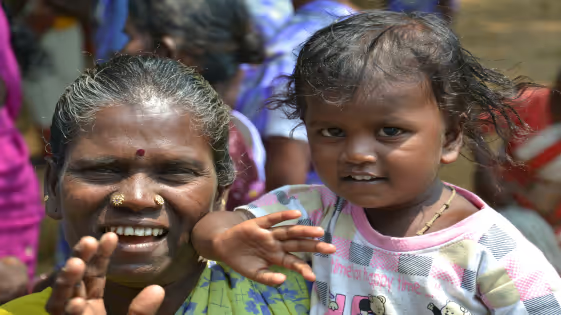
केवल विकास ही नहीं: गरीबी दूर करने में पुनर्वितरण का महत्व
हाल के अध्ययनों से इस बात की पुष्टि मिलती है कि विकासशील देशों में नीतियां और संस्थान विश्व के संपन्न देशों के अनुरूप बदल रहे हैं और इसी वजह से इन देशों की प्रति-व्यक्ति आय औद्योगीकृत देशों के बराबर होने की राह पर है। इस लेख में, एनवॉल्डसन और पांडेय ने तर्क दिया है कि इन देशो में व्याप्त अत्यधिक गरीबी को मिटाने के लिए यह देश-स्तरीय बराबरी पर्याप्त नहीं होगी, क्योंकि इस 'विकास' का फल गरीबों तक नहीं पहुंच रहा है। अतः समावेशी समृद्धि के लिए एक राजनीतिक समाधान- यानी पुनर्वितरण की आवश्यकता होगी।
Not by growth alone: The salience of redistribution in poverty eradication
Recent studies posit that per capita incomes of developing countries are finally on track to catch up to those of industrialised countries. In this post, Enevoldsen and Pande contend that this country-level catch-up will not be sufficient to eradicate extreme poverty, as the blessings of this ‘growth’ are not reaching the poor. Inclusive prosperity requires a political solution: redistribution.
Smart data: Can visualised administrative data help inform and hold public stakeholders accountable?
The project examined how interactive data visualisations can be used to present administrative data in a way that is easily digestible, lends itself to exploration and provides a clear link to required action for administrators. The findings from the project showed that government officials responded more to visualised data as compared to plain tabular data.

तृतीय अशोक कोतवाल स्मृति व्याख्यान- स्वैच्छिक कार्बन बाज़ार : विकासशील अर्थव्यवस्थाओं में चुनौतियाँ और अवसर
हमारे संस्थापक प्रधान संपादक अशोक कोतवाल की याद में वर्ष 2022 में ‘अशोक कोतवाल स्मृति व्याख्यान’ की शुरुआत विकास के प्रमुख मुद्दों पर एक वार्षिक व्याख्यान के रूप में की गई थी। 11 दिसंबर 2024 को संपन्न इस व्याख्यान के तीसरे संस्करण में, प्रोफेसर रोहिणी पांडे ने स्वैच्छिक कार्बन बाज़ारों और विकासशील अर्थव्यवस्थाओं में संबंधित चुनौतियों और अवसरों के बारे में बात की। इस व्याख्यान की रिकॉर्डिंग अब विडियो प्रारूप में उपलब्ध है।
Third Ashok Kotwal Memorial Lecture: Voluntary Carbon Markets: Challenges and Opportunities in Developing Economies
The Ashok Kotwal Memorial Lecture was instituted in 2022, in memory of our founding Editor-in-Chief, as an annual lecture on key issues in development. For the third edition on 11 December 2024, Professor Rohini Pande spoke about voluntary carbon markets, and the associated challenges and opportunities in developing economies. A recording of the lecture is now available to view.
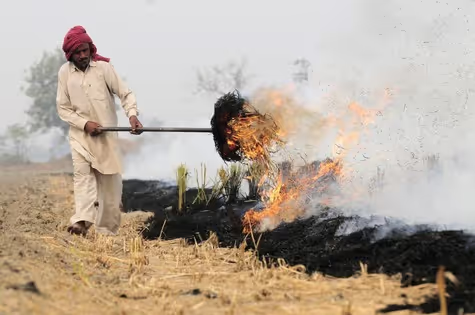
भारत में पराली जलना कम करने के लिए स्थानांतरण भुगतान डिज़ाइन करना
पराली जलाने से होने वाले वायु प्रदूषण का स्वास्थ्य पर गंभीर प्रभाव पड़ता है, ख़ासकर उत्तर भारत में। पर्यावरण के अनुकूल प्रथाओं को अपनाने के लिए सशर्त नकद हस्तांतरण कार्यक्रम की शुरुआत के बावजूद, किसानों में इस प्रक्रिया में तरलता और विश्वास की कमी है। यह लेख पंजाब में किए गए एक अध्ययन का वर्णन करता है और बताता है कि यद्यपि कार्यक्रम के अनुपालन में चुनौतियों का सामना हो सकता है, आंशिक अग्रिम भुगतान वाले अनुबन्ध पराली जलने को कम करने और पराली जैसे फसल अवशेषों के कुशल प्रबंधन में उपकरणों व तकनीक के उपयोग को बढ़ाने में मदद कर सकते हैं।
Designing transfer payments to reduce crop burning in India
Air pollution caused due to crop burning has severe health impacts, particularly in north India. Despite the introduction of a conditional cash transfer programme to adopt environmentally friendly practices, farmers lack liquidity and trust in the process. This article describes a study undertaken in Punjab, and reveals that although the programme may face challenges with compliance, contracts that include partial upfront payments can help reduce crop burning and increase the use of equipment to manage crop residue.
Clearing the air: The effects of transparency on plant pollution emissions
Of the 20 cities in the world with the worst fine particulate air pollution, 13 are in India. If good information on who pollutes is available, then traditional environmental regulation can bring down emissions somewhat, but regulators may lack the will or resources to penalise every polluter. What more can government due to contain such widespread damages? This project measuring the effect of information disclosure on emissions in a large-scale plant-level randomised controlled trial in India. In collaboration with the Maharashtra Pollution Control Board, it develops a star-rating programme that assigns plants to categories based on their recent air pollution emissions, which are either privately shared with the plant alone or publicly disclosed.
Star power: Rating industries in Maharashtra by emission levels
Maharashtra Pollution Control Board recently launched a programme to rate industries based on their emission levels – the first such initiative by a government regulator. An easy and accessible way to inform residents about industry emissions around where they live and work, Greenstone, Pande, Ryan and Sudarshan contend that the programme can infuse transparency and accountability into the system, and instil healthy competition among industries.
Building Environmental Regulation that Enables Growth
This project is linked to a broader research-policy collaboration with India’s Ministry of Environment and Forests (MoEF), Central Pollution Control Board (CPCB), and State Pollution Control Boards of Gujarat, Maharashtra, and Tamil Nadu to design, implement and evaluate an emissions market for particulate matter (PM) emissions in India, a pollutant of serious concern.
What is causing Delhi's air pollution?
Several policies aimed at reducing Delhi’s air pollution have been implemented this winter, but what remains unclear is where the pollution comes from. This column takes stock of what we know about pollution sources and the portion contributed by each. It contends that good information systems are required to turn the critical convergence of public concern, policymaker attention, and academic contribution into a smart policy response.
Emissions Trading as an Environmental Innovation in India: Measuring the Policy Impact on Emissions and Abatement Costs
Growth in developing countries has improved living standards of millions, but has led to high pollution concentrations and serious public health damages. Market-based environmental regulation can reduce the costs of pollution reduction and thus transform the trade-off between environmental quality and growth.

Moving in or dropping out? India's female migrants and urban labour force integration
One important, yet understudied, constraint to female labour force participation is women’s inability to successfully migrate to where the jobs are – cities.
Constructing housing for the poor without destroying their communities
The Pradhan Mantri Awas Yojana aims to achieve housing for all by 2022. However, vacancy of 23% was reported last year in urban housing built under the programme. In this article, Rohini Pande, contends that take-up can be increased if policies are designed in a way that allows the intended beneficiaries to preserve their social networks when they relocate.
Access to credit and female labour supply in India
While microfinance is believed to have the potential to increase female labour force participation, short-term experimental evaluations of microfinance have not found significant economic benefits for women.
Long Run-Effects of Repayment Flexibility in Microfinance: Evidence from India
Financiers across the world structure debt contracts to limit the risk of entrepreneurial lending. But debt structures that reduce risk may inhibit enterprise growth, especially among the poor.