
.svg)
.svg)
%201.svg)
%201.svg)
.svg)

.svg)
.svg)
Rosa Abraham
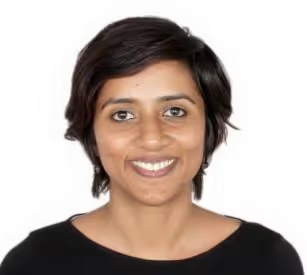
Rosa Abraham is a Postdoctoral Research Fellow at Azim Premji University, Bangalore. She completed her Ph.D. from the Centre for Economic Studies and Policy (CESP), Institute for Social and Economic Change (ISEC), Bangalore. Her research focused on forms of informal labour in India, examining the rise of informalisation in the formal/organised sector and the consequent impacts on productivity and inequality. Prior to her Ph.D., she worked at the Ashoka Trust for Research in Ecology and Environment, and taught at the Madras School of Economics (MSE). Her research interests include understanding workers’ preferences for alternative work arrangements, the changing nature of informal work, and implications for job polarisation in the Indian context.
.svg)

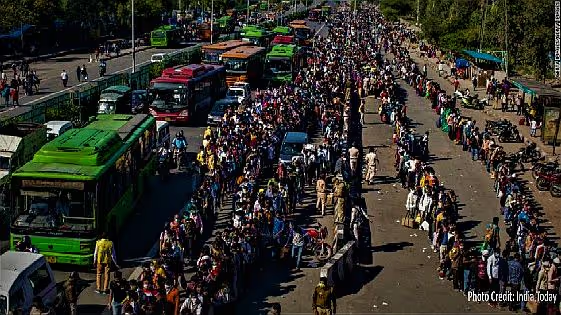
Pandemic as a lens: Identifying and addressing livelihood vulnerabilities
Based on the findings from a phone survey of around 5,000 Indian workers, the authors explore the impact of the Covid-19 economic lockdown on two forms of livelihood vulnerabilities: employment insecurity and food insecurity. They argue that the policy response needs to go beyond addressing the immediate consequences of this specific shock; this juncture posits the need for structural reforms that seek to address and fill these gaps concretely rather than suturing temporarily.


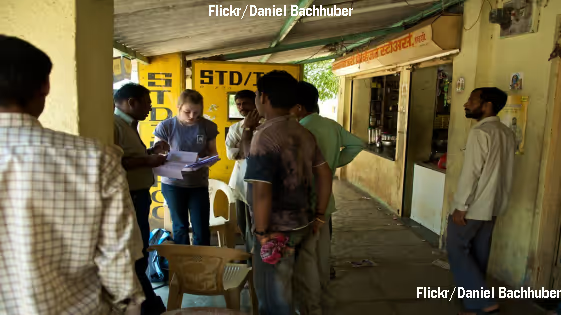
Improving survey quality using paradata: Lessons from the India Working Survey
To improve the credibility of survey data, several monitoring tools are used by researchers – such as ‘paradata’, which have gained prominence with the growth of computer-aided interviewing. In this post, Goel et al. discuss how paradata were used in the ‘India Working Survey’ conducted in the states of Karnataka and Rajasthan in 2020, to streamline enumerator practices and enhance data quality.