
.svg)
.svg)
%201.svg)
%201.svg)
.svg)

.svg)
.svg)
Samuel Scott

Samuel Scott is a Research Fellow at IFPRI’s (International Food Policy Research Institute) Poverty Health and Nutrition Division and conducts applied nutrition research in the South Asia region. He has experience working on iron deficiency and anaemia, adolescent health, biofortification, human functional outcomes such as cognition, behaviour change communication strategies, women’s self-help groups, school feeding programmes, and health systems.
Prior to joining IFPRI, he completed his postdoctoral research on “The Interactions of Malnutrition and Enteric Infections: Consequences for Child Health and Development (MAL-ED)” study. His doctoral research involved randomised controlled trials in India and Rwanda to measure the efficacy of iron-biofortified pearl millet and beans, and a study examining interrelations between iron status, physical fitness, and cognitive function among female college students in the US. He holds a Ph.D. in Nutritional Sciences from The Pennsylvania State University.
.svg)

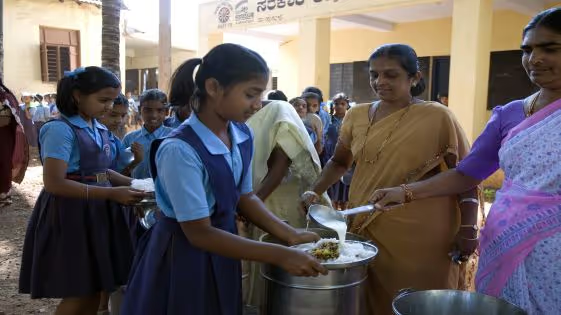
पोषण में सुधार हेतु स्कूली भोजन योजनाओं का महत्व
भारत में अल्पपोषित बच्चों की संख्या दुनिया में सबसे अधिक है और यहां मिड-डे मील (एमडीएम) के रूप में स्कूली भोजन की सबसे बड़ी योजना जारी है परंतु इस योजना के अंतर-पीढ़ीगत प्रभाव पर सीमित साक्ष्य उपलब्ध हैं। राष्ट्रीय परिवार स्वास्थ्य सर्वेक्षण और राष्ट्रीय नमूना सर्वेक्षण के आंकड़ों के आधार पर, यह लेख दिखाता है कि अगर स्कूली शिक्षा के दौरान एक माँ एमडीएम की लाभार्थी थी, तो उसके बच्चों की लम्बाई की कमी में 20-30% की गिरावट आती है।


The power of school feeding programmes to improve nutrition
India has the world’s highest number of undernourished children and the largest school-feeding programme – the Mid-Day Meal (MDM) scheme – but limited evidence is available on the intergenerational impact of the programme. Based on data from the National Family Health Survey and National Sample Survey, this article shows if a mother was a beneficiary of MDM during schooling, there is a 20-30% reduction in height deficits of her children.