
.svg)
.svg)
%201.svg)
%201.svg)
.svg)

.svg)
.svg)
Sandip Sukhtankar

Sandip Sukhtankar is an Associate Professor in the Department of Economics at the University of Virginia and an affiliate of the Bureau for Research and Economic Analysis of Development (BREAD) and the Jameel Poverty Action Lab (J-PAL). He received his PhD from Harvard University in 2009, and a BA from Swarthmore College (with Highest Honors) in 2000. He previously worked at Dartmouth College, the Brookings Institution and the Center for Global Development.
Prof Sukhtankar’s research interests are in development economics, political economy, and public economics, with a particular focus on corruption, governance, and the delivery of public benefits and services. Past papers have examined the political economy of sugarcane cooperatives, incentives for corruption in India’s National Rural Employment Guarantee Schemes, and a randomized evaluation of biometric ID cards in India. Current projects include randomized trials of large-scale government programs leveraging technology and direct transfers of cash in lieu of in-kind benefits in India.
Prof Sukhtankar’s research has been published in top economics journals such as the American Economic Review, American Economic JournalApplied Economics, and the Journal of Public Economics. His paper published in theAmerican Economic JournalEconomic Policy was awarded the Best Paper award by the American Economics Association. His work has been supported by the National Science Foundation, the Omidyar Network, and the Bill and Melinda Gates Foundation.
.svg)


पीडीएस में पसंद-आधारित विकल्प की आवश्यकता
भारत के प्रमुख खाद्य सुरक्षा कार्यक्रम पब्लिक डिस्ट्रीब्यूशन सिस्टम (पीडीएस) पर सार्वजनिक व्यय का एक बड़ा हिस्सा अपेक्षित लाभार्थियों तक नहीं पहुंचता है। इसलिए सब्सिडी वाले अनाज के बदले डायरेक्ट बेनिफिट ट्रांसफर (डीबीटी) का विचार एक प्रमुख नीति विकल्प के रूप में उभरा है। मुरलीधरन, नीहौस, और सुखतंकर एक सरल लेकिन शक्तिशाली दृष्टिकोण की सलाह देते हैं: इसके बजाय कि नीति निर्माता पीडीएस और डीबीटी के बीच निर्णय लें, हम लाभार्थियों को यह विकल्प दे सकते हैं।


Price risk and poverty
A common feature of markets in many developing economies is a lack of integration. This leads to substantial variation in prices of basic commodities across space, and risk to households from local supply shocks.
Sugar mills: Ownership, productivity and crop choice
This project examines the effect of firm ownership structure on firm behaviour and the economic outcomes of upstream suppliers by comparing privately-owned sugar mills to cooperatives and public mills in India.

शासन में सुधार के लिए मोबाइल का उपयोग
मुख्य सार्वजनिक कार्यक्रमों का कितनी अच्छी तरह क्रियान्वयन हो रहा है इसे मापना शासन की एक बड़ी चुनौती बनी हुई है। देश में मोबाइल-फोन की तेजी से बढ़ रही पहुंच को देखते, मुरलीधरन, नीहौस, सुखतंकर, और वीवर का मानना है की सार्वजनिक सेवा वितरण में सुधार के लिए इस सशक्त साधन का लाभ उठाना चाहिए।
Using mobiles to improve governance
Measuring how well major public programmes are implemented remains a core governance challenge. With the increasing mobile-phone penetration in the country, Muralidharan, Niehaus, Sukhtankar, and Weaver make the case for leveraging this powerful tool to improve public service delivery.
मनरेगा से निकली हैं कई राहें
भारत की महात्मा गांधी राष्ट्रीय ग्रामीण रोजगार गारंटी योजना (मनरेगा) की भूमिहीन ग्रामीण परिवारों को लाभ पहुंचाने के लिए बनाए गए सुरक्षा तंत्र के रूप में प्रभावशीलता को लेकर बहुत सारे विवाद उत्पन्न हुए हैं। मुरलीधरन, नीहौस, और सुखतंकर ने बड़े पैमाने पर एक मूल्यांकन के परिणामों की चर्चा करके बताया है कि मनरेगा भूमिहीन ग्रामीण गरीबों के कल्याण में सुधार, और समग्र ग्रामीण उत्पादकता में वृद्धि के लिए आश्चर्यजनक रूप से प्रभावी उपकरण हो सकता है।
Strengthen MNREGS to support the rural economy
India’s Mahatma Gandhi National Rural Employment Guarantee Scheme (MNREGS) has generated a lot of controversy about its effectiveness as a safety net designed to benefit landless rural households. Muralidharan, Niehaus, and Sukhtankar discuss the results from a large-scale randomised evaluation that suggest MNREGS may be a surprisingly effective tool both for improving the welfare of the landless rural poor and increasing overall rural productivity.
Need for a choice-based approach in PDS
A large share of public spending on the Public Distribution System (PDS), India’s flagship food security programme, does not reach intended beneficiaries. Thus, the idea of Direct Benefits Transfer (DBT) in lieu of subsidised food has emerged as a leading policy alternative. Muralidharan, Niehaus, and Sukhtankar recommend a simple but powerful approach: rather than policymakers deciding between PDS and DBT, we could give beneficiaries that choice.

What do we know about corruption in India?
Despite ample media coverage of corruption, there remains a gap between headline-making scandals, policy options under discussion, and the actual evidence base drawn from empirical research on corruption. Based on an extensive review of the literature on corruption in India, this column highlights the underlying factors driving corruption, establishes a classification of corrupt activities, and distills five general principles that should guide future reform efforts.
Building state capacity for better programme implementation: Lessons from the Andhra Pradesh Smartcard Programme
Biometric payment systems are posited to reduce leakages in public welfare programmes but there is limited evidence on their effectiveness. This column presents evidence on the impact of the Andhra Pradesh Smartcard Programme on MNREGS and Social Security Pension beneficiaries, based on a large-scale randomised controlled trial. It finds substantial economic benefits, and concludes that using biometric payment infrastructure to deliver welfare payments can be a game changer for governance in India.
Two questions about the 2G scandal
The scandal involving corruption in the allocation of 2G licenses left the nation stunned. This column presents estimates of the revenue loss to the government, and says that while the common man was affected indirectly as social spending may have been reduced due to the losses, there was no direct negative impact on the telecom market in terms of lower quality of services or higher prices.
Corruption and the Mahatma Gandhi National Rural Employment Guarantee Act
Corruption continues to strangle India’s public finances. This column presents evidence of embezzlement in India’s flagship rural employment programme and suggests new ways policymakers can test what works in the struggle against corruption.
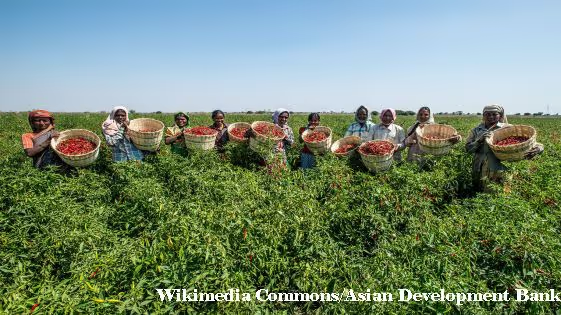
How reforming India’s workfare programme raised private sector earnings
By randomising the rollout of improved, biometric payment infrastructure used to issue National Rural Employment Guarantee Scheme payments in Andhra Pradesh, this study found that this reform raised incomes and reduced poverty. This effect was realised mostly through increases in private labour market earnings, as higher earnings through NREGS put competitive pressure on large landowners who had kept wages low by limiting employment. These findings highlight how critical it is to get implementation of policies and social programmes right..

भ्रष्टाचार और बहिष्करण को संतुलित करना: आधार को पीडीएस में शामिल करना
सार्वजनिक रूप से प्रदान की जाने वाली वस्तुओं और सेवाओं के लाभार्थियों को इन लाभों को प्राप्त करने के लिए अपनी पहचान कैसे साबित करनी चाहिए? यह लेख, झारखंड राज्य में सार्वजनिक वितरण प्रणाली (पीडीएस) में बायोमेट्रिक प्रमाणीकरण के आधार पर अधिक कड़ी पहचान आवश्यकताओं के प्रभावों के अध्ययन को हमारे सामने रखता है। यह अध्ययन झारखंड राज्य में 1.5 करोड़ लाभार्थियों के बड़े पैमाने पर एक प्रयोग के तौर पर किया गया है। इसमे यह पाया गया है कि भ्रष्टाचार को कम करने के प्रयासों में, इस प्रक्रिया के कारण कुछ कम आय वाले परिवार अपने लाभ से वंचित हो गए हैं।

Balancing corruption and exclusion: Incorporating Aadhaar into PDS
How should recipients of publicly provided goods and services prove their identity in order to access these benefits? This article reports findings from a large-scale experiment across 15 million beneficiaries to evaluate the effects of more stringent identification requirements based on biometric authentication, on the delivery of subsidised food through Public Distribution System in the state of Jharkhand. It finds that attempts to reduce corruption has cost some low-income households their benefits in the process.

Price risk and poverty
There is an ongoing policy debate in India on whether grain entitlements under PDS should be converted into cash transfers. This column shows that in the face of high price variability, in-kind transfers such as the PDS can be superior to cash transfers as they could significantly reduce the strength of the relationship between prices and caloric intake, hence, shielding households from price risk.