
.svg)
.svg)
%201.svg)
%201.svg)
.svg)

.svg)
.svg)
Sanjib Pohit
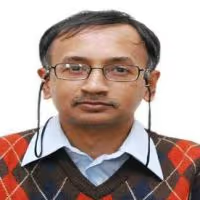
Sanjib Pohit is a Senior Fellow at NCAER (National Council of Applied Economic Research). He is an experienced modeller in the area of trade and environment with 20 years of modelling experience. His domain of research experience includes trade, energy, environment, climate change, and South Asian integration. Previously, he had worked with Council of Scientific & Industrial Research (CSIR): National Institute of Science, Technology & Development Studies as Professor AcSIR & Senior Principal Scientist. He has served as a member of several committees of Government of India including Climate Change Modelling group of Ministry of Environment & Forests. He was educated at the Indian Statistical Institute.
.svg)


Identifying the binding constraints of agricultural growth in Bihar
Out of the seven-year period set for doubling of farmers’ income by the government, four full agricultural years have already gone. This article identifies the binding constraints on farmers’ income or economic activity in Bihar. It finds that the poor functioning of agricultural markets, reflected in the instability in the prices of agricultural produces and the low level of crop diversification, are the reasons for slow agricultural growth.


‘Nowcasting’ the Indian economy: A new approach to know the now-GDP
Bhadury and Pohit describe NCAER’s new ‘nowcasting’ model, which seeks to predict India’s GDP numbers at frequent intervals − typically on a monthly or quarterly basis − by exploiting the incremental information in published data on economic indicators.

India’s R&D expenditure: Composition matters
While gross expenditure on R&D in India has been on the rise in recent years, it is dominated by public investment. In this post, Sanjib Pohit contends that the current system of allocating public funds for R&D is geared towards low-risk, low-return incremental research, and should instead promote innovative research. He also recommends encouraging private investment in ‘core’ R&D activities via tax incentives.

जलवायु परिवर्तन और नदी प्रदूषण : भारत में उच्च गुणवत्ता के पर्यावरण डेटा की आवश्यकता
भारत में जल प्रदूषण को नियंत्रित करने और जल संसाधनों की सुरक्षा के लिए गहन डेटा संग्रह और निगरानी की आवश्यकता है। पोहित और मेहता इस लेख में, एनसीएईआर और टीसीडी की एक परियोजना का वर्णन करते हैं, जिसमें उत्तर प्रदेश और पश्चिम बंगाल में गंगा नदी के प्रमुख स्थानों पर पानी की गुणवत्ता मापदंडों से संबंधित आंकड़े एकत्र करने के लिए नावों से जुड़े स्वचालित सेंसरों का उपयोग किया गया। वे इस बात पर ज़ोर देते हैं कि कैसे इन निष्कर्षों से प्रदूषण के स्रोतों को समझने में मदद मिल सकती है ताकि प्रभावी नीतिगत हस्तक्षेप और प्रदूषकों द्वारा नियामक अनुपालन सुनिश्चित किया जा सके।
Climate change and riverine pollution: The need for high-quality environment data in India
Controlling water pollution and protecting water resources in India requires comprehensive collection and monitoring of data. In this article, Pohit and Mehta describe a project undertaken by NCAER and TCD, which used automated sensors attached to boats to collect data on water quality parameters at key points along the Ganga river in Uttar Pradesh and West Bengal. They emphasise how these findings can help understand the sources of pollution to ensure effective policy interventions and regulatory compliance by polluters.