
.svg)
.svg)
%201.svg)
%201.svg)
.svg)

.svg)
.svg)
Santosh Kumar

Santosh Kumar is an applied microeconomist whose research focuses on the economics of global health and economic development in low- and middle-income countries. His research examines the causal association between child and maternal health, human capital, and poverty.
Kumar is currently working on research projects related to the effects of prenatal conditions on birth outcomes and human capital accumulation; the effects of birth endowment, postnatal investments, and micronutrient deficiencies on human capital, and the effects of access to physical infrastructures (road, electricity, sanitation) and microfinance on human well-being. Kumar’s work uses experimental and quasi-experimental research methods and he has extensive experience collecting survey data in India, Bhutan, and Albania. His research has been published in numerous peer-reviewed journals, and he is an associate editor of Economic Modelling.
.svg)

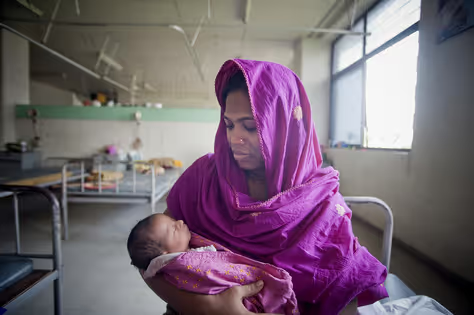
Did Covid-19 pandemic increase incidence of low-birth-weight among newborns?
Globally, one in four babies are born with low birth weight, with long-term impacts on health and economic outcomes. This article uses Indian data from 2019-2021 to analyse the impact of the Covid-19 pandemic on birth outcomes, given the disruption of essential maternal and neonatal services. It finds that infants born post-pandemic had 45 grams lower birth weight, with 3% greater incidence of low birth weight than infants born before the pandemic.


Can double-fortified salt in school mid-day meals help reduce anaemia?
Micronutrient malnutrition is a major risk factor for more than half of the daily under-five deaths in India. It leads to iron-deficiency anaemia, which especially affects pregnant women, and young and adolescent children. Based on an intervention in Bihar, this article estimates the impact of supplying double-fortified salt in mid-day meals in schools on anaemia as well as cognition and educational outcomes of second-grade children.

The less the merrier? Family size and education in India
In the face of financial constraints, children from larger families are expected to have relatively less education and poor health. This column explores the empirical relevance this ‘quantity-quality trade-off’ in India with regard to education. It finds that family size has a negative impact on the schooling of children, particularly for low caste, poor and rural households.
Droughts and child health
Research has pointed towards the importance of foetal health in child development. Assessing the impact of rainfall variability on child health, this column finds that exposure to drought in the womb increases the child’s likelihood of being underweight. It suggests that policies aimed at reducing child malnutrition need to start at the beginning of human life, that is, in the womb.
Distance and institutional deliveries in rural India
India has the highest rate of maternal deaths in the world. A major cause is that a significant proportion of women continue to deliver babies at home without the presence of a skilled attendant. This column says that distance to health facilities is a key barrier to seeking delivery care at a facility.
Women's Reservations in Bihar and Children's Health Outcomes
This project investigates the impact of political decentralization and gender quota in local governance on different measures of health outcomes and behaviors. The findings of the prioject are consistent with local leaders having better information or greater concern for women and child health.

Political decentralisation, female leadership, and health in rural Bihar
Political decentralisation and female representation in governance are known to improve social welfare by influencing policy decisions in favour of women and children. Analysing data from rural Bihar, this column finds that having a female leader at the village council level has a strong positive association with institutional births, and child survival rates for richer households.