
.svg)
.svg)
%201.svg)
%201.svg)
.svg)

.svg)
.svg)
Seema Jayachandran

Seema Jayachandran is a Professor of Economics and Public Affairs at Princeton University. Her research focuses on environmental conservation, gender equality, health, and other microeconomic topics in developing countries. Prior to this she was an Associate Professor of Economics at Northwestern University. She is also an affiliate of the National Bureau of Economic Research, Bureau for Research and Economic Analysis of Development, Abdul Latif Jameel Poverty Action Lab, International Growth Centre, and Innovations for Poverty Action. Dr. Jayachandran earned a Ph.D. in economics from Harvard University, a master’s degree in physics and philosophy from the University of Oxford where she was a Marshall Scholar, and a bachelor’s degree in electrical engineering from MIT. Prior to joining Northwestern, she was an Assistant Professor of Economics at Stanford University and a Robert Wood Johnson Scholar in Health Policy Research at the University of California, Berkeley. She also previously worked as a management consultant with McKinsey & Company. Dr. Jayachandran’s research interests span a wide range of topics in development economics. Much of her recent work focuses on maternal and child health in Africa and South Asia. She has also made contributions related to political economy, labor markets and environmental conservation in developing countries.
.svg)


The youngest are hungriest
Babies born in India are more likely to be stunted than those in sub-Saharan Africa, even though the former are better off on average. This column examines how the India-Africa height gap varies by birth order within the family and finds that it begins with the second-born and becomes more pronounced with each subsequent baby. Favouritism toward firstborn sons in India explains this trend.



An overview of (elder) son preference in India
In the fourth article in the Ideas@IPF2023 series, Seema Jayachandran presents key information about son preference and how it manifests as gaps in health and updates these outcomes with NFHS-5 data. She substantiates a more novel assertion on how elder sons are favoured and its consequences for other children, especially considering and the impact of declining fertility on sex-selection practices. She concludes with a discussion of the shortcomings of commonly employed policies intended to improve the sex ratio in India.
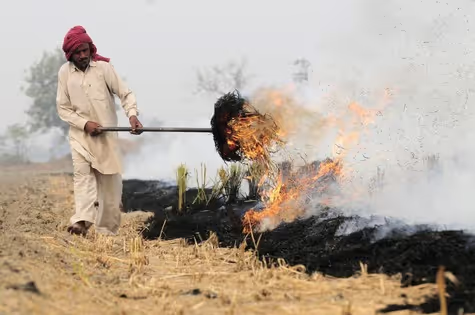
भारत में पराली जलना कम करने के लिए स्थानांतरण भुगतान डिज़ाइन करना
पराली जलाने से होने वाले वायु प्रदूषण का स्वास्थ्य पर गंभीर प्रभाव पड़ता है, ख़ासकर उत्तर भारत में। पर्यावरण के अनुकूल प्रथाओं को अपनाने के लिए सशर्त नकद हस्तांतरण कार्यक्रम की शुरुआत के बावजूद, किसानों में इस प्रक्रिया में तरलता और विश्वास की कमी है। यह लेख पंजाब में किए गए एक अध्ययन का वर्णन करता है और बताता है कि यद्यपि कार्यक्रम के अनुपालन में चुनौतियों का सामना हो सकता है, आंशिक अग्रिम भुगतान वाले अनुबन्ध पराली जलने को कम करने और पराली जैसे फसल अवशेषों के कुशल प्रबंधन में उपकरणों व तकनीक के उपयोग को बढ़ाने में मदद कर सकते हैं।
Designing transfer payments to reduce crop burning in India
Air pollution caused due to crop burning has severe health impacts, particularly in north India. Despite the introduction of a conditional cash transfer programme to adopt environmentally friendly practices, farmers lack liquidity and trust in the process. This article describes a study undertaken in Punjab, and reveals that although the programme may face challenges with compliance, contracts that include partial upfront payments can help reduce crop burning and increase the use of equipment to manage crop residue.