
.svg)
.svg)
%201.svg)
%201.svg)
.svg)

.svg)
.svg)
Shagun Sabarwal

Shagun Sabarwal is the Monitoring, Evaluation and Learning and South Asia Director at WomenLift Health. She has more than 13 years of experience in social policy and development research, focusing on improving gender equality and health in India. Over the years, Shagun has led a portfolio of projects to support governments to scale evidence-based solutions, designed evaluation research, created capacity building programmes in monitoring and evaluation, and provided technical advisory on evidence-informed policy design.
Before joining WomenLift Health, Shagun was the Director of Policy, Training and Communication at J-PAL South Asia and the Director of CLEAR South Asia. She led engagements with governments, donors, and civil society organizations to initiate new research, disseminate policy lessons, and scale up evidence-based programs.
She completed her Doctorate in Public Health from Harvard University.
.svg)

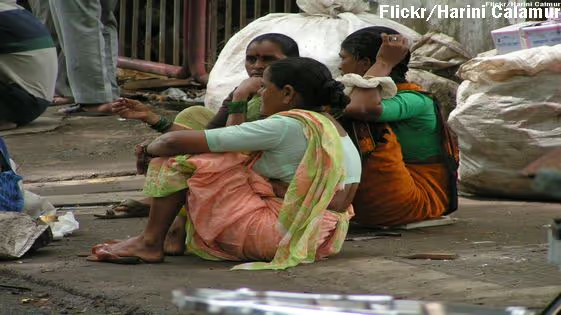
अज्ञात गरीबों की खोज: अत्यधिक गरीबी में रहने वाले लोगों की पहचान और लक्ष्यीकरण
गरीबी के बारे में अलग-अलग अनुमानों के परिणामस्वरूप कुछ वंचित समुदाय अक्सर सरकारी कल्याण योजनाओं से बाहर रह जाते हैं। सबरवाल और चौधरी बिहार में लागू ‘सतत जीविकोपार्जन योजना’ का अध्ययन करते हैं, जिसमें अत्यधिक गरीबी में रहने वाले लोगों की पहचान करने और यह सुनिश्चित करने के लिए कि उन्हें सामाजिक सुरक्षा योजनाओं तक पहुंच प्राप्त हो, बीआरएसी द्वारा अपनाए गए ‘ग्रेजुएशन अप्रोच’ कार्यप्रणाली के ज़रिए सामुदायिक ज्ञान का उपयोग किया जाता है। वे इस बात की चर्चा करते हैं कि यह लक्ष्यीकरण दृष्टिकोण किस तरह से गैर-मौद्रिक अभाव को ध्यान में रखता है और महिलाओं व अन्य हाशिए पर रहने वाले समूहों का समावेश सुनिश्चित करता है।


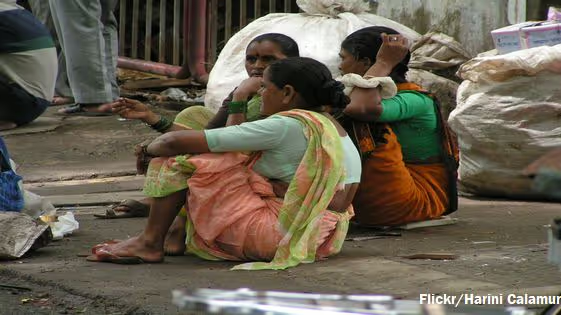
Finding the indiscernible poor: Community knowledge as a targeting approach
Varying estimates of poverty have often resulted in some deprived communities being excluded from government welfare schemes. Sabarwal and Chowdhry look at the case of Satat Jeevikoparjan Yojana in Bihar, which uses the mechanisms recommended by BRAC’s Graduation Approach and harnesses community knowledge to identify those living in extreme poverty and ensure that they receive access to social protection schemes. They discuss how this targeting approach takes into account non-monetary deprivation, and ensures the inclusion of women and marginalised groups.