
.svg)
.svg)
%201.svg)
%201.svg)
.svg)

.svg)
.svg)
Shekhar Tomar

Shekhar Tomar is an Assistant Professor in the Economics and Public Policy Area at the Indian School of Business. His research lies at the intersection of macroeconomics, trade, and finance, and he extensively uses micro-data to answer macro questions.
Prior to ISB, he worked as a research economist at the Reserve Bank of India between 2017-2019 after completing a PhD from Toulouse School of Economic
.svg)


आप्रवासन नीति सम्बन्धी अनिश्चितता श्रम बाज़ारों को प्रभावित करती है
राष्ट्रपति ट्रम्प के फिर से चुने जाने से एच-1बी वीज़ा सम्बन्धी नीतियों पर बहस फिर से शुरू हो गई है, यह एक अस्थाई उच्च कौशल कार्य वीज़ा है जिसमें 70% वीज़ा भारतीयों के पास हैं। इस लेख में, वर्ष 2016 में ट्रम्प की पहली बार हुई जीत के दौरान भारत से प्राप्त नौकरियों के आँकड़ों का विश्लेषण करते हुए पाया गया है कि अमेरिकी आप्रवासन नीतियों के बारे में अनिश्चितता बढ़ने के कारण तथा वीज़ा कोटा एवं प्रक्रियाओं में कोई बदलाव नहीं होने के कारण, कई फर्मों ने नौकरियाँ अमेरिका से भारत स्थानांतरित कर दीं।


How immigration policy uncertainty affects labour markets
President Trump’s re-election has reignited debate over H-1B visa policies, a temporary high-skill work visa programme wherein 70% of visas are held by Indians. Analysing jobs data from India from the period around Trump’s first victory in 2016, this article finds that increased uncertainty around US immigration policies – without any change in visa quotas and procedures – caused firms to relocate jobs from the US to India.
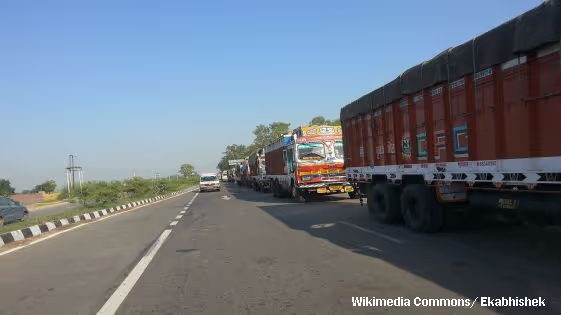
Lockdown-induced trade disruptions and adaptations by firms
In the face of trade disruptions, firms can reorient their trade to minimise risk. This article documents a fall in inter-state trade in India during the Covid-19 lockdown, that continues until December 2020. This is explained by ‘reshoring’, as plants more dependent on inter-state sales (and input-sourcing) shifted to intra-state sales (and input-sourcing). The extent of reshoring is determined by a new measure – Scope for Home Expansion – that captures excess home production which can be diverted within the state