
.svg)
.svg)
%201.svg)
%201.svg)
.svg)

.svg)
.svg)
Shreya Biswas

Shreya Biswas is Assistant Professor at the Department of Economics and Finance, BITS Pilani, Hyderabad Campus. Prior to joining BITS, she was an Assistant Professor of Economics at the School of Economics, NMIMS, Mumbai. She received her Ph.D. and Masters from Indira Gandhi Institute of Development Research (IGIDR), Mumbai. Her primary research interests include public policy, household finance, and social networks.
.svg)


Why firms should appoint ‘networked’ women directors
India has introduced regulations mandating companies to appoint woman directors on their boards, to improve gender balance at the top. In this context, this article traces the evolution of women-director networks in listed firms during 2010-2020. It finds that networked women directors are more involved in board activities, and positively impact firm performance through bridging information gaps and improving corporate governance.



All is not well: Unintended consequences of maternity leave policy in India
In 2017, mandated paid maternity leave for women employees in India was increased from 12 weeks to 26 weeks. Analysing data for 160,000 households, this article finds that the policy change caused a fall in employment and income among women in the high-fertility age group. This was driven by a rise in firms’ ‘reservation productivity’ for hiring these women, since employers alone finance the leave.
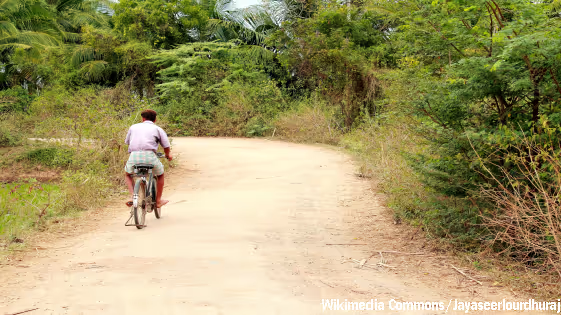
गांव में अपराध: क्या सड़क जैसी बुनियादी सुविधाओं से फर्क पड़ता है?
ग्रामीण भारत में गरीबी के उन्मूलन और आर्थिक विकास हेतु अच्छी बुनियादी सुविधाओं तक पहुंच होना महत्वपूर्ण है। यह लेख, भारत मानव विकास सर्वेक्षण (आईएचडीएस) के 2004-05 और 2011-12 के आंकड़ों का विश्लेषण करते हुए दर्शाता है कि पक्की सड़कों से जुड़े गांवों के परिवारों में अपराध, श्रम बल की भागीदारी और पारिवारिक आय के सन्दर्भ में उन गांवों में रहने वालों की तुलना में बेहतर परिणाम पाए गए जहाँ पक्की सड़कें नहीं थी।
Crime in the village: Does road infrastructure make a difference?
Access to better infrastructure is critical for poverty alleviation and economic development in rural India. Analysing data from the 2004-05 and 2011-12 waves of the India Human Development Survey (IHDS), this article shows that households in villages connected with pucca roads had better outcomes in terms of crime, labour force participation, and family income, relative to those residing in villages with no pucca roads.