
.svg)
.svg)
%201.svg)
%201.svg)
.svg)

.svg)
.svg)
Smit Gade

Smit Gade is Data and Research Manager at Good Business Lab (GBL) where he looks after research design and field implementation. He currently works on research projects related to Female labour force participation, Skilling, and Labour productivity.
Prior to GBL, he worked as a Research Associate at Abdul Latif Jameel Poverty Action Lab(J-PAL) working on Early Childhood Development projects with the Government of Rajasthan and the Government of Tamil Nadu.
His research interests also include Child Malnutrition, Economics of Corruption, and Political Economy. He holds M.Phil. Economics from Oxford University.
.svg)

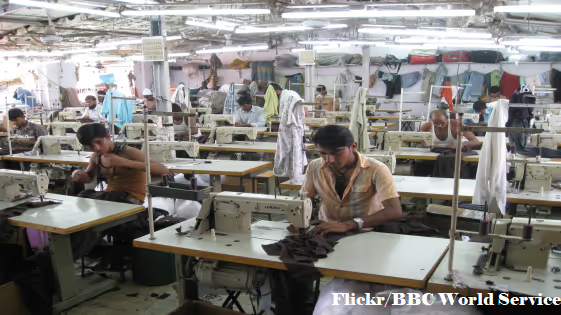
भारत के विनिर्माण क्षेत्र के श्रमिकों में निवेश और उत्पादकता
पहली मई को दुनिया भर में श्रम दिवस मनाया जाता है और आधुनिक विश्व की अर्थ व्यवस्था और प्रगति में श्रम, श्रम बाज़ार व श्रमिकों की महत्वपूर्ण भूमिका है। इसी सन्दर्भ में आज के इस लेख में, अध्वर्यु एवं अन्य भारत में घटती विनिर्माण उत्पादकता तथा राज्यों और उद्योगों में व्याप्त भिन्नता से सम्बंधित कुछ तथ्यों का संकलन प्रस्तुत करते हैं। वे श्रमिक उत्पादकता बढ़ाने की क्षमता वाले चार प्रमुख क्षेत्रों- सॉफ्ट स्किल्स, आवाज़ यानी उनका मत, भौतिक वातावरण और प्रबन्धकीय गुणवत्ता में निवेश के बारे में मौजूदा साहित्य की जाँच करते हैं, जिसमें भारतीय और वैश्विक दोनों सन्दर्भों में किए गए अध्ययनों पर प्रकाश डाला गया है। वे सम्भावित कारणों के साथ यह निष्कर्ष निकालते हैं कि क्यों कम्पनियाँ श्रमिकों में पर्याप्त निवेश नहीं कर रही हैं।



How worker investments can fuel productivity in India’s manufacturing sector
In the second article in the Ideas@IPF2023 series, Adhvaryu et al. synthesise some facts on India’s declining manufacturing productivity and variations across states and industries. They examine existing literature on investments in four key areas with the potential to increase worker productivity – soft skills, voice, physical environment, and managerial quality – highlighting studies conducted in both the Indian and global context. They conclude with possible reasons why firms may not be adequately investing in workers.

Expectations, wage hikes, and worker voice
Understanding how exit decisions of workers are affected by their ability to voice their concerns, is a central question in labour economics. Based on an experiment in 12 garment factories in Karnataka around the time of a wage hike, this article shows that providing workers a channel to express grievances – through an anonymous employee satisfaction survey – reduces quit rates, especially for those most disappointed with the wage hike.

Role of private sector in the holistic skilling of India’s workforce
Low skill levels of workers are a key reason for low labour productivity in developing countries. In this article, Adhvaryu et al. discuss research that centres around two important questions in this context: who should conduct and pay for skilling, and what kind of skills does the workforce need?