
.svg)
.svg)
%201.svg)
%201.svg)
.svg)

.svg)
.svg)
Sonalde Desai
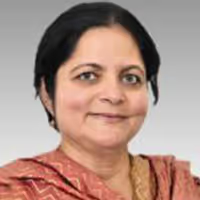
Sonalde Desai is a Professor of Sociology at University of Maryland with joint appointment as a Senior Fellow at the National Council of Applied Economic Research (NCAER), New Delhi. She received a Ph.D. from Stanford University and post-doctoral training at University of Chicago and The RAND Corporation.
She is a demographer whose work deals primarily with human development in developing countries with a particular focus on gender and class inequalities. She studies employment, education and maternal and child health outcomes by locating them within the policy discourse and political economy of the region. While much of her research focuses on India, she has also undertaken comparative studies across South Asia, Latin America and Sub Saharan Africa.
.svg)

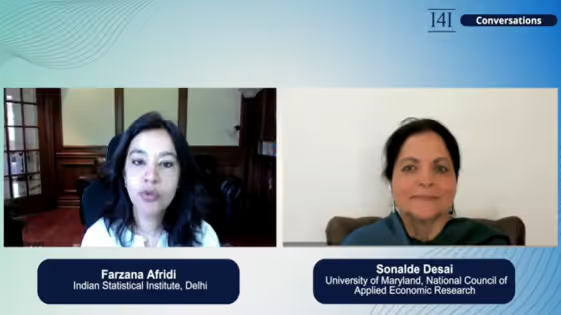
Managing India’s demographic transition
India’s population is expected to peak at about 1.7 billion in 2064, and while the current median age is only 28, the share of Indians aged 65 and above will go from 7% to 20% in the next 40 years or so. Has India been able to take advantage of its demographic dividend of a large working-age population, and is the country prepared for the upcoming transition from a young to an ageing population? In a new edition of I4I conversations, Farzana Afridi (Indian Statistical Institute, Delhi) and Sonalde Desai (University of Maryland & National Council of Applied Economic Research) discuss the challenges associated with India’s demographic dividend. They emphasise the need to tap into the full workforce, including women, as well as ensuring that workers are productive. They also analyse the issue of ageing both from the perspective of society and family. ....


Managing India’s demographic transition
India’s population is expected to peak at about 1.7 billion in 2064, and while the current median age is only 28, the share of Indians aged 65 and above will go from 7% to 20% in the next 40 years or so. Has India been able to take advantage of its demographic dividend of a large working-age population, and is the country prepared for the upcoming transition from a young to an ageing population? In a new edition of I4I conversations, Farzana Afridi (Indian Statistical Institute, Delhi) and Sonalde Desai (University of Maryland & National Council of Applied Economic Research) discuss the challenges associated with India’s demographic dividend. They emphasise the need to tap into the full workforce, including women, as well as ensuring that workers are productive. They also analyse the issue of ageing both from the perspective of society and family. ....

Of Picasso and Cezanne: Early achievers vs. late bloomers
Children learn at different paces – some are early achievers while others bloom late. In this article, Desai and Vanneman, Professors of Sociology at University of Maryland, present evidence to show that children from privileged backgrounds are much more likely to overcome early disadvantages in learning, as compared to those from poorer backgrounds. The New Education Policy should recognise this and support children that are falling behind.

बदलते समाज में सामाजिक सुरक्षा जाल पर पुनर्विचार करना
इस लेख के सह-लेखक देबाशीष बारिक, पल्लवी चौधरी, बिजय चौहान, ओम प्रकाश शर्मा, दिनेश कुमार तिवारी (एनसीएईआर) और शरण शर्मा (मैरीलैंड कॉलेज पार्क विश्वविद्यालय और एनसीएईआर) हैं। ऐतिहासिक रूप से सामाजिक सुरक्षा जाल के प्रति भारत के दृष्टिकोण में गरीबों की पहचान करना और उन्हें सामाजिक सुरक्षा तक प्राथमिकता प्रदान करना शामिल रहा है। भारत मानव विकास सर्वेक्षण के 2004-05, 2011-12 और 2022-24 में तीन चरणों में एकत्र किए गए आँकड़ों का विश्लेषण करते हुए, इस लेख में पाया गया है कि अर्थव्यवस्था के बढ़ने के साथ-साथ परिवारों को गरीबी में और उससे बाहर निकलने में काफी बदलाव का सामना करना पड़ता है, जिससे गरीबों की सटीक तरीके से पहचान करना और उन्हें लक्षित करना मुश्किल हो जाता है। यह आइडियाज़@आईपीएफ2024 श्रृंखला का तीसरा लेख है।

Rethinking social safety nets in a changing society
This paper was coauthored by Debasis Barik, Pallavi Choudhuri, Bijay Chouhan, Om Prakash Sharma, Dinesh Kumar Tiwari (NCAER) and Sharan Sharma (University of Maryland College Park and NCAER). Historically, India’s approach to social safety nets has involved identifying the poor and providing them with priority access to social protection. Analysing data from the India Human Development Survey, collected in three waves across 2004-05, 2011-12 and 2022-24, this article finds that households face considerable transition in and out of poverty as the economy grows, making it difficult to identify and target the poor in a precise manner. This is the third article in the Ideas@IPF2024 series
शहरी अपवर्जन (बहिष्करण): कोविड-19 के मद्देनजर भारत में सामाजिक सुरक्षा पर पुनर्विचार करना
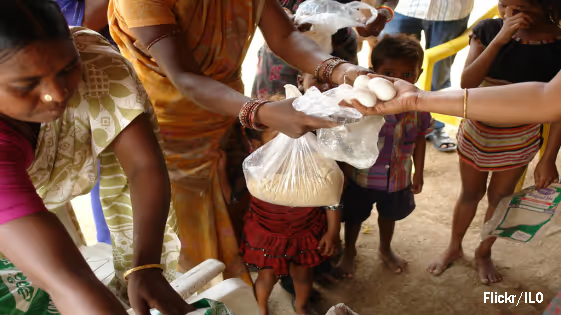
कोविड-19 के शुरुआती दिनों में लॉकडाउन के कारण हुई आर्थिक असुरक्षा के चलते कई परिवार अपनी उपभोग जरूरतों को पूरा करने के लिए सरकारी कल्याणकारी योजनाओं पर निर्भर रहने के लिए मजबूर हुए। यह लेख दिल्ली एनसीआर कोरोना वायरस टेलीफोन सर्वेक्षण के जून 2020 के दौर के डेटा का उपयोग करते हुए, दर्शाता है कि विशेष रूप से शहरी क्षेत्रों में कुछ परिवारों को ही खाद्यान्न और नकद अंतरण- दोनों प्राप्त हुए, और शहरी निवासियों की उनके ग्रामीण समकक्षों की तुलना में नकद अंतरण प्राप्त करने की संभावना भी आठ प्रतिशत कम थी।
Urban exclusion: Rethinking social protection in India in the wake of Covid-19
Economic insecurity caused by lockdowns during the early days of Covid-19 forced many households to rely on government welfare schemes to fulfil their consumption needs. Using data from the June 2020 round of the Delhi NCR Coronavirus Telephone Survey (DCVTS) by NCAER, this article shows that few households received both foodgrains and cash transfers, particularly in urban areas, and urban residents were also eight percentage points less likely to receive cash transfers vis-à-vis their rural counterparts.