
.svg)
.svg)
%201.svg)
%201.svg)
.svg)

.svg)
.svg)
Song Yuan

Song Yuan is a Ph.D. candidate in economics at the University of Warwick. His research interests include development economics, political economy, and economic history.
.svg)

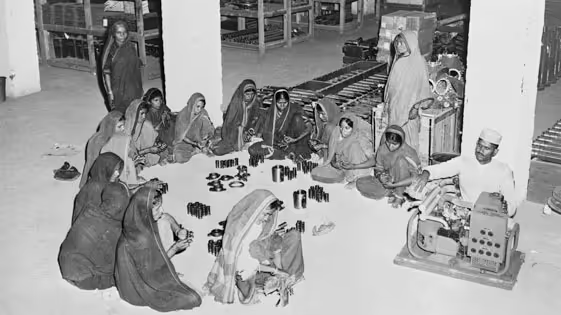
Demographic shocks and female labour force participation: Evidence from 1918 flu pandemic
The Influenza pandemic of 1918 killed about 5% of India’s population. This article finds that districts most adversely affected by influenza mortality saw a temporary increase in the country’s female labour force participation in 1921, driven in part, by distress labour supply by widows and higher wages. The increase was concentrated in the service sector, and had been reversed by 1931.


Demographic shocks and female labour force participation: Evidence from 1918 flu pandemic
The Influenza pandemic of 1918 killed about 5% of India’s population. This article finds that districts most adversely affected by influenza mortality saw a temporary increase in the country’s female labour force participation in 1921, driven in part, by distress labour supply by widows and higher wages. The increase was concentrated in the service sector, and had been reversed by 1931.

नौकरशाही नियुक्तियों को मिलने वाले निजी लाभ: भारत में वित्तीय खुलासे से साक्ष्य
हम अक्सर देखते हैं कि नौकरशाहों की तनख्वाह का ढांचा बहुत बंधा हुआ होता है | साथ ही, उन्हें मिलने वाली अन्य आर्थिक सुविधाएं और भत्ते न सिर्फ बेहद कम होते हैं, बल्कि उनमें प्रदर्शन के आधार पर कोई खास फर्क नहीं होता | इस लेख के लिए हमने भारत की 2010-2020 की अचल संपत्ति रिटर्न (आईपीआर) रिपोर्ट को आधार बनाया है, जिसमें नौकरशाहों ने खुद अपनी संपत्ति की जानकारी दी है| यह रिपोर्ट बताती है कि जब अफ़सरों को किसी ‘अहम’ मंत्रालय में पुनर्नियुक्ति कर भेजा जाता है, तो उन्हें निजी फ़ायदों के रूप में अच्छी सुविधाएं मिलती हैं | इन अफ़सरों की अचल संपत्तियों की संख्या और मूल्य दोनों बढ़ते हैं जिसका सीधा मतलब है कि उन्हें अपने काम के चलते निजी तौर पर कहीं ज़्यादा फ़ायदे और आर्थिक सुविधाएं मिलती हैं |
Private returns to bureaucratic appointments: Evidence from financial disclosures in India
Bureaucrats often face rigid salary structures, and face low-powered incentives that have less wage differentiation based on performance. Using bureaucrats’ self-reported asset declarations from the Immovable Property Return (IPR) reports for 2012-2020 in India, this article concludes that officers encounter high-powered incentives – in the form of private returns – on reassignment to an ‘important’ ministry. These officials see their immovable properties increase, both in value and number, and it is concluded that these effects are partly driven by their rent-seeking behaviour.