
.svg)
.svg)
%201.svg)
%201.svg)
.svg)

.svg)
.svg)
Sonia Bhalotra

Sonia Bhalotra is Professor of Economics at the University of Essex in the UK. Her research is centred upon the creation of human capital. She has active research programmes on the long run benefits of childhood health interventions, educational reform, conflict, the political economy of public service delivery, intergenerational transmission of human capital and poverty, and the dynamics of mortality, fertility and sex selection. Her research on India includes papers on political identity, infant mortality, and Hindu-Muslim differences (in political preferences, son preference, health and education). Sonia’s earlier research concerned child labour and the labour market impacts of economic liberalisation in India. She is currently also analysing cross-country micro-macro data for developing countries and historical data from America, Norway, Denmark and Sweden with the purpose of addressing contemporary policy problems in India and other relatively poor countries.
She holds an M.Phil. and a D.Phil. from Oxford and a B.Sc. from Delhi. She has, for several years, been on the Senior Management Team of the Centre for Market and Public Organisation and the Townsend Centre for International Poverty Research, both in Bristol. Her current membership of scientific committees includes the Council of the European Society of Population Economics, the International Review Panel of the Danish Council for Independent Research, the Advisory Board of Academics Stand Against Poverty (Yale), the International Scientific Advisory Board of the Centre for Modern Indian Studies in Gottingen University, the British Academy Area Panel for South Asia, the Assessment Panel for the ESRC Future Research Leaders Scheme and the ESRC Peer Review College. She is a Research Fellow at IZA, CHILD, CSAE and QEH. She has contributed policy relevant research to several international organisations.
.svg)


Female Politicians and Economic Growth: Evidence from State Elections in India
This project investigates whether women legislators are good for economic growth using constituency level data for all elections to State Legislative Assemblies in India during 1992-2012.


Like parent, like child: Health transmission in developing countries
To what extent is children’s health determined by their mothers’ health? This column analyses three decades’ worth of data on over two million children across 38 developing countries to explore how health is transmitted across generations – and how public policy can respond.

भारत में महिलाओं के विरासत के अधिकार और पुत्र की प्राथमिकता
भारत में अस्वाभाविक रूप से पुरुष-पक्षपाती जनसंख्या लिंग-अनुपात का एक महत्वपूर्ण कारण भारतीय माता-पिता की पुत्र होने की महत्वाकांक्षा है। यह लेख इस बात की पड़ताल करता है कि उनकी यह इच्छा किस हद तक उनकी बेटियों की तुलना में बेटों की मजबूत आर्थिक स्थिति से प्रेरित है - विशेष रूप से पैतृक संपत्ति के संदर्भ में। इस लेख यह पता चलता है कि महिलाओं और पुरुषों की विरासत के अधिकारों को समान करने से कन्या भ्रूण-हत्या में वृद्धि हुई और यह भी दर्शाता है कि सामाजिक मानदंड कानूनी सुधार में बाधा बने हुए हैं।

भारत में महिलाओं के विरासत के अधिकार और पुत्र की प्राथमिकता
भारत में अस्वाभाविक रूप से पुरुष-पक्षपाती जनसंख्या लिंग-अनुपात का एक महत्वपूर्ण कारण भारतीय माता-पिता की पुत्र होने की महत्वाकांक्षा है। यह लेख इस बात की पड़ताल करता है कि उनकी यह इच्छा किस हद तक उनकी बेटियों की तुलना में बेटों की मजबूत आर्थिक स्थिति से प्रेरित है - विशेष रूप से पैतृक संपत्ति के संदर्भ में। इस लेख यह पता चलता है कि महिलाओं और पुरुषों की विरासत के अधिकारों को समान करने से कन्या भ्रूण-हत्या में वृद्धि हुई और यह भी दर्शाता है कि सामाजिक मानदंड कानूनी सुधार में बाधा बने हुए हैं।
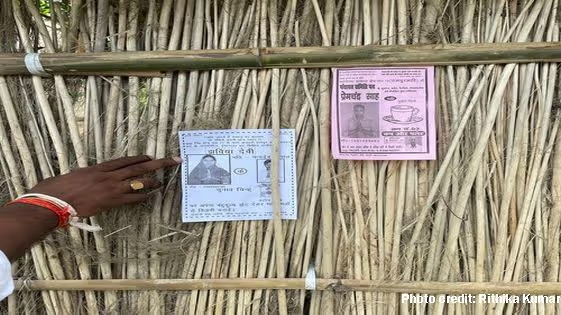
How women in politics impact maternal mortality
In the twelfth post of I4I’s month-long campaign to mark International Women’s Day 2023, Bhalotra et al. show that mortality during and after childbirth remains high, even where the knowledge and resources to avoid this are available, and demonstrate that raising the share of women in parliament can trigger action. Leveraging the introduction of gender quotas across developing countries, they identify reductions in maternal mortality, through increased skilled birth attendance and prenatal care utilisation, alongside a decline in fertility and an increase in schooling.
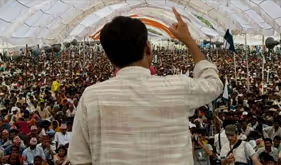
How leader identity impacts group coordination
In principle, leaders can facilitate group coordination towards a common goal but in diverse societies, their effectiveness may depend upon their social identity, and how citizens react to leader identity. Based on a lab-in-field experiment in India, this article investigates the role of leader religion in improving coordination, and the effectiveness of two policies that are often used to aid disadvantaged groups: intergroup contact, and affirmative action.