
.svg)
.svg)
%201.svg)
%201.svg)
.svg)

.svg)
.svg)
Sourangsu Chowdhury

Sourangsu Chowdhury has been a Fulbright Nehru Doctoral Scholar at the School of Public Health, University of California Berkeley, US, and is pursuing a Ph.D. at the Centre for Atmospheric Sciences, Indian Institute of Technology (IIT) Delhi.
.svg)


कोयला आधारित बिजली इकाइयों से प्रदूषण और बच्चों एवं महिलाओं की एनीमिक स्थिति
स्वास्थ्य पर वायु प्रदूषण के प्रभाव को व्यापक रूप से शोध-साहित्य में जगह मिली है। जहां अन्य अध्ययनों में मुख्य रूप से सामान्य रुग्णता और मृत्यु दर जैसे परिणामों पर ध्यान केंद्रित किया गया है, यह लेख भारत में छोटे बच्चों और प्रौढ़ उम्र की महिलाओं की एनीमिक स्थिति पर कोयला आधारित बिजली इकाइयों द्वारा पड़ने वाले प्रदूषण के प्रभाव का मूल्यांकन प्रस्तुत करता है। इन अतिरिक्त लागतों के जुड़ जाने से नवीकरणीय ऊर्जा की ओर प्रगतिशील बदलाव और कोयले पर निर्भरता कम करने का मामला मजबूत होता है।


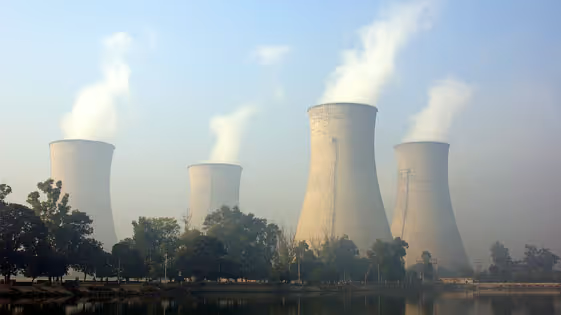
Pollution from coal-based power units and anaemic status of children and women
An extensive literature has considered the impact of air pollution on health. While studies have mainly focussed on outcomes such as general morbidity and mortality, this article evaluates the impact of pollution caused by coal-based power units on the anaemic status of young children and prime-age women in India. Factoring in these additional costs strengthens the case for a progressive shift to renewable energy and reduced reliance on coal.

प्रारंभिक जीवन और वायु प्रदूषण से संपर्क: भारत में बच्चों पर प्रभाव
भारत की आधी से ज्यादा आबादी ऐसी हवा में सांस लेती है जिसमें पीएम 2.5 की मात्रा राष्ट्रीय परिवेश वायु गुणवत्ता मानकों द्वारा तय किए गए वार्षिक सीमा से ज्यादा है। इस लेख में जियो-कोडेड जनसांख्यिकी और भारतीय स्वास्थ्य सर्वेक्षण के आंकड़ों को उपग्रह पीएम 2.5 डेटा के साथ मिलाकर बच्चों के स्वास्थ्य पर बाहरी वायु प्रदूषण के प्रभाव की जांच की गई है। हमारी जांच से पता चलता है कि जो बच्चे अपने प्रारंभिक जीवन में प्रदूषण के उच्च स्तर में सांस लेते हैं उनके बाल्यावस्था में स्वास्थ्य प्रदूषण के निम्न स्तर के संपर्क में रहने वाले बच्चों की तुलना में ज्यादा खराब होते हैं।
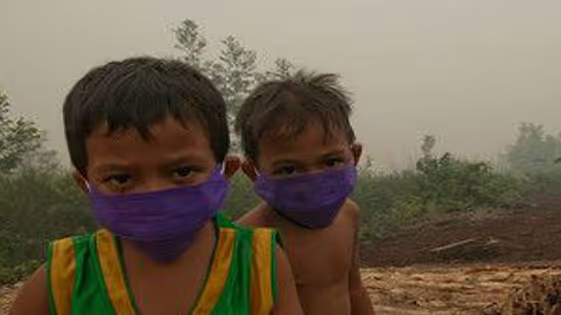
Early-life exposure to air pollution: Effect on child health in India
More than half of Indian population gets exposed to PM2·5 greater than the annual limit recommended by the National Ambient Air Quality Standards. This article examines the effect of outdoor air pollution on child health by combining satellite PM2.5 data with geo-coded Demographic and Health Survey of India. It finds that children exposed to high levels of pollution in their early lives have worse child health outcomes than those exposed to lower levels of pollution.
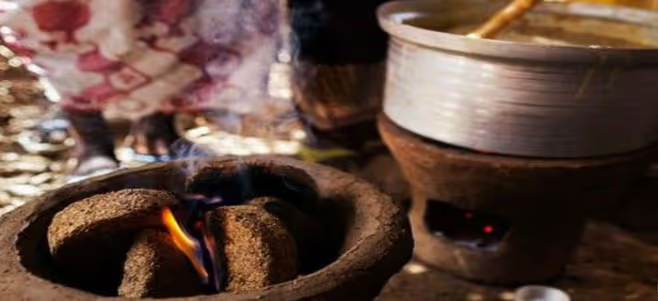
How much do households contribute to ambient air pollution in India?
Burning solid fuels like firewood in homes for cooking, heating, and other energy services is the single largest source of air pollution exposure in India. In this post, Chowdhury, Chafe, Pillarisetti, Lelieveld, Guttikunda, and Dey compare the estimates of the percentage contribution of household fuel combustion to ambient air pollution, from seven independent studies. They argue that cleaning up household fuel use benefits those directly exposed, in addition to having broader population benefits by reducing ambient air pollution.