
.svg)
.svg)
%201.svg)
%201.svg)
.svg)

.svg)
.svg)
Souvik Dutta

Souvik Dutta is Assistant Professor of Economics at Indraprastha Institute of Information Technology Delhi (IIITD) since December 2019. He specialises in the fields of development economics, political economy, and game theory. Before joining IIITD, he was a faculty member at the Indian Institute of Management Bangalore (IIMB) where he received the Young Faculty Research Chair (2015-18). He holds a Ph.D. in Economics from Pennsylvania State University, a Masters in Economics from Delhi School of Economics, and an undergraduate degree in Economics from Presidency College, Kolkata.
.svg)


Facilitating investment in organic food business through the right policies
The Indian government has undertaken several policy initiatives to promote organic farming and organic food exports, and many domestic and foreign companies have responded positively to these measures. This column reports findings from a survey of 75 companies that sought to understand their views on the growth potential of this sector and what policies can support the growth.


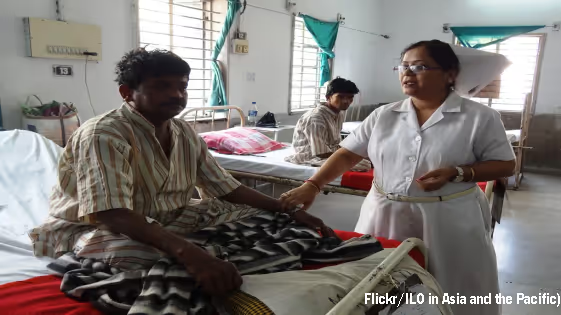
राष्ट्रीय स्वास्थ्य बीमा योजना (आरएसबीवाई) का स्वास्थ्य सेवा के उपयोग और खर्च को कैसे प्रभावित किया
सामाजिक स्वास्थ्य बीमा का उद्देश्य गरीबों को उनके स्वास्थ्य पर होने वाले अत्यधिक खर्च से बचाना और उन्हें स्वास्थ्य सेवा के अधिकाधिक उपयोग हेतु प्रोत्साहित करना है। इस लेख में, वर्ष 2004-05 और वर्ष 2011-12 के भारतीय मानव विकास सर्वेक्षण के आंकड़ों का विश्लेषण करते हुए, पाया गया कि राष्ट्रीय स्वास्थ्य बीमा योजना ने लंबी अवधि की बीमारी के उपचार हेतु अस्पताल में भर्ती होने तथा अल्पकालिक बीमारी में डॉक्टर के दौरे की संभावना को बढ़ा दिया है। जैसे ही स्वास्थ्य हेतु जेब से खर्च में (ओओपी) वृद्धि हुई, वहीँ बीमारी के कारण खोए दिनों की संख्या में गिरावट आई।
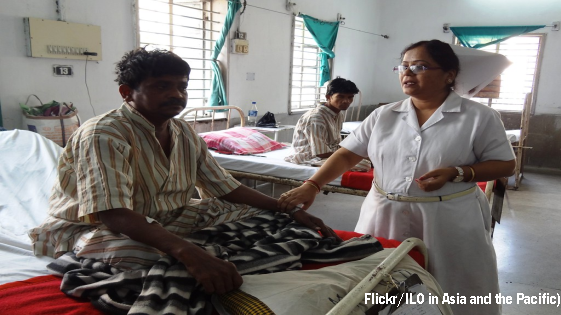
How RSBY impacted healthcare utilisation and spending
Social Health Insurance seeks to protect the poor from high health spending, and encourage healthcare utilisation. Analysing 2004-05 and 2011-12 Indian Human Development Survey data, this article finds that Rashtriya Swasthya Bima Yojana increased the likelihood of hospitalisation for long-term illness, and of doctor visits for short-term illness. While out-of-pocket health expenditure rose, there was a decline in the number of days lost due to illness.

सिंचाई जल के विकेन्द्रीकरण का गलत स्थानिक आवंटन पर प्रभाव
भारत में सिंचाई का एक महत्वपूर्ण स्रोत नहरों का पानी है, जिसका वितरण किसी भौगोलिक क्षेत्र के भीतर किसानों के बीच अक्सर असमान रूप से होता है। इस लेख में, ओडिशा राज्य में नहर सिंचाई प्रणालियों के प्रबंधन के विकेन्द्रीकरण के बाद किए गए एक सर्वेक्षण के आधार पर पाया गया कि नीतिगत सुधार के सकारात्मक प्रभाव पड़ते हैं, लेकिन सुधार का संस्थागत डिज़ाइन भी मायने रखता है।
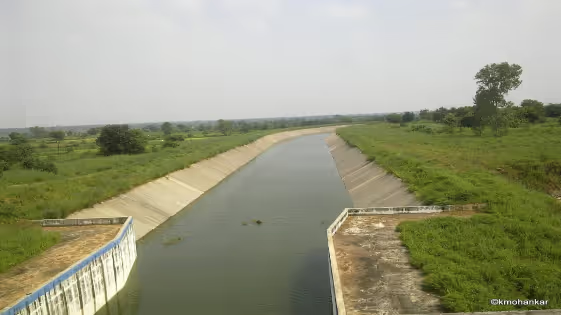
Decentralisation and spatial (mis)allocation of irrigation water
Canal water – an important source of irrigation in India – often tends to be unequally distributed among farmers within a geographical area. Based on a survey in the state of Odisha, following the decentralisation of the management of canal irrigation systems, this article finds that the policy reform has positive impacts – but the details of the institutional design matter.

Surrogacy bill: Implications and way forward
Contributing to the ongoing debate on India’s surrogacy bill, Dutta and Sarkar discuss the potential implications of the bill on the country’s billion-dollar surrogacy industry. They contend that India could follow in the footsteps of Israel and adopt a more pragmatic and holistic approach to regulating commercial surrogacy, rather than banning it altogether.
Informal Insurance under Group Lending with Individual Liability
This study aims to provide empirical support to the hypothesis that informal insurance plays an important role in the context of group lending under individual liability, and to evaluate the impact of informal insurance on repayment rates.
Emergence of Bandhan as a bank: A new era in the Indian banking industry
At a time when the Indian banking industry is experiencing a steep rise in bad loans, Bandhan – an MFI with a near 100% loan recovery rate – has converted into a bank. Based on a survey of 112 Bandhan clients in West Bengal, this column highlights the features of Bandhan’s lending model that have enabled it to keep its bad loans at negligible levels.