
.svg)
.svg)
%201.svg)
%201.svg)
.svg)

.svg)
.svg)
Subhasree Sarkar

Subhasree Sarkar has completed her Ph.D. in Economics from the Indian Institute of Management Bangalore in March 2022. She is an applied microeconomist with research interests in the fields of development economics, health economics, and international trade. She is also currently a scholar at the Global Labour Organization Virtual Young Scholar Program 2021-2022. Prior to her Ph.D., she completed her M.Phil. and Masters in Economics from the University of Calcutta and an undergraduate degree in Economics from Lady Shri Ram College for Women. She is also CBSE-UGC NET qualified.
.svg)

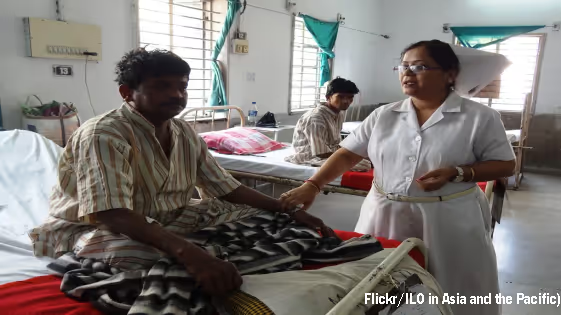
राष्ट्रीय स्वास्थ्य बीमा योजना (आरएसबीवाई) का स्वास्थ्य सेवा के उपयोग और खर्च को कैसे प्रभावित किया
सामाजिक स्वास्थ्य बीमा का उद्देश्य गरीबों को उनके स्वास्थ्य पर होने वाले अत्यधिक खर्च से बचाना और उन्हें स्वास्थ्य सेवा के अधिकाधिक उपयोग हेतु प्रोत्साहित करना है। इस लेख में, वर्ष 2004-05 और वर्ष 2011-12 के भारतीय मानव विकास सर्वेक्षण के आंकड़ों का विश्लेषण करते हुए, पाया गया कि राष्ट्रीय स्वास्थ्य बीमा योजना ने लंबी अवधि की बीमारी के उपचार हेतु अस्पताल में भर्ती होने तथा अल्पकालिक बीमारी में डॉक्टर के दौरे की संभावना को बढ़ा दिया है। जैसे ही स्वास्थ्य हेतु जेब से खर्च में (ओओपी) वृद्धि हुई, वहीँ बीमारी के कारण खोए दिनों की संख्या में गिरावट आई।


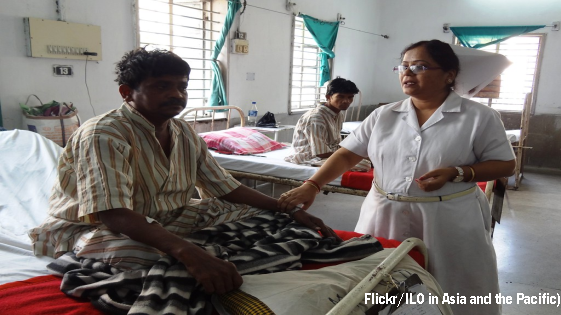
How RSBY impacted healthcare utilisation and spending
Social Health Insurance seeks to protect the poor from high health spending, and encourage healthcare utilisation. Analysing 2004-05 and 2011-12 Indian Human Development Survey data, this article finds that Rashtriya Swasthya Bima Yojana increased the likelihood of hospitalisation for long-term illness, and of doctor visits for short-term illness. While out-of-pocket health expenditure rose, there was a decline in the number of days lost due to illness.

Surrogacy bill: Implications and way forward
Contributing to the ongoing debate on India’s surrogacy bill, Dutta and Sarkar discuss the potential implications of the bill on the country’s billion-dollar surrogacy industry. They contend that India could follow in the footsteps of Israel and adopt a more pragmatic and holistic approach to regulating commercial surrogacy, rather than banning it altogether.