
.svg)
.svg)
%201.svg)
%201.svg)
.svg)

.svg)
.svg)
Subhodeep Basu

Subhodeep Basu is a Research Fellow with the Agriculture, Policy, Sustainability and Innovation (APSI) team at ICRIER. He holds an MSc in Economics (Development Studies) from Symbiosis School of Economics and a BSc in Economics (Hons) from Scottish Church College, University of Calcutta. With over six years of experience in mixed-method research on rural livelihoods, he has worked on several impact evaluations for the Ministry of Tribal Affairs. At ICRIER, he oversees research on agrivoltaics. Prior to this, he was associated with the International Water Management Institute (IWMI) and the Bharat Rural Livelihoods Foundation (BRLF). His interests include farmer collectives, agricultural solarization, and groundwater governance.
.svg)


खुशी के बीज : क्या कृषि फोटोवोल्टिक्स किसानों की आय को दोगुना करने का मार्ग प्रशस्त कर सकता है?
हाल के वर्षों में, सकल घरेलू उत्पाद में कृषि और इससे संबद्ध गतिविधियों का योगदान कम हो गया है और किसानों की वास्तविक आय लगभग स्थिर हो गई है। यह लेख दर्शाता है कि कृषि में सौर ऊर्जा को शामिल करने वाले एग्रीफोटोवोल्टिक्स जैसे नए विचारों में किसानों की आय बढ़ाने के साथ-साथ, भूमि-उपयोग दक्षता को बढ़ाने और जलवायु परिवर्तन से निपटने की क्षमता है।


Sowing sunshine: Can agriphotovoltaics offer a path to doubling farmers’ income?
In recent years, the contribution of agriculture and allied sectors to economic output has declined, with farmers’ real incomes virtually stagnating. This article demonstrates that new ideas such as agriphotovoltaics, which combine solar power with crop cultivation, have the potential to boost farmers’ incomes while also enhancing land-use efficiency and combating climate change.
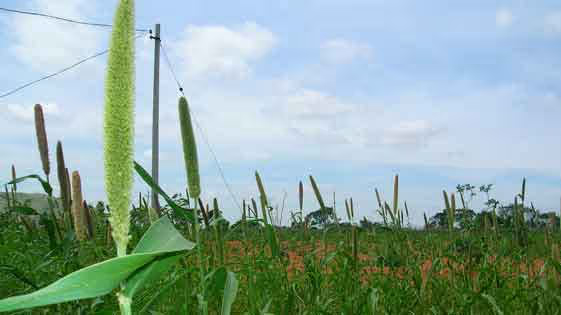
Addressing the nutrition crisis: Reflections from Odisha Millets Mission
The state of Odisha has a severe malnutrition problem, and evidence shows that increasing risks of climate change will render the resource-intensive, rice-wheat cropping system unsustainable. In this note, Saha et al. outline how nutrient-dense, resource-efficient millets have the potential to address malnutrition among vulnerable populations. Based on a qualitative survey of stakeholders, the authors discuss the implementation, progress, and challenges of the ‘Odisha Millets Mission’.