
.svg)
.svg)
%201.svg)
%201.svg)
.svg)

.svg)
.svg)
Sudha Narayanan

Sudha Narayanan is an Associate Professor at the Indira Gandhi Institute of Development Research (IGIDR), Mumbai. She obtained a Ph.D. from Cornell University in 2011, specialising in agricultural and development economics. She earlier obtained M.A. and M.Phil. degrees in Economics from the Delhi School of Economics, India. Sudha's research interests straddle agriculture, food and nutrition policy, and human development in India. Her current research focuses on contract farming, technology adoption in agriculture, public policies for food security and employment guarantee and agriculture-nutrition linkages. Prior to studying for a doctoral degree, Sudha worked with the Institute of Economic Growth, Delhi, IFPRI, Washington D.C. and the Right to Food Campaign in India and Cornell University, among others. Her past works include a book co-authored with Ashok Gulati titled “The Subsidy Syndrome in Indian Agriculture” published by the Oxford University Press, New Delhi.
.svg)


एक महामारी के दौरान खाद्य और कृषि: प्रभावों का प्रबंधन
नोवल कोरोनोवायरस महामारी के बाद लॉकडाउन का एक महत्वपूर्ण प्रभाव यह हुआ है कि किसान और उपभोक्ता इस बात को लेकर असमंजस, अनिश्चितता और चिंता में हैं कि आखिर आने वाले हफ्तों में क्या होगा। इस पोस्ट में, सुधा नारायणन खाद्य एवं कृषि उत्पादों की आपूर्ति श्रृंखला में वर्तमान बाधाओं की जानकारी देती हैं, और इन्हें जल्द से जल्द पटरी पर लाने के लिए सरकार द्वारा की जाने वाली कार्रवाई हेतु सुझाव देती हैं।


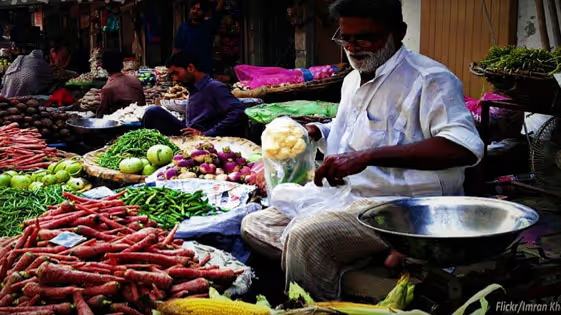
Food and agriculture during a pandemic: Managing the consequences
A critical fallout of the lockdown following the novel coronavirus pandemic has been a combination of confusion, uncertainty, and anxiety for farmers and consumers alike as to what lies in store in the coming weeks. In this post, Sudha Narayanan provides a sense of current bottlenecks in the supply chains of food and agricultural produce, and makes recommendations for government action to get these back on track quickly.

आर्थिक सर्वेक्षण 2019-20: यह कृषि क्षेत्र की चुनौतियों का समाधान कैसे करेगा?
इस वर्ष का आर्थिक सर्वेक्षण, जोकि वित्त मंत्रालय का प्रतिनिधि दस्तावेज है, हाल ही में संसद में पेश किया गया था। यह ऐसे वक्त में आया है जिसमे भारत आर्थिक मंदी और ग्रामीण तंगी के दौर से गुजर रहा है। इस पोस्ट में, सुधा नारायणन ने कृषि के दृष्टिकोण से आर्थिक सर्वेक्षण की समीक्षा की है, तथा साथ ही रिपोर्ट में उल्लिखित मुद्दों को हल करने का एक वैकल्पिक तरीका भी प्रस्तुत किया है।
Economic Survey 2019-20: How does it seek to address challenges of farm sector?
This year’s Economic Survey, the flagship document of the Ministry of Finance, was recently tabled in the Parliament at a time of economic slowdown and rural distress in India. In this post, Sudha Narayanan offers a critical review of the Economic Survey from the point of view of agriculture, while also proposing an alternative way of framing the issues mentioned in the report.
Unified agricultural markets: Where are the reforms lacking?
In April 2016, Modi government launched the e-National Agriculture Market (e-NAM) platform – a pan-India electronic marketplace for trading of agricultural commodities. However, rather than ushering in a revolution, concerns have been raised regarding lack of traded volumes on the platform. To understand the reluctant progress of e-NAM, this column analyses the experience of the state of Karnataka that embarked on agricultural market reforms in 2007.
वर्ष 2019-20 के केंद्रीय बजट में सामाजिक संरक्षण
इस पोस्ट में सुधा नारायणन ने केंद्रीय बजट 2019 में सामाजिक संरक्षण से संबंधित प्रावधानों का विश्लेषण किया है। उनका तर्क है कि बजट के आंकड़ों से लगता है कि सरकार समाज कल्याण की अनेक योजनाओं के मामले में सही रास्ते पर चल रही है, लेकिन भारत में सामाजिक संरक्षण के ढांचे को वह धीरे धीरे कमज़ोर कर रही हो सकती है।
Digital India Land Records Modernisation Programme: Assessing impact in Himachal Pradesh and Maharashtra
Government of India launched the National Land Records Modernisation Programme in 2008, with the aim of establishing a system of titles to ensure conclusive proof of land ownership. The programme was revamped in 2014, with its inclusion in the Digital India initiative. This article presents findings from an impact assessment of the programme in Himachal Pradesh and Maharashtra, and draws implications for policy formulation pertaining to land records management
Social protection in the Union Budget 2019
In this post, Sudha Narayanan analyses the provisions pertaining to social protection in the Union Budget 2019. She contends that while the budgetary figures give the impression that the Government is staying the course with many social welfare programmes, it may well be chipping away the architecture of social protection in India.

Assessing the quality and usefulness of MNREGA assets in Maharashtra
Questions have been raised regarding the quality and usefulness of assets created under MNREGA. To examine the validity of the scepticism, this column reports results from a study of MNREGA assets in Maharashtra. While the assets are largely found to be useful and durable, the study suggests that greater attention to design and maintenance, and local participation in the decision-making process can lead to further improvement.
Politics and MNREGA: A limited Link in Andhra Pradesh
The Ministry of Rural Development claims that MNREGA needs to be changed in order to reduce politics and corruption in the scheme. One of the studies cited by the Ministry is an analysis of the extent of political manipulation of MNREGA funds in Andhra Pradesh. In this column, the authors of the study assert that while politics may influence programme expenditure in some places and to a small extent, this is not universally true and does not undermine the effective targeting and good work of the scheme at large.
Saving people's livelihoods
The new government is seeking to alter the essence of MNREGA based on the premise that it is not useful in its current form. In this article, Sudha Narayanan criticises the move and argues that despite its shortcomings, MNREGA is the best available institutional mechanism to preserve the resource base for food production and build resilience of Indian agriculture.

MNREGA and its assets
Critics of MNREGA believe that the programme is a dole to dig a hole and hence, a huge waste of resources and that it would be better to simply provide cash. In this article, Sudha Narayanan, Associate Professor at the Indira Gandhi Institute of Development Research, argues that evidence from various states on the quality of MNREGA assets suggests that this ‘dole-hole’ view of is largely unfounded.
What did demonetisation do to domestic agricultural markets?
When the note ban was announced a year ago, many feared that it would hit agriculture and informal sectors the hardest given the widespread use of cash for transacting in these sectors. Based on analysis of data from 2,953 mandis across India for 35 major agricultural commodities for the period 2011-2017, this column finds that there are lingering impacts of demonetisation on farmers and adverse distributional consequences overall.
Demonetisation and agricultural markets
In this article, Aggarwal and Narayanan contend that demonetisation alone cannot turn agricultural markets cashless. Such a shift would require sustained and focussed effort to expand the reach of formal institutions, especially for credit and storage.