
.svg)
.svg)
%201.svg)
%201.svg)
.svg)

.svg)
.svg)
Sukanta Bhattacharya

Sukanta Bhattacharya is Associate Professor of Economics at the University of Calcutta. An alumnus of Presidency College, Calcutta and the University of Calcutta, Sukanta received his Ph.D. from the University of British Columbia. The broad areas of his teaching and research interests are political economy, institutional economics, and development economics.
.svg)

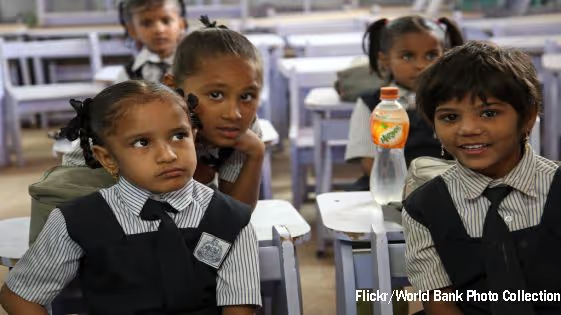
Teacher-student gender matching and learning outcomes
Studies have found positive effects of teacher-student gender matching on students’ learning outcomes in certain countries. Based on a theoretical model – tested empirically with survey data from Andhra Pradesh – this article shows that the positive effect in the Indian context seems to be a consequence of higher quality female teachers and more competent female students ‘self-selecting’ into urban, private schools on account of gender norms and institutional structures of teacher hiring.



वर्ग और जाति किस प्रकार से स्कूल के चुनाव को प्रभावित करते हैं
माता-पिता द्वारा अपने बच्चों की शिक्षा के सम्बन्ध में लिए जाने वाले निर्णयों पर परिवार की सामाजिक-आर्थिक स्थिति प्रभाव डालती है। जाति और वर्ग की परस्पर-क्रिया को ध्यान में रखते हुए, यह लेख दर्शाता है कि परिवार जब बहुत अमीर या बहुत गरीब होते हैं, तब उनकी जाति की पहचान स्कूल के चुनाव के उनके निर्णयों को प्रभावित नहीं करती है। लेकिन, संपत्ति-वितरण के बीच में आने वाले वर्गों के लिए, जाति की पहचान बहुत मायने रखती है- वंचित जातियों के छात्र, जिनके माता-पिता श्रम बाज़ार में अच्छी तरह से जुड़े नहीं होते, उन्हें शिक्षा के रिटर्न कम मिलते हैं।

How class and caste influence school choice
Families' socioeconomic status impacts how parents make decisions regarding their children's education. Taking into account the interplay of caste and class, this paper finds that when families are too rich or too poor their caste identity does not affect their decisions about school choice. However, it is in the middle of the wealth distribution that caste identity matters most – students from disadvantaged castes whose parents are not as well connected in the labour market see lower returns to education.