
.svg)
.svg)
%201.svg)
%201.svg)
.svg)

.svg)
.svg)
Suman Bhattacharjea
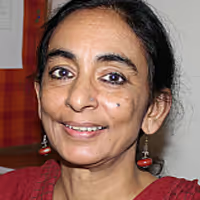
Dr Suman Bhattacharjea is a Director of ASER Centre. She earned her undergraduate degree in Economics with Honors from Delhi University, and M.Ed. and Ed.D. degrees in Education from Harvard University. Dr Bhattacharjea has extensive experience in the fields of education, gender, and women’s rights. She has worked with government, private, non-government and international organisations in several countries, including India, US, Pakistan and Mexico. She has taught courses on research design, gender and education and has authored or co-authored numerous articles and books in these areas.
.svg)

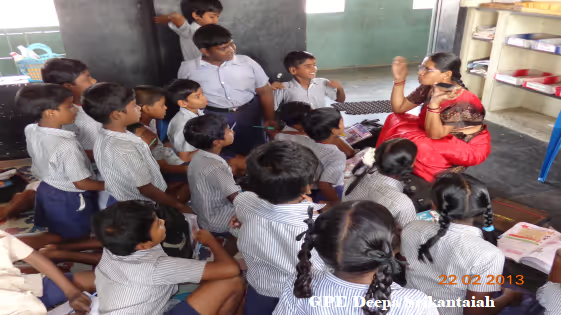
Reflections on how the New Education Policy plays out in the classroom
The National Education Policy, 2020 emphasises the acquisition of foundational literacy and numeracy by Standard 2. Yet, little is known about how the related initiatives have translated into changes in teaching-learning in the classroom. In this note, Bhattacharjea, Bhutada and Bisht share insights from a study involving classroom observations and teacher interviews across eight states in India – on aspects such as classroom composition, teachers’ attitudes towards young children, and teaching methods.


What ASER 2023 reveals about the gender gap in confidence
The Annual Status of Education Report (ASER) 2023 finds that although gender gaps in school enrolment have fallen over the years, girls still lag behind in terms of access to and use of digital technologies. In this post, Suman Bhattacharjea explores factors such as patterns of social and family control over youth of each sex, expectation from girls of refraining from independent action, and availability of role models at home and school.
India’s early years mathematics curriculum: Continuity, discontinuity and progression
Research has shown the importance of building strong foundations for learning, as the development of cognitive skills in preschool and early primary years is predictive of later mathematical achievement. This article examines the national curriculum for mathematics and learning materials used in three states and finds that state textbooks do not always follow the prescribed content and there is a lack of continuity between the curriculum followed during preschool and early years of primary school.

What do children in rural India do in their early years?
This year’s Annual Status of Education Report throws light on what children in India do in their early years. In this article, Bhattacharjea and Ramanujan argue that the assumption that there is a universal, age-based trajectory that children follow from home to preschool to primary school is far from what happens on the ground. Children take different pathways through the early years that have consequences for what they experience and learn.
Translating the 'Right to Education': Assumptions and reality
The Right to Education Act focuses on inputs in the schooling process and teaching the prescribed curriculum, but has little to say about learning outcomes of children. This article argues that educational policy needs to be more in line with ground realities. Teachers need to be trained to teach classrooms with students that are diverse in terms of age and ability.