
.svg)
.svg)
%201.svg)
%201.svg)
.svg)

.svg)
.svg)
Sumit Mishra

Sumit is an Assistant Professor of economics at the Institute for Financial Management and Research, Sri City. His research focus is on examining how geography and state capacity affect the relationship between social divisions and economic development. He is also interested in the issue of structural transformation in India.
.svg)


Diversity and public goods: Why the geographical unit of analysis matters
Research has shown that regions with higher caste diversity have lower share of villages with essential public goods. This article challenges this finding and shows that empirical models estimated at higher levels of geographical aggregation mask a considerable amount of variation. Any meaningful statistical relationship between diversity and public goods needs to be sensitive to geographical scale as the nature of local politics plays an important role.


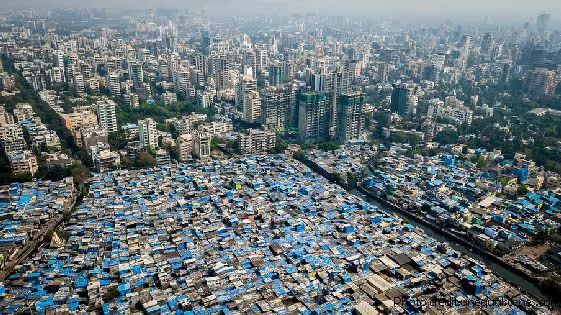
Residential segregation in urban India and persistence of caste
B.R. Ambedkar had exhorted lower-caste people to move towards cities to defy localism and benefit from the virtues of cosmopolitanism that urbanisation might provide. Using 2011 enumeration block-level Census data for five major cities in India – Bengaluru, Chennai, Delhi, Kolkata, and Mumbai – this article finds that not only are Indian cities highly segregated, but population size seems to have no association with the extent of segregation. In fact, the largest cities are some of the most segregated.