
.svg)
.svg)
%201.svg)
%201.svg)
.svg)

.svg)
.svg)
Surjit Bhalla
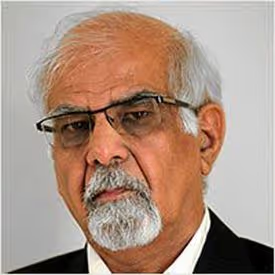
Surjit Bhalla is a former part-time member of Prime Minister Narendra Modi’s Economic Advisory Council. In addition, he serves as Chairperson for the Ministry of Commerce High Level Advisory Group on Trade; Economic Adviser to the Fifteenth Finance Commission, Government of India.
Surjit has taught at the Delhi School of Economics and served as executive director of the Policy Group in New Delhi, the country’s first non-government funded think tank. Since 1999, he has been on the governing board of India’s largest think tank, NCAER. He has worked as a research economist at the RAND Corporation, the Brookings Institution, and at both the research and treasury departments of the World Bank, and as a consultant to Warburg Pincus. He has also worked on Wall Street in Deutsche Bank and Goldman Sachs.
He holds a PhD in Economics from Princeton University, a Master in Public and International Affairs from Woodrow Wilson School, Princeton University, and a BSEE degree from Purdue University.
.svg)

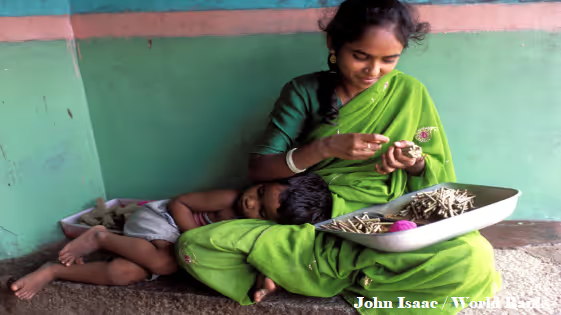
Female labour force participation: Measurement and data quality
Official data revealed a sharp decline in female labour force participation in India between 2004-05 and 2011-12, despite fast economic growth in the country. Examining the measurement of women’s work and data quality issues, this article identifies three explanations for the low observed female labour force participation: inconsistent treatment of non-market work, more women in higher education, and the disproportionate time spent by women on childcare


Measuring poverty in the absence of Consumption Expenditure Survey data
In the first post of a six-part series on , Surjit Bhalla and Karan Bhasin discuss issues related to measurement of absolute poverty in India. They summarise their IMF working paper from April 2022, and defend their assumption of unity pass-through and impact of food transfers. They point out shortcomings in certain measurement approaches, including the World Bank’s reliance on the outdated Uniform Recall Period, and cite other poverty estimates which corroborate their own findings.