
.svg)
.svg)
%201.svg)
%201.svg)
.svg)

.svg)
.svg)
Swati Dutta

Swati Dutta is a Fellow at Institute for Human Development (Delhi). She has a Ph.D. in Economics from Madras University through the Institute for Financial Management and Research (IFMR). She has more than 10 years of experience in handling large data sets. She is trained economist with a specialisation in econometrics and its application in various development issues. She was awarded the Prof MJ Manohar Rao Young Economist Award selected by The Indian Econometric Society for the year 2016. She has more than seven years of research experience in the field of maternal and child heath, child deprivation, poverty, human development, women empowerment, women entrepreneurship and in conducting research in Bihar and Jharkhand. She has worked for various international agencies such as ILO, UNICEF, BMGF, GIZ, IGC among others in the issue of maternal and child nutrition, risk and investment on child education, social protection schemes, women empowerment measurement issues, need for crèches, women’s unpaid work, and gender gaps in child nutritional outcome. She has published papers in reputed journals such as Child Indicators Research, Social Indicators Research, World Economics, Poverty and Public Policy, Economic and Political Weekly, Asia Pacific Population Journal among others.
.svg)


Covid-19: Impact on migrant workers in Bihar
The nationwide lockdown – imposed in March 2020 to contain the spread of Covid-19 – left large sections of migrant workers in a precarious position, with livelihoods lost, and no means of public transport to get back home. This note presents findings from a survey of over 1,600 households in 12 villages across seven districts of the state of Bihar – a major source of migrant workers – to assess the impact of the pandemic on their lives.


Covid-19 and growing food insecurity: Insights from rural Bihar
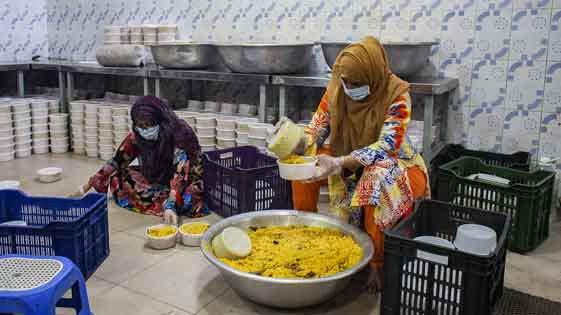
Emerging research shows that Covid-19 has had a devastating impact on the already undernourished and marginalised populations, by affecting their access to food and nutrition, and consumption patterns. In this note, Dutta et al. discuss findings from their field study in rural Bihar and highlight three key reasons for reduced food consumption by households – fear of contracting Covid-19, price hikes, and closure of markets.