
.svg)
.svg)
%201.svg)
%201.svg)
.svg)

.svg)
.svg)
Tanika Chakraborty

Tanika is Associate Professor at the Indian Institute of Management, Calcutta (IIM-C). Prior to joining IIM-C, she worked at DIW, Berlin, and at the Indian Institute of Technology, Kanpur, after completing her Ph.D. in Economics from Washington University, St Louis. Tanika’s research interests span a wide range of issues in labour and development economics. She is a Fellow at Institute for the Study of Labor (IZA) Bonn, CESifo Munich, and the Global Labor Organization. Her research has featured in the Journal of Development Economics, Journal of Economic Behavior and Organization, World Development, Journal of Comparative Economics and Demography, among others. Tanika has undertaken research and consulting projects funded by ICSSR, IDRC Canada, DFID, UNICEF, and various ministries of the Government of India.
.svg)


Hazards of farm loan waivers
In theory, debt waivers are expected to induce the optimal level of effort from the debtor for loan repayment. However, repeated waivers may distort household expectations about credit contract enforcements in the future. This column analyses the effect of Uttar Pradesh’s state-level debt waiver programme – announced right after India’s nationwide Agricultural Debt Waiver and Debt Relief Scheme – on consumption and investment behaviour of households.


Network membership and demand for health insurance
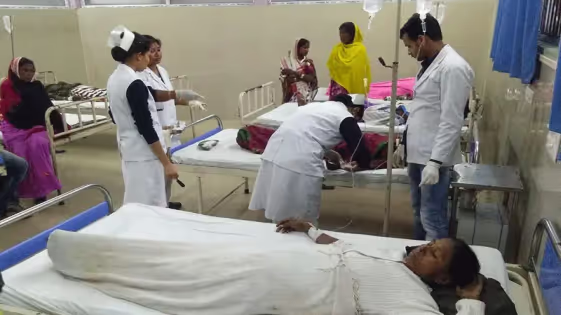
Despite being free and having liberal eligibility criteria, the adoption of public health insurance in India remains low. This article examines how informal networks influence adoption behaviour, in the context of Andhra Pradesh’s Aarogyasri programme. It shows that network type matters: information networks do not significantly impact the uptake of public insurance, whereas financial networks actually facilitate, rather than hinder, public insurance adoption.

Court congestion, caste identity, and business performance
Effective contract enforcement is the key for the formation and expansion of business enterprises. But how does improvement in court performance matter differently to different caste groups? This article shows that the benefit of an efficient judiciary is higher for first-time entrepreneurs within communities that lack traditional informal business networks. This implies that besides other factors, improvements in court quality can be instrumental in enhancing social mobility.