
.svg)
.svg)
%201.svg)
%201.svg)
.svg)

.svg)
.svg)
Tanya Rana

Tanya is a Research Associate at the Accountability Initiative, Centre for Policy Research (CPR). At CPR, she works at the intersection of gender, nutrition and health, and public finance. Her previous engagements include working at Institute of Social Studies Trust, where she mapped different forms of collectivisation practices of women farmers in India. She was also a Graduate Research Assistant at the Centre for New Economics Studies (CNES), and has worked with Dasra and Observer Research Foundation (ORF).
Tanya holds an MA in Public Policy from O.P. Jindal Global University, Sonipat, and a BSc in Finance from Narsee Monjee Institute of Management Studies (NMIMS), Mumbai.
.svg)

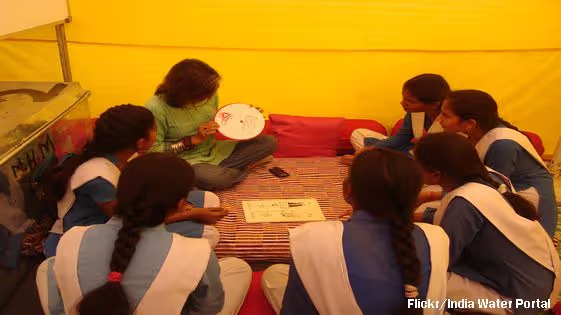
मासिक धर्म सम्बन्धी स्वास्थ्य को कल्याणकारी प्राथमिकता देना : तीन राज्यों से प्राप्त अंतर्दृष्टि
अक्तूबर 11 पूरी दुनिया में अन्तर्राष्ट्रीय बालिका दिवस के रूप में मनाया जाता है। इस दिवस को मनाने का मुख्य उद्देश्य है देशों, समुदायों और समाजों को बालिकाओं के महत्त्व के बारे में याद दिलाना और उन्हें जीवन के हर क्षेत्र में बराबरी का स्थान दिलाना। इसी सन्दर्भ में आज का यह लेख प्रस्तुत है जिसमें तान्या राणा ने बिहार, मध्य प्रदेश और राजस्थान के फ्रंटलाइन कार्यकर्ताओं के साथ बातचीत से प्राप्त अंतर्दृष्टि साझा की है। मासिक धर्म सम्बन्धी सार्वजनिक स्वास्थ्य नीतियों का ध्यान मुख्य रूप से महिलाओं और बालिकाओं को सैनिटरी नैपकिन वितरित करने पर केन्द्रित रहता है। अपने इस लेख में तान्या राणा ने अधिक व्यापक मासिक धर्म सम्बन्धी स्वास्थ्य सेवाओं को उपलब्ध कराने की आवश्यकता पर ज़ोर दिया है। वह इस बात पर प्रकाश डालती हैं कि मासिक धर्म सम्बन्धी स्वास्थ्य योजनाएं कार्यक्रम के खराब कार्यान्वयन और फ्रंटलाइन कार्यकर्ताओं के प्रशिक्षण की कमी से ग्रस्त हैं और अनुशंसा करती हैं कि योजना बनाते समय बालिकाओं को चिंतन के केन्द्र में रखने से इन कमियों को दूर किया जा सकता है।


Making menstrual health a welfare priority: Insights from three states
Public policies on menstrual health have mainly focussed on distributing sanitary napkins to women and girls. However, in this note, Tanya Rana shares some insights gained from conversations with frontline workers in Bihar, Madhya Pradesh and Rajasthan which reveal the need for making more comprehensive menstrual health services available. She highlights that menstrual health schemes suffer from poor programme implementation, and a lack of training for frontline workers. She recommends that convergent thinking in planning can solve for these lacunae.
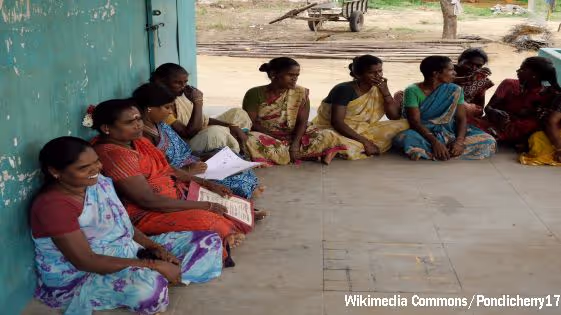
क्या वर्ष 2023-24 का बजट लैंगिक प्राथमिकताओं को संतुलित करने में सफल रहा है?
तान्या राणा और नेहा सुज़ैन जैकब केंद्रीय बजट के लैंगिक बजट वक्तव्य या जेंडर बजट स्टेटमेंट (जीबीएस) के माध्यम से, उसके दो हिस्सों के तहत विभिन्न मंत्रालय और विभाग किन योजनाओं को प्राथमिकता देते हैं, इस पर ध्यान देते हुए योजना आवंटन को वर्गीकृत कर के उसका विश्लेषण करते हैं। वे मनमाने वर्गीकरण, यानी जो योजनाएं पूरी तरह से महिला-केन्द्रित नहीं उनको शामिल करने और योजना के उद्देश्यों को पूरा करने में अपर्याप्त आवंटन संबंधी मुद्दों पर चर्चा करते हैं। वे महिलाओं के सशक्तिकरण हेतु वित्तीय प्राथमिकताओं के लिए निगरानी और स्पष्ट योजना वर्गीकरण की आवश्यकता पर ज़ोर देते हैं।
Has Budget 2023-24 been successful in balancing gender priorities?
Ahead of International Women’s Day, Tanya Rana and Neeha Susan Jacob categorise and analyse scheme allocations through the Union Budget’s Gender Budget Statement (GBS), by looking at what schemes various ministries and departments prioritise under the two parts of the GBS. They discuss issues of arbitrary classification, inclusion of schemes that are not entirely women-centric, and allocations that are inadequate to meet scheme objectives. They emphasise the need for monitoring and unambiguous scheme classifications to achieve financial priorities for women's empowerment.