
.svg)
.svg)
%201.svg)
%201.svg)
.svg)

.svg)
.svg)
Vikram Bahure

Vikram Bahure is a Postdoctoral Research Associate at the Department of International Development. He is currently part of the economic intervention team in the ALIVE project, which focuses on improving adolescent mental health by tackling the impact of poverty.
His primary research interest is development economics and applied economics. He specialises in marriage markets, political economy, and internal migration. In his research, he uses causal empirical designs to study questions on early marriage, crime against women, voter preferences, politician characteristics, and migrant household wellbeing.
Vikram obtained his PhD in Economics from the University of Geneva. He completed a MPhil in Economics and Finance from Bocconi University, Milan. He also has a dual degree (BSc and MSc) in Economics from the Indian Institute of Technology, Kharagpur.
.svg)

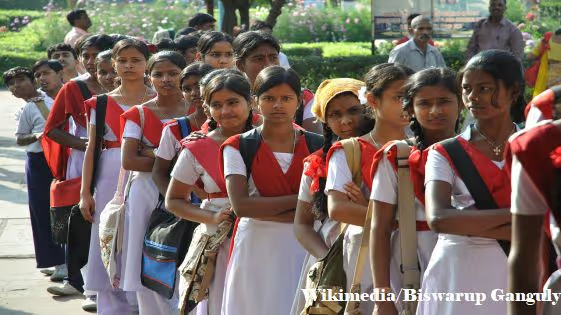
कैसे लड़कियों की शिक्षा में निवेश से भारत में घरेलू हिंसा कम हो सकती है
भारत में 15 से 49 वर्ष की आयु की लगभग एक तिहाई महिलाएँ घरेलू हिंसा का सामना करती हैं। यह लेख जिला प्राथमिक शिक्षा कार्यक्रम, बड़े पैमाने के एक स्कूल विस्तार कार्यक्रम, के कारण लड़कियों की शिक्षा में वृद्धि के उस प्रभाव की जाँच करता है जो वयस्क जीवन में घरेलू हिंसा पर पड़ता है। इसमें महिलाओं के प्रति लैंगिक दृष्टिकोण में सकारात्मक बदलाव, साथी की गुणवत्ता में सुधार और सूचना तक पहुँच में वृद्धि के माध्यम से घरेलू हिंसा में उल्लेखनीय कमी पाई गई है।


How investing in girls’ education can reduce domestic violence in India
One-third of women in India aged 15-49 report experiencing domestic violence. This article examines the impact of an increase in education among girls due to the District Primary Education Programme – a large-scale school expansion programme – on domestic violence in adulthood. It finds a significant decline in domestic violence, via pathways such as positive shifts in gender attitudes among women, improvements in partner quality, and increased access to information.