
.svg)
.svg)
%201.svg)
%201.svg)
.svg)

.svg)
.svg)
Wilima Wadhwa

Dr Wilima Wadhwa is a Director of ASER Centre. She has been associated with ASER since its inception in 2005. Dr Wadhwa earned her undergraduate degree, with Honors in Economics from Delhi University, M.A. degrees in Economics from Delhi University and University of California, and her Ph.D. in Economics from the University of California. Dr Wadhwa has been published extensively and teaches statistics and econometrics at the University of California (Irvine), and the Indian Statistical Institute (New Delhi). She has also been a member of various government committees. Dr Wadhwa’s other research interests include development and economics of education.
.svg)

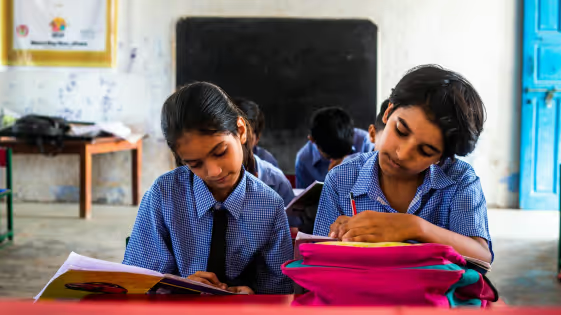
एएसईआर 2024: महामारी के बाद के सुधार से कहीं बेहतर
गत कई वर्षों की ही भाँति शिक्षा की वार्षिक स्थिति रिपोर्ट (एएसईआर) 2024 में भारत के लगभग सभी ग्रामीण जिलों से बच्चों की स्कूली शिक्षा की स्थिति, उनके पठन और अंकगणित के स्तर के बारे में रिपोर्ट प्रस्तुत की गई है। एएसईआर केन्द्र की निदेशक विलिमा वाधवा ने इस लेख में सरकारी और निजी स्कूलों में स्कूल नामांकन और शिक्षा के परिणामों में प्रमुख रुझानों पर चर्चा की है। अधिगम में हुए सुधार का श्रेय उन्होंने नई शिक्षा नीति में बुनियादी साक्षरता और अंक-ज्ञान पर दिए गए ध्यान को दिया है।


ASER 2024: More than a post-pandemic recovery in learning
The Annual Status of Education Report (ASER) 2024 reports on children’s schooling status and reading and arithmetic levels from almost all rural districts of India. In this post, Wilima Wadhwa, Director of the ASER Centre, discusses the key trends in school enrolment and learning outcomes across government and private schools. Noting improvements in learning, she attributes the gains to the focus on foundational learning and numeracy in the New Education Policy.
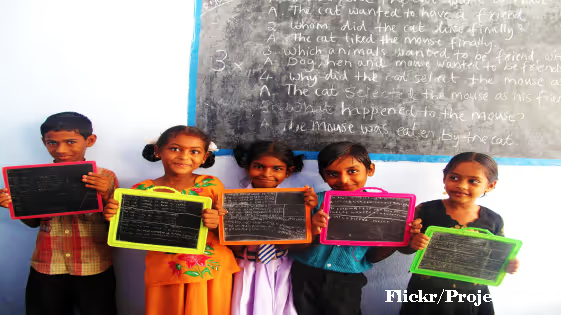
माता-पिता एवं शिक्षक के बीच सहयोग के माध्यम से आधारभूत शिक्षा को बढ़ावा देना
प्राथमिक विद्यालयों में नामांकन में प्रगति होने के बावजूद, ग्रामीण भारत में 50% से अधिक विद्यार्थी मूल साक्षरता हासिल करने में असफल रहते हैं, जबकि 5वीं कक्षा के अंत तक 44% विद्यार्थियों में अंकगणित कौशल का अभाव होता है। ग्रामीण उत्तर प्रदेश में किए गए एक यादृच्छिक प्रयोग के आधार पर, इस लेख में पाया गया है कि माता-पिता और शिक्षकों के बीच सहयोगात्मक तथा भागीदारीपूर्ण दृष्टिकोण के माध्यम से सामुदायिक भागीदारी से स्कूलों में जवाबदेही बढ़ती है, और बच्चों की बुनियादी शिक्षा में उल्लेखनीय सुधार होता है।
Enhancing foundational learning through parent-teacher collaboration
Despite advancements in primary school enrolment, over 50% of pupils in rural India fail to achieve core literacy, while 44% lack numeracy skills at the end of grade 5. Based on a randomised experiment in rural Uttar Pradesh this article finds that community participation, facilitated through a collaborative and participatory approach between parents and teachers, enhances accountability in schools, and significantly improves children’s foundational learning.
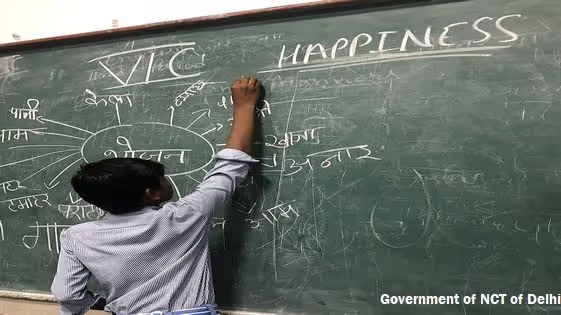
Foundational learning outcomes: More recovery than loss
Sharing data from the recently released ASER 2022, Wilima Wadhwa discusses the trends in primary school enrollment and learning during the pandemic. Using data collected from Karnataka, Chhattisgarh and West Bengal in 2021 to fill in the gap in the surveys, she shows how there were large learning losses in reading and maths between 2018 and 2021; however, learning levels had recovered by 2022. She also highlights the emphasis given to foundational learning, the results of which are reflected in ASER 2022.
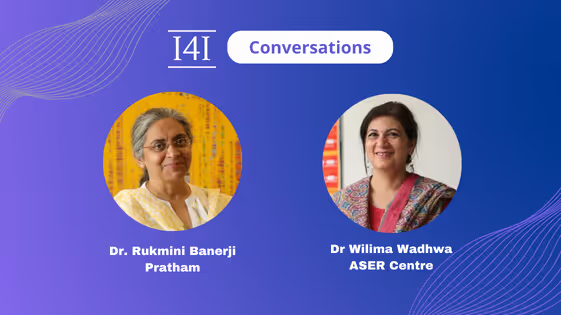
Tracking learning outcomes: ASER’s work through the pandemic
With the onset of the Covid-19 pandemic and the associated lockdowns, schools quickly pivoted to online learning. However, there was limited information about whether children had access to learning materials, and what was actually taking place within households. In this edition of I4I Conversations, Rukmini Banerji and Wilima Wadhwa discuss the role that the Annual Status of Education Report (ASER) played in remedying this gap in the data. They discuss a few major findings from the survey on learning outcomes during the pandemic. Although the proportion of children not enrolled in schools went up, the proportion of children enrolled in government schools increased, and most of them had access to digital learning materials due to an increase in smartphone coverage. They discuss the challenges they faced while conducting ASER during the pandemic, including being limited to phone surveys and rallying volunteers amidst uncertainty. However, after the lack of data during the first ...
Tracking learning outcomes: ASER’s work through the pandemic
With the onset of the Covid-19 pandemic and the associated lockdowns, schools quickly pivoted to online learning. However, there was limited information about whether children had access to learning materials, and what was actually taking place within households. In this edition of I4I Conversations, Rukmini Banerji and Wilima Wadhwa discuss the role that the Annual Status of Education Report (ASER) played in remedying this gap in the data. They discuss a few major findings from the survey on learning outcomes during the pandemic. Although the proportion of children not enrolled in schools went up, the proportion of children enrolled in government schools increased, and most of them had access to digital learning materials due to an increase in smartphone coverage. They discuss the challenges they faced while conducting ASER during the pandemic, including being limited to phone surveys and rallying volunteers amidst uncertainty. However, after the lack of data during the first ...
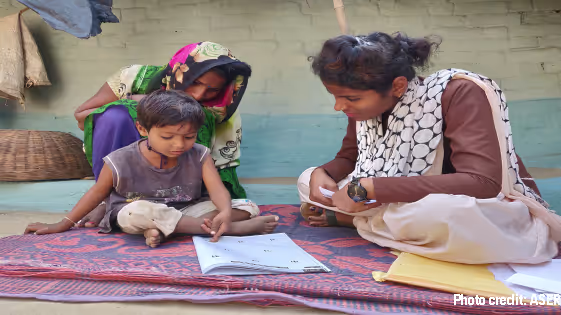
कोविड-19 और मानसिक स्वास्थ्य: क्या बच्चे वापस स्कूल में जाने के लिए तैयार हैं?
कोविड-19 और मानसिक स्वास्थ्य' पर आयोजित की गई I4I ई-संगोष्ठी के पूर्व भाग में स्कूल बंद होने के कारण, विशेष रूप से हाशिए पर रहे और कमजोर समूहों से संबंधित बच्चों के मनोवैज्ञानिक स्वास्थ्य पर पड़ने वाले संभावित प्रतिकूल प्रभावों की चर्चा की गई है। इस लेख में, विलीमा वाधवा ने इस अवधि के दौरान सीखने की सामग्री तक बच्चों की पहुंच के बारे में एएसईआर (वार्षिक शैक्षिक स्थिति रिपोर्ट) 2020 के आधार पर प्राप्त निष्कर्ष प्रस्तुत किये हैं। उनका तर्क है कि स्कूलों के फिर से खुलते ही, शिक्षण-व्यवस्था को किसी अन्य तरीकों को न अपनाते हुए बच्चों और उनकी वर्तमान वास्तविकता के अनुकूल चलना होगा।
Covid-19 and mental health: Are children ready to go back to school?
Previous parts of the I4I e-symposium on ‘Covid-19 and mental health’ have discussed the potential adverse effects of school closures on children’s psychological well-being – particularly those belonging to marginalised and vulnerable groups. In this post, Wilima Wadhwa presents ASER (Annual Status of Education Report) 2020 findings on children’s access to learning materials during this period. She contends that when schools reopen, the system will have to adapt to children and their current reality, rather than the other way around.
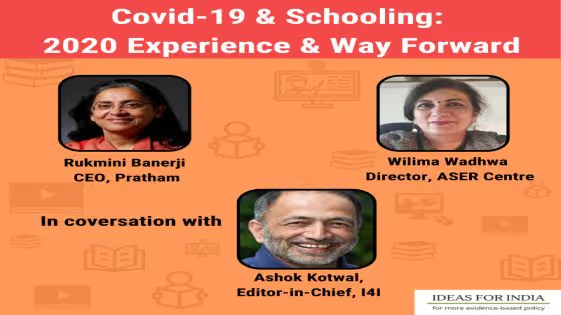
Covid-19 and schooling: 2020 experience and way forward
The onset of the Covid-19 pandemic brought with it significant challenges for the education sector. On the one hand, closing schools meant imposing a heavy cost on a whole generation of students, and on the other hand, keeping schools open was a health hazard. India and several other developing countries – reluctantly at first – adopted online teaching. However, this was riddled with problems given the weak access to digital connectivity and devices. So how was the schooling experience in 2020, and are there any lessons for the future? To explore these crucial questions, I4I Editor-in-Chief Ashok Kotwal speaks with Rukmini Banerji (CEO of Pratham; India’s largest education non-profit) and Wilima Wadhwa (Director, Annual Status of Education Report (ASER) Centre). Banerji and Wadhwa discuss the mechanics of the ASER 2020 phone survey; availability of educational materials and learning activities in rural homes; how families, communities, and schools came together to keep up children’s le
School education in India: Equity in learning?
In recent years, the focus has shifted from enrolment to learning in school education in India. The debate has been centred on learning levels of children and whether they moved up or down, but what about equity in learning? In this post, Wilima Wadhwa discusses inequity in school education across three dimensions – school type, distribution of learning outcomes, and geographical location.
New Education Policy: An opportunity not to be lost
There are now various assessments to measure learning levels, and much debate around what learning indicators to use at different stages of schooling. In this article, Wilima Wadhwa, Director of ASER Centre, contends that there is a lot to learn from the different approaches to assessment and the New Education Policy provides an opportunity to re-examine and unify them.
Choice and cost: The role of household decision making and spending on secondary education in rural Bihar
This project attempts to understand the educational choices that households make and expenditures they undertake for children going from upper primary school to secondary school in Bihar. It is designed to capture household choices on education and money they spent; understand the magnitude of private tuition; the costs associated with private tuition; and tuition practices and tutor background.
Translating the 'Right to Education': Assumptions and reality
The Right to Education Act focuses on inputs in the schooling process and teaching the prescribed curriculum, but has little to say about learning outcomes of children. This article argues that educational policy needs to be more in line with ground realities. Teachers need to be trained to teach classrooms with students that are diverse in terms of age and ability.