
.svg)
.svg)
%201.svg)
%201.svg)
.svg)

.svg)
.svg)
Yamini Aiyar

Yamini Aiyar is the President and Chief Executive of the Centre for Policy Research (CPR), New Delhi. Her research interests lie in the fields of social policy and development. In 2008, Yamini founded the Accountability Initiative at CPR. Under her leadership, the Accountability Initiative has produced significant research in the areas of governance, State capacity, and social policy. It pioneered a new approach to tracking public expenditures for social policy programmes, and is widely recognised for running the country’s largest expenditure-tracking survey in elementary education. Yamini’s own research on social accountability, elementary education, decentralisation, and administrative reforms has received both academic and popular recognition.
Yamini Aiyar is a TED fellow, and a founding member of the International Experts Panel of the Open Government Partnership. She has also been a member of the World Economic Forum’s global council on good governance. Previously, she has worked with the World Bank’s Water and Sanitation Programme and Rural Development unit in Delhi, where she focussed on action research, aimed at strengthening mechanisms for citizen engagement in local government. Additionally, she was a member of the decentralisation team at the World Bank that provided policy support to strengthen Panchayati Raj (local governance) in India.
Aiyar is an alumna of the London School of Economics (LSE), St. Edmund's college at Cambridge University, and St. Stephen’s College, Delhi University.
.svg)

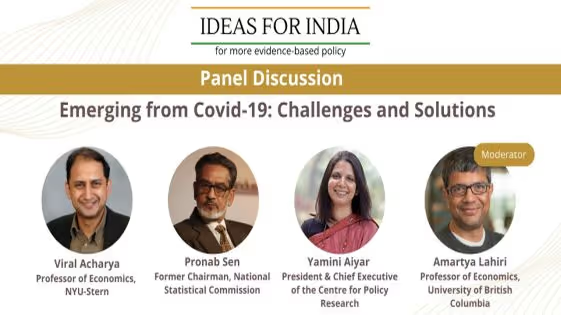
I4I@10 | Emerging from Covid-19: Challenges and solutions
As India emerges from the Covid-19 pandemic, economists will have to rethink how they understand the Indian economy in context of global volatilities. In this panel, moderated by Amartya Lahiri, Viral Acharya, Yamini Aiyar and Pronab Sen discuss both the macroeconomic implications of growth, infrastructure and public policy, and the microeconomic concerns of whether we are creating enough good jobs, ensuring welfare, and reducing income inequality.


बजट 2021-22: राजनीतिक अर्थव्यवस्था के परिप्रेक्ष्य में
वर्ष 2021-22 के केंद्रीय बजट को एक राजनीतिक अर्थव्यवस्था के दृष्टिकोण से जांचते हुए यामिनी अय्यर कहती हैं कि भारत सरकार द्वारा चुने गए नीतिगत विकल्प यह दर्शाते हैं कि सरकार का झुकाव वित्तीय संसाधनों को राज्य सरकारों को हस्तांतरित करने की बजाय उन्हें केंद्रीकरण की ओर तथा कल्याणकारी नीतियों से दूर हटने की ओर है।

India's Union Budget 2017-18: Status quo for the social sector
On 1 February, The Finance Minister of India presented the Union Budget 2017-18. In this article, Yamini Aiyar, Director of Accountability Initiative, contends that for social policy, the Budget suggests more continuity than radical change in India’s welfare architecture. However, it lacks a coherent vision for health and education.
Building an outcome-focused approach to elementary education financing in India
Government expenditure on elementary education in India is designed to promote a system that is accountable for schooling rather than learning. In this article, Yamini Aiyar, Director of the Accountability Initiative at the Centre for Policy Research, proposes a novel approach to governing public financing of elementary education that would give more flexibility to states over planning and budgeting, and incentivise them to work towards learning goals.
Education reform and frontline administrators: A case study from Bihar - II
The frontline administration in India is infamous for corruption and patronage, indifference towards citizens, low effort and high absenteeism. This column reports findings from a year-long qualitative study on frontline education administrators in Bihar. Part 1 captured perspectives of frontline administrators on their role in the education hierarchy and how organisational design and culture shapes everyday behaviour. This part offers insights into how the frontline responds to reform efforts, and how this impacts institutionalisation and scaling up of reforms.
Education reform and frontline administrators: A case study from Bihar - I
The frontline administration in India is infamous for corruption and patronage, indifference towards citizens, low effort and high absenteeism. This column reports findings from a year-long qualitative study on frontline education administrators in Bihar. It captures perspectives of frontline administrators on their role in the education hierarchy and how organisational design and culture shape everyday behaviour.
महामारी के समय में बजट और राजनीति
हाल ही में वर्ष 2022-23 के लिए घोषित बजट को राजनीतिक अर्थव्यवस्था के चश्मे से देखते हुए, यामिनी अय्यर तर्क देती हैं कि महामारी के दौरान घोषित किये गए दोनों बजटों में कल्याण से ज्यादा पूंजीगत व्यय पर दिया गया जोर "बाजार के अनुकूल सुधारों" की ओर राजनीतिक आख्यान में बदलाव का सिलसिला मात्र है जो 2019 में मोदी सरकार के फिर से चुने जाने के साथ शुरू हुआ है।
Budget and politics in pandemic times
Applying a political economy lens to the recently announced Budget 2022-23, Yamini Aiyar contends that the emphasis on capital expenditure over welfare in the two Budgets announced during the pandemic are a mere continuation of a shift in political narrative towards “market-friendly reforms” that began with the Modi government’s re-election in 2019.

Outlays to Outcomes: Understanding pathways to improving learning outcome
This project responds to a specific Government of Bihar request to assess the effectiveness of its "Mission Gunvatta" programme, which aimed at improving the learning outcomes of children attending elementary schools. This project tracks one component of the programme, an initiative to develop student progress cards, examining the quality of these progress cards and developing a set of recommendations on the kinds of incentive structures and monitoring tools that could be designed from the information generated by these report cards.