
.svg)
.svg)
%201.svg)
%201.svg)
.svg)

.svg)
.svg)
.svg)
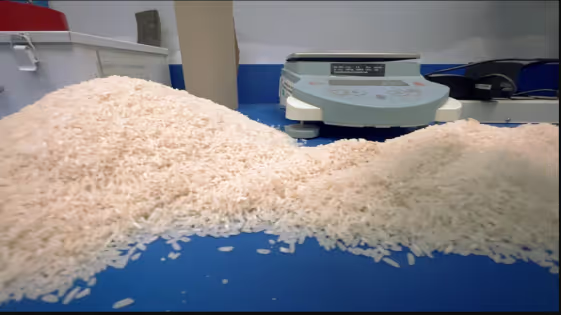
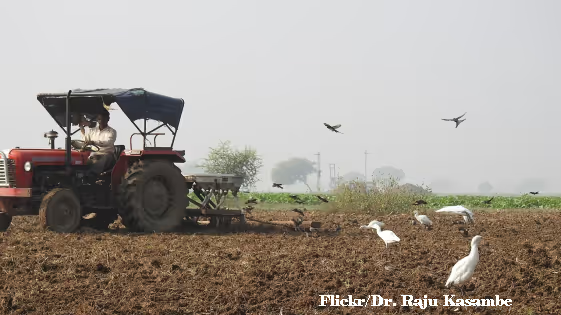
Why India's plan to sell rice for ethanol undermines food and water security
.svg)

.svg)


Agriculture

Transforming landholding agricultural workers into farmers
Some believe that MNREGA has negatively impacted agriculture by reducing the supply of labour available for farm work. This column refutes this view and argues that MNREGA has enabled agricultural workers with small and marginal landholdings to move up the social and occupational ladder – from wage workers to farmers - by complementing their farm income and providing for start-up investments in agriculture.


Financial inclusion for agricultural growth: An alternative approach
Traditional, group-based microcredit has had limited success at enabling farmers to expand the cultivation of risky but profitable cash crops. Evidence suggests that this is mainly because of its mechanisms for borrower selection and enforcement of repayment. This column proposes a new approach that leverages local intermediaries and aligns their incentives with farmer profits, to generate better outcomes for agricultural production and incomes.
Reconstructing facts in Bt cotton: Why scepticism fails
In disputes around Bt cotton, a “triumph narrative” is alleged to have emerged from researchers - mainly economists - catering to vested interests of the biotech industry, its funding and allied journals promoting biotechnology. This column explains why the ‘conspiracy theory’ fails, and then illustrates why the main claims of the peer-reviewed literature demonstrating agro-economic success of Bt cotton are consistent with the near universal adoption of the technology by farmers in India.
Do the poor need genetically modified crops?
Field trials of a few genetically modified crops were recently put on hold by the Environment Ministry. This article asserts that the decision reflects an ideological resistance to and suspicion about the technology, which is at odds with the government’s stated policy of using GM crops for the benefit of rural poor. It argues that GM crops can go a long way in helping farmers by improving crop yields.
Why do insecure rural property rights persist?
Poorly specified and weakly enforced property rights over land may reduce productivity in the agricultural sector. This column examines why strong private property rights are not adopted more widely, and offers a theory of the determination of rural property rights institutions.
The unintended child health consequences of the Green Revolution in India
While the Green Revolution in India greatly enhanced agricultural production, the enhanced use of fertilisers led to the contamination of surface and ground water. This column analyses the impact of fertiliser agrichemicals in water on infant and child health. It is found that exposure of mothers to these contaminants in the month after conception increases the chances of infant death within a month of birth, and also has long-lasting negative effects on child health.
Sign up to our newsletter to be notified about the latest updates
.svg)
Just One Step Away!
Complete your signup to start getting the latest news, stories, and updates delivered straight to your inbox.