
.svg)
.svg)
%201.svg)
%201.svg)
.svg)

.svg)
.svg)
.svg)
.svg)

.svg)

Money and Finance
How financial stress impacts consumer confidence
The financial turmoil of 2008 and the subsequent recession amplified the association between vulnerabilities in the financial markets and the real economy. Examining the behavioural responses of Indian households to financial stress, this article finds that rising financial stress raises household pessimism about the economy – more substantially affecting current perceptions than future outlooks. Further, the impact varies by demographic characteristics such as income and education.


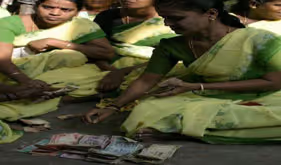
Can the microcredit model be improved?
Microcredit is frequently touted as an effective policy tool to fight global poverty. However, studies suggest that the long-term impact on recipients’ lives is limited. In this post, Mushfiq Mobarak of Yale University, and Vikas Dimble of Tata Centre for Development, argue that new research reveals microcredit can help more people by modifying and extending its model.
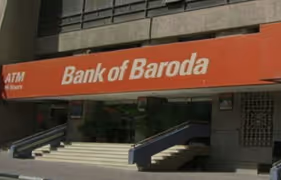
Amalgamation of public sector banks: The task ahead
The central government has proposed amalgamation of three public sector banks (PSBs), the first stage of which has been completed. This strategic move is touted to be the beginning of transformation of PSBs into smart and agile entities to compete with their private peers. In this post, K. Srinivasa Rao discusses reasons for amalgamation, strengths and challenges of the new amalgamated entity, and ingredients for success of amalgamations in the PSB space.

What ails the Indian banking sector?
Non-performing assets (NPAs) of Indian banks have risen from under 3% to over 13% in the past couple of years, making the state of the banking sector one of the biggest challenges facing the country in accelerating investments and growth. In this post, Dr Pronab Sen diagnoses the causes of the current NPA problem, and proposes solutions.

Measuring the equilibrium impacts of credit: Evidence from India’s 2010 microfinance crisis
In October 2010, the government of Andhra Pradesh issued an emergency ordinance, bringing microfinance activities in the state to a complete halt and causing a nationwide shock to the liquidity of lenders, especially those with loans in the affected state. Using this massive dislocation in the microfinance market, this article identifies the “general equilibrium” impacts of a reduction in credit supply, which encompass changes to wages, employment, and consumption in the economy.
Financial inclusion in India: Progress and prospects
Financial inclusion is globally considered as a critical indicator of development and well-being of society. In this post, Srinivasa Rao traces the financial inclusion journey in India so far, and discusses prospects for the future.
The cycle of debt among vendors in India and the Philippines
Many street vendors rely on daily or weekly loans from moneylenders to finance working capital. Given the high interest rates, why do they not use a little bit of each day’s earnings to buy working capital, thus borrowing less? To explore this question, this article discusses three experiments that were conducted in India and Philippines, which involved giving cash grants and brief financial training to indebted vendors.

Explainer: Conceptual foundations of cryptocurrencies
In recent times, cryptocurrencies have become a subject of intense deliberations among policymakers, market participants, investors, and other stakeholders. Whether cryptocurrencies will revolutionise banking and payment systems or is the euphoria surrounding cryptocurrencies like a bubble waiting to burst ̶ only time will tell. In this explainer, Pandey and Sharma attempt to decode the mechanics of cryptocurrencies and simplify the jargon used in the discussion on cryptocurrencies.

Explainer: India’s payments banks
In August 2015, the RBI issued in-principle licences to 11 entities to establish payments banks in India – a unique format of banking which has not been used anywhere else in the world. Fully based on modern technology, these banks are expected to bring the huge unbanked population of India under the formal banking system. In this explainer, Rahul Choudhury describes the evolution of payments banks, the opportunities they offer, and the challenges they face.
Sign up to our newsletter to be notified about the latest updates
.svg)
Just One Step Away!
Complete your signup to start getting the latest news, stories, and updates delivered straight to your inbox.