
.svg)
.svg)
%201.svg)
%201.svg)
.svg)

.svg)
.svg)
.svg)
.svg)

.svg)

Money and Finance

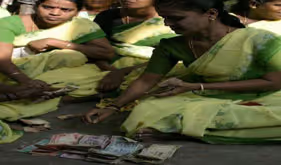
Socially disadvantaged groups and microfinance in India
The benefits of microfinance are in the details. This column takes a look at lending by commercial banks in India to self-help groups – smaller, informal community-based groups – as a new and successful microfinance initiative. Different ways of thinking about getting credit to the poorest and most marginalised in society can work, but only if the institutions are properly geared up for their customers


The Indian banking system: A ticking time bomb
In response to RBI’s call to accelerate the recognition of stressed assets, publicly traded banks in India added nearly Rs. 1 trillion in bad loans in the quarter ending December 2015. In this article, Ashish Pandey, a finance professional, proposes a multipronged approach to addressing the Non-Performing Assets crisis in the Indian banking system.
Recapitalising public sector banks by disinvesting in RBI: Right and wrong
The Economic Survey 2015-16 put forth the argument that the Government of India could reduce its capital in the RBI from its current large level and use it to increase its capital in public sector banks, which face a capital shortage. RBI Governor Raghuram Rajan has stated that this argument is not valid. In this article, Prof. Gurbachan Singh contends that while the argument does not hold in general, it does so for all practical purposes under the present conditions.
Achieving financial inclusion: Going cashless
A World Bank survey reveals that while about half of all individuals in India had bank accounts in 2014, only 12% had made a cashless transaction in the past year. In this article, Bappaditya Mukhopadhyay, Professor of Economics and Finance at the Great Lakes Institute of Management, contends that cashless transactions can be encouraged by ensuring that payments – beyond government transfers - are made directly into the bank accounts of recipients.
How doorstep banking increased savings and income in Sri Lanka
Recent findings in development economics indicate that microloans are likely to perform best when accompanied by financial education, insurance, and savings products. This column presents evidence from an experiment in Sri Lanka, which involved offering saving accounts with door-to-door deposit collection services to otherwise unbanked rural households. It suggests that the programme incentivised participants to increase savings by increasing their income.
Increasing economic divide within backward castes
While the high level of socioeconomic inequality between the forward and backward caste groups in India is well documented, there is little research on inequalities within the backward caste groups. This column finds that economic divide within Scheduled Castes and within Scheduled Tribes has been on the rise over the past three decades.
Financial inclusion for the poor: Using RCTs for effective programme design
While the Pradhan Mantri Jan Dhan Yojana – the Indian government’s flagship financial inclusion scheme - is impressive in its mission, it does not seem to have achieved meaningful results so far. In this article, Ruchira Bhattamishra, Senior Fellow at the Centre for Development Research, Sustainability and Technical Advancement, makes a case for the use of the Randomised Controlled Trial methodology for impact evaluation to gather credible evidence on the effectiveness of pilot financial programmes/particular components of programmes, before the government invests heavily in scaling them up.

When higher volatility is good news
Conventional wisdom suggests that access to financial services such as banks and bond markets, providing savings and borrowing instruments, allows smoothing consumption over lifetime, irrespective of income fluctuations. Yet, India and other emerging economies have witnessed an increase in consumption volatility relative to income volatility after financial sector development. This column argues that large permanent income shocks in emerging economies explain this puzzle.
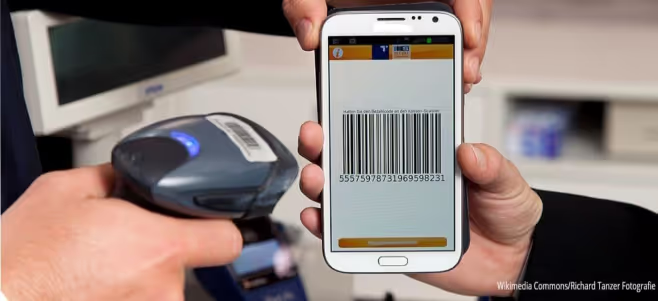
Cash to cashless
The RBI is in discussion with the government on ways to reduce cash usage in the economy and to promote the use of cashless instruments. This column presents results from a study that estimates the extent of cashless transactions in the economy, and analyses the enabling factors and bottlenecks.
Sign up to our newsletter to be notified about the latest updates
.svg)
Just One Step Away!
Complete your signup to start getting the latest news, stories, and updates delivered straight to your inbox.