
.svg)
.svg)
%201.svg)
%201.svg)
.svg)

.svg)
.svg)
.svg)
.svg)

.svg)



Trade

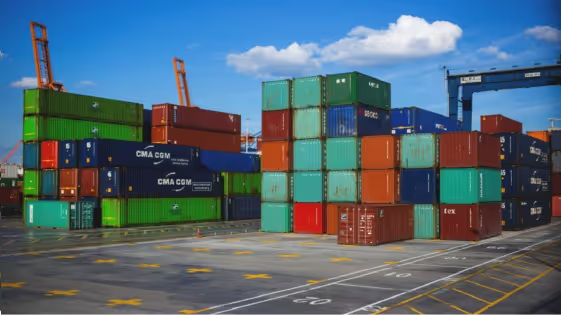
India’s millets consumption and trade over the last three decades
In the first post of the e-Symposium on ‘Carrying forward the promise of International Year of Millets’, Manan Bhan introduces the concept of ‘embodied land area’, which accounts for land use at the point of consumption and places the burden of negative impacts on consumers rather than producers. He notes the decline in land area under use for the production of millets and sorghum, and the potential to expand millet cultivation, trade and consumption in a sustainable manner to benefit both producers and consumers.


Growing threats to global trade
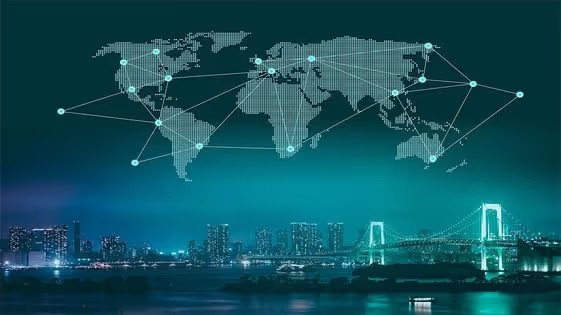
After an era of hyperglobalisation in the 1990s, there has been a clear change in policy and public attitude toward global trade. This article looks at the recent backlash against globalisation and the role that different factors played in contributing to it. It considers the effect of the pandemic and geopolitical pressures due to the conflict in Ukraine, and warns that protectionism could make the world less resilient, more unequal, and more conflict-prone.
Does development of transport infrastructure increase rural land inequality?
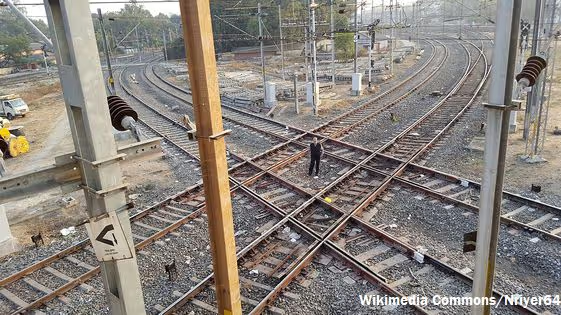
Investments in transport infrastructure reduce trade costs and lead to integration of villages with urban markets. This article suggests that this spatial integration could have the unintended consequence of increasing land inequality in rural India. It isolates the effects of market access using colonial railroad locations and the distance of a village from the Golden Quadrilateral highway network. The study finds that integration also increases the share of landless households and the adoption of productive farming technology, which would lead to large farms getting bigger and increase land inequality
Economic integration and the transmission of democracy
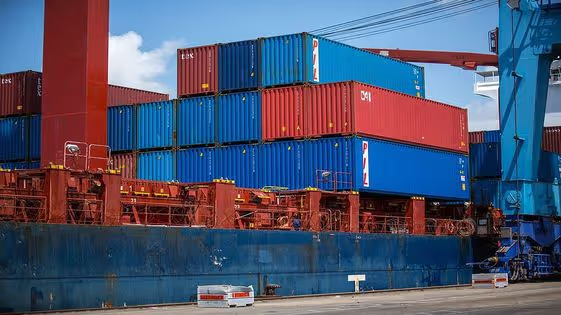
Dramatic increases in globalisation resulted in autocratic countries being exposed to the institutions and values of their democratic trade partners. Exploiting improvements in air transportation relative to sea shipping that occurred over the last five decades, and combining survey data with country level measures of democracy from 1960 to 2015, Tabellini and Magristretti document that trade with democracies increases both citizens’ support for democracy and countries’ democracy scores, and investigate the feasibility of the mechanisms through which this democratisation occurs.
Lockdown-induced trade disruptions and adaptations by firms
In the face of trade disruptions, firms can reorient their trade to minimise risk. This article documents a fall in inter-state trade in India during the Covid-19 lockdown, that continues until December 2020. This is explained by ‘reshoring’, as plants more dependent on inter-state sales (and input-sourcing) shifted to intra-state sales (and input-sourcing). The extent of reshoring is determined by a new measure – Scope for Home Expansion – that captures excess home production which can be diverted within the state
The impact of services trade on non-tradable services in India
A share of India's service sector growth can be attributed to tradable services, which can also have positive productivity impacts on manufacturing. This article looks at the effect of services trade on employment growth in non-tradable services. It finds that an increase in tradable services employment led to an increase in employment in non-tradable services from 1990 to 2013, and that this is explained by increases in consumer demand. The impact is larger among female workers and small firms.
Opportunities, risks and realities of India’s participation in global value chains
Despite its manufacturing capability, India, unlike other Asian countries, has failed to integrate into global value chains (GVCs). In this post, Karishma Banga discusses the nature of India’s GVC integration, primarily through forward participation; the sectors that fuel productive linkages; and the factors that have caused low integration – lack of well-developed, labour-intensive industries, large domestic market, labour market rigidities and low FDI. Finally, she recommends strategies to maximise gains for domestic firms integrating into GVCs.
How tradable services can aid the jobs challenge in India
Although the rising demand for services has led to its increased contribution to employment in many developing countries and globally, India's growth in services has not translated into a proportionate increase in employment. Rupa Chanda examines two factors which need to be considered if services are to play a bigger role in job creation– improving the quality of jobs along with increasing formalisation of labour, and investing in skills and training to face technological changes.
Has the export-oriented manufacturing model reached its sell-by date for India?
As India faces the challenge of creating millions of well-paying jobs for its rapidly growing working-age population, Devashish Mitra analyses which sectors and what strategies can provide these good jobs. He posits that four factors can help the export-oriented manufacturing model succeed – further labour reforms; the signing and implementation of free trade agreements and establishing special economic zones; and participation in global supply chains. This will allow India to leverage its labour, along with advanced-country technology, to create productive jobs


Sign up to our newsletter to be notified about the latest updates
.svg)
Just One Step Away!
Complete your signup to start getting the latest news, stories, and updates delivered straight to your inbox.