
.svg)
.svg)
%201.svg)
%201.svg)
.svg)

.svg)
.svg)
Maitreesh Ghatak Ghatak

Maitreesh Ghatak was educated at the Presidency College, University of Calcutta, Delhi School of Economics, and Harvard University, where he received his Ph.D. in 1996. He has been Professor of Economics at the London School of Economics since 2004, having earlier taught at the University of Chicago. He is the Editor-in-Chief of the Journal of Development Economics since 2009 and the Director of the research programme Economic Organization and Public Policy (EOPP) at STICERD, LSE since 2006. Earlier he was the Managing Editor of the Review of Economic Studies, and a Co-Editor of the Economics of Transition. He is currently a member of the Executive Committee of BREAD, and a Co-Editor of Economica. He is a founder member of the research networks Theoretical Research in Development (ThReD) and Non-Profits, Governments, and Organisations (NGO). His areas of research interest are development economics, economics of contracts and organisations, and public economics. Current projects include the role of market structure in microfinance, land acquisition and compensation for displaced farmers, non-profits and social enterprise, and incentives and organisation design in public service delivery.
.svg)


The crisis of farmer suicides
More than 15,000 Indian farmers have committed suicide per year, on average, in the last two decades – a suicide rate that appears to be higher than that of the general population. In this article, Maitreesh Ghatak emphasises the need to think of farmer suicides as a policy problem, rather than tragedy, and to deliberate on the causes and remedies.


West Bengal’s economic performance relative to India over the last three decades
Against the backdrop of the ongoing elections in West Bengal, Maitreesh Ghatak examines how the state’s economic performance compares with that of the country as a whole, over the past three decades. He highlights that despite West Bengal’s lack of economic dynamism, its agricultural growth rate as well as the growth rate of consumption expenditure in its rural areas, that house 72% of the population, has been higher than the national average.

An assessment of policy performance under the current regime
Commenting on the recent policy paper by Subramanian-Felman, Maitreesh Ghatak discusses why – looking at the same numbers – he would tend to be less generous in his grades for the performance of policy initiatives under the current regime. Regarding the Covid-19 shock, Ghatak contends that to the extent there is a policy trade-off between lives and livelihoods, one wonders why India does not score highly on either – whether it is “hardware problems” or “software” glitches in policy design and implementation.
What would make India’s growth sustainable?
Much of the discussion on the economic slowdown in India in recent years – as well as on the government’s measures to tackle the present economic crisis due to the Covid-19 lockdown – is focused on the supply side. In this post, Ghatak, Kotwal, and Ramaswami emphasise the demand channel, and argue that this is the fate of any growth episode that is not inclusive.
Union Budget 2018: Unpleasant arithmetic and the art of the possible
In this article, Maitreesh Ghatak contends that while the Union Budget 2018-19 deserves some praise for signalling priorities given the constraints, it disappoints in terms of its vision of reforms.
The dangers that lie beneath India's IT layoffs
The ongoing layoffs in India’s IT sector are at a scale that has not been seen since the global financial crisis of 2008. In this article, Maitreesh Ghatak, Professor of Economics at LSE, contends that while this is a major shock, the country’s demographic dividend, and global trends such as automation, demand an economic strategy that prioritises job creation more broadly.
Nobel prize in Economics 2016: The economy as a nexus of contracts
An important line of research in microeconomics has tried to explain how the economic institutions that underpin the ‘invisible hand of the market’ actually work. The specific economic institution that Hart and Holmström focus on is contracts. In a tribute to the Nobel laureates, Maitreesh Ghatak, Professor of Economics at the London School of Economics, discusses the working and importance of contract theory.
Union Budget 2016: A UPA-III Budget
In this article, Maitreesh Ghatak, Professor of Economics at the London School of Economics, contends that the Modi government presented a reasonably good United Progressive Alliance (UPA)-III Budget that tinkers at the margin. However, in his view, minor tweaks may not suffice in the current growth scenario.
Land acquisition Act: Addressing both justice and prosperity
The Modi government’s land acquisition ordinance did away with the consent and social impact assessment requirements for private projects in certain sectors under UPA’s 2013 land Act. In this article, Ghatak and Ghosh contend that in seeking to eliminate these hurdles, the ordinance puts more weight on prosperity and less on justice. In their view, justice and prosperity need not be irreconcilable objectives.
Land acquisition debate: The price is not right
The central government’s move to amend the 2013 land acquisition Act has come under criticism for being ‘anti-farmer’. In this article, Maitreesh Ghatak and Parikshit Ghosh argue that while the amendments would streamline the land acquisition process, the law will still be fatally flawed unless a more rational method of determining compensation for land owners is put in place.
From 'Mess in India' to Made in India' as a global brand?
PM Modi recently launched the ‘Make in India’ campaign to attract investment and boost manufacturing. In this article, Maitreesh Ghatak contrasts the campaign with the Chinese model of economic governance, and reflects on its potential to enable higher growth and poverty reduction.
The Land Acquisition Act is deeply flawed
In the second part of the Land Acquisition Act debate, Ghatak and Ghosh argue that the legislation is ill-conceived and falls short on several counts. They contend that the formula for compensation is arbitrary, and recommend holding large-scale land auctions to discover the true value of land. They contradict Pande’s point that the Act strikes a fine balance between industrialists and farmers.
Developing a Land Acquisition Policy for India
The Land Acquisition Bill is a key piece of legislation under consideration in the Indian Parliament. This column argues that the current policy on compensating landowners, as proposed in the Bill, is misguided and could adversely affect the pace and character of future growth in India. It draws lessons from economic theory as well as the failed land acquisition experience in Singur to propose a workable model for determining appropriate compensation for land acquisition.
Land acquisition: Is there a way out?
India is hungry for space to grow into a developed economy. Yet this hunger is increasingly raiding farmland and threatening traditional livelihoods. For some, this is a necessary evil, for others it is unjustified exploitation. This column argues that the debate need not be so stark and that politicians, policymakers and the public need to see that another way is possible.
Building foundations well: The challenge for primary education
Rukmini Banerji contends that the draft New Education Policy gets it right in emphasising the importance of Early Childhood Care and Education and the need to urgently work on establishing foundational literacy and numeracy at the primary stage, where there is currently a learning crisis.

बुनियाद की मज़बूती: प्राथमिक शिक्षा की चुनौती
रुक्मिणी बनर्जी बताती हैं कि नई शिक्षा नीति का प्रारूप एक सही कदम के रूप में बच्चों की शुरुआती देख-रेख और शिक्षा के महत्व पर ज़ोर देता है। साथ ही, यह प्राथमिक स्तर पर बुनियादी साक्षरता व गणितीय क्षमता को अविलम्ब दुरुस्त करने की ज़रूरत को रेखांकित करता है – वह स्तर जो आज सीखने के संकट से जूझ रहा है।
ASER 2018: Behind the headlines
Thanks to more than a decade of Annual Status of Education Reports (ASER), the main headlines from the surveys are widely known – the learning levels of Indian school going children are worryingly low. In this article, Rukmini Banerji takes a closer look at the recently released ASER 2018 data to see what else it can tell us, and discusses actionable steps to bring forward children who are falling behind
Tracking learning outcomes: ASER’s work through the pandemic
With the onset of the Covid-19 pandemic and the associated lockdowns, schools quickly pivoted to online learning. However, there was limited information about whether children had access to learning materials, and what was actually taking place within households. In this edition of I4I Conversations, Rukmini Banerji and Wilima Wadhwa discuss the role that the Annual Status of Education Report (ASER) played in remedying this gap in the data. They discuss a few major findings from the survey on learning outcomes during the pandemic. Although the proportion of children not enrolled in schools went up, the proportion of children enrolled in government schools increased, and most of them had access to digital learning materials due to an increase in smartphone coverage. They discuss the challenges they faced while conducting ASER during the pandemic, including being limited to phone surveys and rallying volunteers amidst uncertainty. However, after the lack of data during the first ...
Tracking learning outcomes: ASER’s work through the pandemic
With the onset of the Covid-19 pandemic and the associated lockdowns, schools quickly pivoted to online learning. However, there was limited information about whether children had access to learning materials, and what was actually taking place within households. In this edition of I4I Conversations, Rukmini Banerji and Wilima Wadhwa discuss the role that the Annual Status of Education Report (ASER) played in remedying this gap in the data. They discuss a few major findings from the survey on learning outcomes during the pandemic. Although the proportion of children not enrolled in schools went up, the proportion of children enrolled in government schools increased, and most of them had access to digital learning materials due to an increase in smartphone coverage. They discuss the challenges they faced while conducting ASER during the pandemic, including being limited to phone surveys and rallying volunteers amidst uncertainty. However, after the lack of data during the first ...
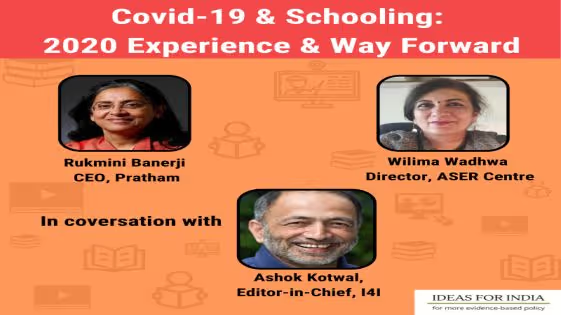
Covid-19 and schooling: 2020 experience and way forward
The onset of the Covid-19 pandemic brought with it significant challenges for the education sector. On the one hand, closing schools meant imposing a heavy cost on a whole generation of students, and on the other hand, keeping schools open was a health hazard. India and several other developing countries – reluctantly at first – adopted online teaching. However, this was riddled with problems given the weak access to digital connectivity and devices. So how was the schooling experience in 2020, and are there any lessons for the future? To explore these crucial questions, I4I Editor-in-Chief Ashok Kotwal speaks with Rukmini Banerji (CEO of Pratham; India’s largest education non-profit) and Wilima Wadhwa (Director, Annual Status of Education Report (ASER) Centre). Banerji and Wadhwa discuss the mechanics of the ASER 2020 phone survey; availability of educational materials and learning activities in rural homes; how families, communities, and schools came together to keep up children’s le
Teaching at the right level: Solutions for low learning levels in India
At least half of all children in India have not acquired basic literacy and arithmetic skills by the end of primary school. In this article, Rukmini Banerji of Pratham and J-PAL Director Esther Duflo present evidence that shows that significant gains in learning outcomes can be achieved by reorganising and grouping children by their learning level rather than the usual grouping by age or grade.
Introduction to e-Symposium: Ideas for reforms in education policy in India
A New Education Policy is being formulated in India based on a time-bound grassroots consultative process. As a contribution to the discussions, Rukmini Banerji of the education NGO Pratham and Ashok Kotwal, Editor-in-Chief, I4I, are hosting an e-symposium on ideas for reforms in education policy. Over the next few days, the e-symposium will bring together key findings from recent research in education and experience-based insights by stakeholders from academia and civil society.
Building a movement, assessment to action
While citizen-led assessments of children’s learning have been applauded for building awareness around the issue, observers have pointed out that information does not automatically galvanise action. In this article, Rukmini Banerji, of the education NGO Pratham, contends that citizen-led assessments can lead to citizen-led action for improving learning by making the problem visible, engaging with people, and demonstrating how change can be brought about.
Taking education beyond educationists
ASER – Annual Status of Education Report – has been tracking learning outcomes of children in rural India for the past 10 years. In this note, Rukmini Banerji, Director of the ASER Centre/Pratham, highlights how this model of measurement is different from the traditional models of student assessments seen in India or elsewhere. She also points out key policy changes that have taken place in education in India, at least partly in response to ASER findings.
Choice and cost: The role of household decision making and spending on secondary education in rural Bihar
This project attempts to understand the educational choices that households make and expenditures they undertake for children going from upper primary school to secondary school in Bihar. It is designed to capture household choices on education and money they spent; understand the magnitude of private tuition; the costs associated with private tuition; and tuition practices and tutor background.
Improving children's learning: Challenges and priorities for the new government
Over the last 15 years, continued effort to universalise access to elementary education in India has resulted in high enrolment rates in schools. Now that most children are in school, policy and planning efforts are beginning to focus on improving their learning levels. This note contends that it is imperative for the new government to maintain, monitor and strengthen this priority and improve mechanisms for achieving learning goals.
Searching for the 'silver bullet': What works in improving children's learning outcomes?
Children’s learning outcomes in primary schools in India are far from satisfactory. In this article, Rukmini Banerji explores the various theories of change and associated implementation strategies that are currently at work for improving the status of learning in schools. She discusses the challenges of balancing and prioritising the different theories of change, and translating them into practice on scale.
The invisible and urgent challenge of learning
While almost all six to fourteen year olds in India are enrolled in school, their performance is far below expected levels. The common view is that the problem can be addressed by filling gaps in the system such as inadequate infrastructure or teacher shortage. This column argues that these inputs can ensure “schooling for all” but not “learning for all”, and suggests teaching by level rather than by grade to improve learning outcomes.
Why Indian education needs to get back to reality
What is the best advice to give an Indian education department official? This column argues that the best thing officials can do is drop the assumptions and stick to reality – otherwise many children will be missed out and left behind.