
.svg)
.svg)
%201.svg)
%201.svg)
.svg)

.svg)
.svg)
Aastha Dang
Aastha Dang provides technical and management leadership and supports 3ie’s women's empowerment and livelihoods programs, including 'Swashakt: Empowering Indian Women's Collectives', the 'Sanitation-linked Livelihoods Program' in India, and the PeaceFIELD project in South Sudan. Her work focuses on conducting gender-responsive evaluations by examining critical questions on changes in women’s empowerment outcomes and gender relationships. She also supports business development and project bids.
Prior to joining 3ie, Aastha worked at various organisations, including NITI Aayog, BBC Media Action, Alexander Associates, and Indian Institute of Management (IIM) Lucknow. In the policy space, NITI Aayog credits Aastha for drafting India’s report for Voluntary National Review on Sustainable Development Goals (SDGs) and the SDG Baseline Index. Her work, published in collaboration with IIM Lucknow, has contributed to the theme of workplace-related discrimination faced by women professionals.
Aastha holds a Bachelor’s degree from St. Stephen's College, a Master's in Sociology from Delhi School of Economics, and an MPhil in Gender Studies from Ambedkar University, Delhi. She has completed her PhD in Gender Studies from Ambedkar University, Delhi.
.svg)

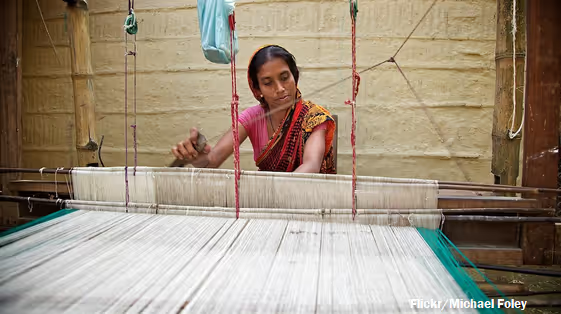
पीढ़ी-दर-पीढ़ी बुनाई : ग्रामीण भारत में पारिवारिक व्यवसायों में उत्पादकता लाभ
हर साल 12 फरवरी को मनाए जाने वाले राष्ट्रीय उत्पादकता दिवस का उद्देश्य अर्थव्यवस्था में उत्पादकता, नवाचार और निपुणता के महत्त्व पर ज़ोर देना है। इसी सन्दर्भ में प्रस्तुत इस लेख में पारिवारिक स्वामित्व वाले बुनाई उद्यम की चर्चा की गई है। आंध्र प्रदेश और तेलंगाना में बुनाई का कार्य अक्सर एक पारिवारिक उद्यम है। 1,800 से अधिक परिवारों के डेटा का उपयोग करते हुए, हैममेकर एवं अन्य द्वारा किया गया मिश्रित-विधियों का मूल्याँकन यह दर्शाता है कि पीढ़ी-दर-पीढ़ी बुनाई व्यवसाय में जुटे परिवार बुनाई कार्य में अधिक कमाते हैं और केवल एक पीढ़ी के बुनकरों वाले परिवारों की तुलना में उनकी पारिवारिक आय अधिक होती है। हालाँकि, पाया गया कि उत्पादकता के ये लाभ पूरे परिवार में समान रूप से वितरित नहीं होते हैं, क्योंकि वे उन महिला बुनकरों के लिए विस्तृत एजेंसी के रूप में तब्दील नहीं होते जो इन व्यवसायों का हिस्सा होती हैं।


Weaving through generations: Productivity gains in family-owned businesses in rural India
In Andhra Pradesh and Telangana, weaving is often a family enterprise. Using data from over 1,800 households, this ongoing mixed-methods evaluation by Patel et al. shows that households with multi-generational weaving businesses earn more in weaving revenue and have greater household incomes relative to households with only one generation of weavers. However, it notes that these gains in productivity are not equally distributed across the household, as they do not translate into greater agency for the women weavers who are part of family-owned businesses.
Supporting women weavers: Learnings from producer companies
The lack of market demand and low earnings, as well as competition from power looms, has led to declining participation of artisans in India's handloom industry. In this note, Dang et al. share some insights gained through conversations with women weavers and other members of the weaving community, which reveal the need for greater technical and management training and provision of suitable working conditions for weavers to ensure the long-term sustainability of weaving enterprises.