.svg)
.svg)
%201.svg)
%201.svg)
.svg)

.svg)
.svg)
Bharat Ramaswami

Bharat Ramaswami is a Professor of Economics at Ashoka University and prior to that he was at the Indian Statistical Institute, Delhi. He has held visiting appointments at universities in Canada, Japan, Sweden and the United States. Before earning a PhD from the University of Minnesota, Ramaswami obtained a Bachelor’s and Master’s degrees in Economics from the University of Delhi. He was awarded the Mahalanobis Memorial Medal by the Indian Econometric Society in 2004 for his contributions to quantitative economics.
.svg)

The agricultural productivity gap: Informality matters
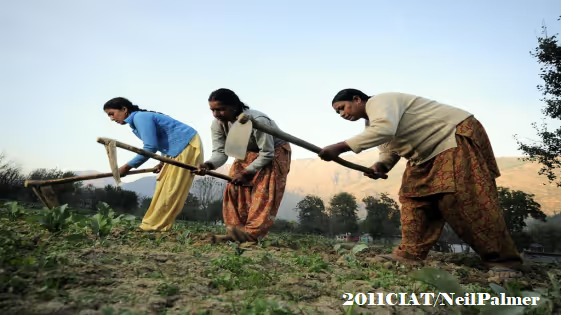
There are various explanations in the literature for the observed productivity gap between agriculture and other sectors, in developing countries. Using Indian data, this article questions the standard view of the two-sector productivity gap. It shows that while the productivity gap between the farm sector and informal non-farm sector is negligible, a worker in the formal non-farm sector is 3-4 times more productive than a worker in the farm sector.


Introduction to e-Symposium: Carrying forward the promise of International Year of Millets
Although millets were a staple food in many Indian diets, their consumption has declined over the last few decades. Taking into account their resilience to climate change and potential to contribute to nutritional security, the Indian government has vowed to increase millet production and consumption and successfully advocated the United Nations to declare 2023 as the International Year of Millets (IYoM). Starting from World Food Day on 16 October, Ideas for India will host six pieces from researchers and practitioners discussing how the promise of millets can be realised. Anchored by Bharat Ramaswami, this series will feature perspectives on increasing millets’ land under cultivation; investment in R&D and machinery for its production and processing; suggestions to revive demand by including millets in government food programmes; and increasing the scope for exports.
कृषि कानून: गतिरोध का समाधान
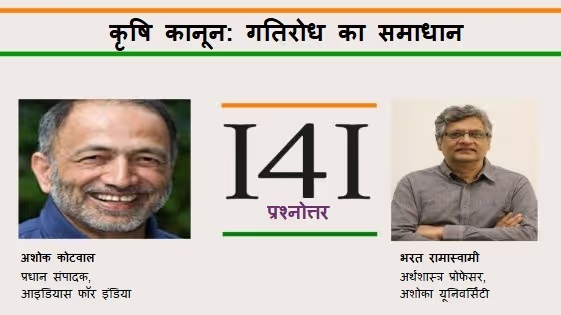
हाल ही में इंडियन एक्सप्रेस के एक लेख में भरत रामास्वामी ने किसानों के विरोध से उत्पन्न मौजूदा संकट को हल करने के लिए कुछ उत्तेजक सुझाव पेश किए हैं। इस पोस्ट में रामास्वामी ने अशोक कोटवाल (प्रधान संपादक, आइडियाज फॉर इंडिया) के साथ एक साक्षात्कार में उन विचारों पर विस्तार से प्रकाश डाला है।
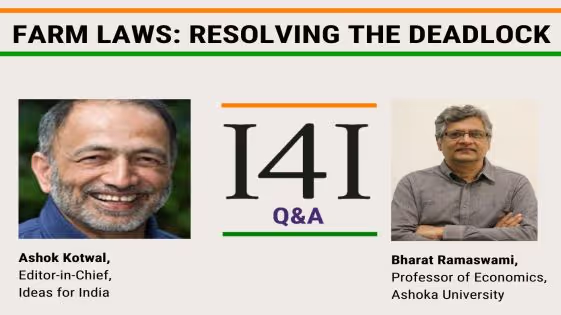
Farm laws: Resolving the deadlock
In a recent Indian Express article, Bharat Ramaswami has proposed some rather provocative suggestions on how the present crisis triggered by the farmers’ protests can be resolved. In this post, Ramaswami elaborates on those views in an interview with Ashok Kotwal (Editor-in-Chief, Ideas for India)
कृषि कानून: कृषि विपणन का उदारीकरण आवश्यक है
कृषि कानून पर अपना दृष्टिकोण प्रदान करते हुए भरत रामास्वामी ने यह कहा है कि कृषि विपणन का उदारीकरण एक आवश्यक कदम है – पूर्व में सभी राजनीतिक विचारधाराओं द्वारा इसका समर्थन किया गया। इसमें बदलाव करना यानि केंद्र द्वारा विधि का उपयोग करना है। खरीद-अधिशेष राज्यों के लिए कोई तात्कालिक लाभ भी नहीं हैं।
Farm laws: Liberalisation of agricultural marketing is necessary
Providing his perspective on the farm laws, Bharat Ramaswami contends that the liberalisation of agricultural marketing is the necessary direction – a view endorsed in the past across the political spectrum. The departure is the use of legislation by the Centre. There are also no immediate gains for the procurement-surplus states.

Grain stocks: Is it a problem of storage capacity?
Foodgrains rot due to insufficient storage capacity, even as millions go to bed hungry. This column argues that increasing capacity is only a partial resolution. The crisis has happened before and will happen again unless different ways are found to support farmers and consumers.
What would make India’s growth sustainable?
Much of the discussion on the economic slowdown in India in recent years – as well as on the government’s measures to tackle the present economic crisis due to the Covid-19 lockdown – is focused on the supply side. In this post, Ghatak, Kotwal, and Ramaswami emphasise the demand channel, and argue that this is the fate of any growth episode that is not inclusive.
कोविड-19: क्या हम लंबी दौड़ के लिए तैयार हैं? - भाग 2
इस आलेख के पहले भाग में, लेखकों ने भारत में कोविड-19 के प्रति सरकार की प्रतिक्रिया का मार्गदर्शन करने हेतु व्यापक सिफारिशें कीं। इस भाग में, वे पांच ऐसे समूहों की पहचान करते हैं जिनके वर्तमान संकट से उत्पन्न आर्थिक एवं स्वास्थ्य संबंधी झटकों की चपेट में आने की आशंका ज्यादा है, और ऐसे क्षेत्र जहां राहत प्रयासों को केंद्रित करने की आवश्यकता है।
कोविड-19: क्या हम लंबी दौड़ के लिए तैयार हैं? - भाग 1
कोविड-19 के प्रसार की संभावित पुनरावृत्ति को रोकने के लिए यह लॉकडाउन, संभवतः भविष्य में किए जाने वाले कई लॉकडाउन में से पहला हो सकता है, इसलिए नीति निर्माताओं को इससे प्रतिकूल रूप से प्रभावित व्यक्तियों को राहत प्रदान करने के लिए तैयार रहना होगा। इसे ध्यान में रखते हुए, लेखक एक व्यापक दृष्टिकोण का प्रस्ताव करते हैं जिसमें अगले 24 महीनों में होने वाले किसी भी लॉकडाउन के दौरान राशन कार्ड धारक सभी परिवारों को प्रदान किए जाने वाले वस्तु रूपी अंतरणों और नकद सहायता के एक संयोजन के लिए तर्क दिया गया है।
Covid-19: Are we ready for the long haul? - Part II
In Part I of this piece, the authors made broad recommendations to guide the government’s response to Covid-19 in India. In this part, they identify five salient population groups that are particularly vulnerable to the economic and health shocks arising from the current crisis, and regions where relief effort needs to be concentrated.
Covid-19: Are we ready for the long haul? - Part I
As this may be the first of many future lockdowns to stamp out possible repeated outbreaks of Covid-19, policymakers must be prepared to provide relief to adversely affected individuals. With this in mind, the authors propose a comprehensive approach that argues for a combination of in-kind transfers and cash support to be provided to all households with ration cards during any lockdown that takes place over the next 24 months.
Union Budget 2018: What will the pivot to agriculture cost?
The Union Budget 2018-19 focusses heavily on agriculture and rural development. In this article, Bharat Ramaswami analyses the key proposals pertaining to investment in agricultural markets and infrastructure, and provision of price support to farmers in order to boost their incomes.
Two views on the Budget
The Modi government’s first Budget has received a mixed response. Eswar Prasad and Bharat Ramaswami present two distinct views on the Budget. While Prasad is of the opinion that the Budget hits the right notes and emphasises some key policy priorities, Ramaswami believes that a coherent policy and worldview is yet to emerge.
How labels influence the decision to buy genetically modified food
A regulation mandating labelling for all packaged products has been in effect in India since the beginning of this year. This column examines the role of information provided by labels in the decision of consumers to buy genetically modified food. It is found that Indians have a lower threat perception of genetically modified ingredients as compared to Europeans.

Aadhaar Bill: Move towards a surveillance State?
Most advanced economies have had some version of UID for a long time, example, the Social Security number in the US, the Social Insurance Number in Canada, etc. This is recorded not only in interactions with the State (example, tax filing) but also in many kinds of non-governmental transactions (example, college admissions or property purchase). Yet, it is arguable that these nations have not become police States, occasional abuse notwithstanding. If privacy concerns in India are justified, is it a reflection of the trust deficit in government specific to India (or poorer countries more generally)? Or do schemes like UID inevitably lead to a surveillance State anywhere in the world?
Aadhaar Bill and government benefits: Risk of increasing exclusion?
Supporters of Aadhaar express the hope that will reduce inclusion errors and corruption by eliminating ghost beneficiaries, say in schemes like MNREGA. Are there substantial benefits to be reaped on this account? Tweet using: #AadhaarBill
Aadhaar Bill and government benefits: Better targeting and reduced corruption?
Supporters of Aadhaar express the hope that will reduce inclusion errors and corruption by eliminating ghost beneficiaries, say in schemes like MNREGA. Are there substantial benefits to be reaped on this account?
Aadhaar Bill: Incremental information-gathering powers for government?
The government already has the means to collect a lot of information on citizens (example, phone conversations and logs, credit card transactions, income tax records, bank account details, etc.). Conversely, there are many activities which happen under the radar (example, cash transactions, informal sector employment, etc.). What kind of information-gathering powers will Aadhaar confer on the State over and above what it already has?
Some reflections on the National Food Security Act
The Food Security Bill became an Act with little parliamentary opposition. Yet the public debate has lingered. Would subsidised food grains reduce malnutrition? Won’t it be better to invest in health and education instead? Can we afford the cost of subsidising food for such a large chunk of the population? Should we continue to waste money on the flawed PDS system? How will the grain markets be affected? This column offers a perspective on these important questions.
A suggestion for WTO negotiations
India’s new food security law is likely to breach WTO’s limit on farmer support. India is keen to ask for a temporary exemption from the rule so that the law can be implemented unhindered. But, in return, it may have to agree on trade facilitation. This article argues that while our food procurement policies do need reform, there is no link between the food security law and free trade.
Doing a number on the Food Security Bill
In a recent article, Kotwal, Murugkar and Ramaswami pointed out errors in estimation by Surjit Bhalla that led him to assert that the Food Security Bill will increase cost of food subsidy by 336%, and presented correct costs of the Bill. Bhalla then defended his methodology and calculations and criticised the authors’ arguments. This article responds to Bhalla’s defence, and says that the astronomical estimates of the Bill are irrelevant.
Correct costs of the Food Security Bill
In a recent article, Surjit Bhalla has asserted that the Food Security Bill will increase costs of food grain subsidy by 336%. Correcting errors in his calculation brings this figure down to 18%. In this article, the authors explain the errors and present the correct cost figures of the Bill.
Food Bill: Neither populist nor unaffordable
Criticism of the National Food Security Bill has led to the government dropping the idea of issuing an Ordinance and instead, saying it would try to get the Bill passed in a special session of Parliament. This article addresses some of the key questions raised by critics of the Bill.
The impacts of linking NREGA payments to UID. A Study of Maharashtra
This project attempts to measure the impact of Universal Identification (UID)-linked wage payments on corruption in public works projects funded under MNREGA (National Rural Employment Guarantee Act).
वस्तु-रूपी हस्तांतरण : डेडवेट हानि या लाभ?
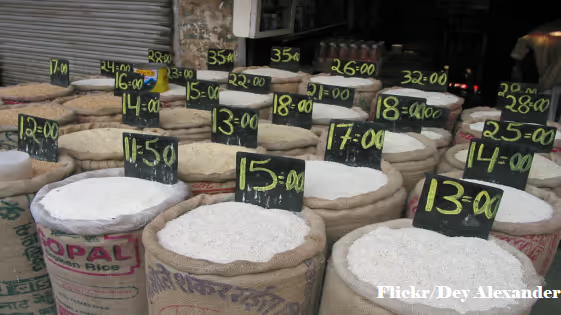
क्या सामाजिक सहायता के लिए वस्तु-रूप में दिया जाने वाला हस्तांतरण उपभोक्ता की पसंद को सीमित करके ‘डेडवेट लॉस’ की ओर ले जाता है? इस लेख में महाराष्ट्र में हुए एक प्रयोग से प्राप्त निष्कर्षों को प्रस्तुत किया गया है जिसमें कम आय वाले उत्तरदाताओं को चावल की मुफ्त मात्रा और नकदी की अलग-अलग मात्रा के बीच विकल्प की पेशकश की गई, ताकि चावल के लिए उनकी भुगतान करने की इच्छा का पता लगाया जा सके। इसमें पाया गया कि परिवार में अधिक मोल-भाव करने की क्षमता वाली महिलाएं चावल की अपेक्षा नकदी को ज़्यादा तरजीह देती हैं।
In-kind transfers: Deadweight losses or gains?
Do in-kind transfers for social assistance lead to ‘deadweight losses’ by restricting consumer choice? This article presents findings from an experiment in Maharashtra, which involved offering low-income respondents the choice between a free quantity of rice and varying amounts of cash to elicit their willingness to pay for rice. It finds that women with higher bargaining power within the household are more likely to choose cash over rice.

‘न्याय' विचार-गोष्ठी: नकद अंतरण नीतियों से संबंधित चार चिंताएं
भरत रामास्वामी (अशोका विश्वविद्यालय में अर्थशास्त्र के प्रोफेसर) ने अतिरिक्त नकद अंतरण (ऍड-ऑन कैश ट्रांसफर) के बतौर ‘न्याय' के क्रियान्वयन में चार प्रकार की आपत्तियों पर चर्चा की है। उनका तर्क है कि पुनर्वितरण के दीर्घस्थायी साधन के रूप में नकद अंतरण का उभरना इस बात पर निर्भर करता है कि वर्तमान सब्सिडियों के साथ वे कैसे फिट होते हैं और वे स्वास्थ्य और शिक्षा के सार्वजनिक बजट को समाप्त तो नहीं कर देते हैं।
NYAY e-Symposium: Four concerns around cash transfer policies
Bharat Ramswami (Professor of Economics, Ashoka University) discusses four sets of caveats in implementing NYAY as an add-on cash transfer. He contends that the emergence of cash transfers as a sustainable tool of redistribution depends on how they mesh with existing subsidies and if they crowd out public budgets for health and education.
Aadhaar that doesn’t exclude
Aadhaar is in the news today partly because of security concerns and partly because of reports that the poor are unable to receive PDS rations because of failures in Aadhaar authentication. In this article, Kotwal and Ramaswami focus on the latter with an eye to look for ways to bring down the exclusion errors.

Protectionism under the guise of food security
India has backed out of the commitment it made at the WTO negotiations in Bali in November 2013. The implicit explanation is that the government needs to accumulate food grain stocks to provide subsidised grain to the poor and ensure food security. In this article, Kotwal, Murugkar and Ramaswami critique this reasoning and India’s position on the issue.
Bali conundrum: WTO and Indian agriculture
The outcome of the recent WTO meetings at Bali is a stopgap arrangement, which implies that the Indian government does not have to make any changes in the implementation of the new Food Security Act in the near future. In this article, the authors suggest disentangling consumer support and producer support via cash transfers so that India can build a safety net for its poor without violating WTO agreements.