
.svg)
.svg)
%201.svg)
%201.svg)
.svg)

.svg)
.svg)
Bishwanath Goldar

Bishwanath Goldar is a Retired Professor of Economics of the Institute of Economic Growth (IEG), Delhi. He is currently a Non-Resident Senior Fellow at the Institute of Economic Growth. He has an MA in economics and PhD from Delhi School of Economics (DSE), University of Delhi.
He has been at IEG from 1979 to 2014, except for three brief stints at a professorial or equivalent position at the National Institute of Public Finance and Policy (NIPFP) (1988-90), the Indian Council for Research on International Economic Relations (ICRIER) (2003-04), and the Centre for International Trade and Development, School of International Studies, Jawaharlal Nehru University (JNU) (2012-13). During 2015-2016, he was a National Fellow of the Indian Council of Social Science Research (ICSSR), affiliated with IEG. He is a former member of the National Statistical Commission.
He has been associated with several committees of the Ministry of Statistics and Programme Implementation, Government of India. At present, he is the Chairman of the Advisory Committee on National Accounts Statistics and a member of the Steering Committee of National Sample Surveys. He has many publications in economic journals. His areas of research interest include productivity measurement, industry, trade, foreign direct investment, industrial pollution, energy use of industries, river water pollution, and rural water supply.
.svg)


How operational efficiency of India's ports impacts its manufacturing exports
The average turnaround time of Indian ports has come down significantly since 2010, indicating improvement in their operational efficiency. However, it still is more than two times the level in some of the best-performing ports in the world. This article provides estimates showing that if the average turnaround time could be cut down by 50%, India’s manufacturing exports may increase by at least 20-25%.


Manufacturing share in GDP: Comparing India with China and South Korea
: It is commonly believed that Indian manufacturing performance is weak, as the sector has not been able to capture a large enough GDP share. Presenting a comparison of manufacturing share in gross domestic product in India, China and South Korea, Bishwanath Goldar argues that this can be explained predominantly by changing terms of trade between manufacturing and services, and manufacturing translating technological and productivity advances into lower prices and better-quality products for customers in India.

भारत के औद्योगिक कार्यबल में महिलाओं की हिस्सेदारी में वृद्धि
पहली मई को दुनिया भर में श्रमिकों के हितों के लिए समर्पित दिवस के रूप में मान्यता प्राप्त है। इसी परिपेक्ष में प्रस्तुत है यह लेख। हाल के वर्षों में, भारत में विनिर्माण क्षेत्र के रोज़गार में औसत वार्षिक वृद्धि दर कुल रोज़गार से अधिक हो गई है। इस लेख में गोलदार और अग्रवाल दर्शाते हैं कि इस प्रवृत्ति के साथ-साथ औद्योगिक कार्यबल में महिलाओं की हिस्सेदारी में वृद्धि हुई है, जो कुल मिलाकर महिलाओं के स्वामित्व वाले विनिर्माण उद्यमों के अनुपात में हुई वृद्धि के कारण है। वे अपने निष्कर्षों में महिलाओं के स्वामित्व वाली इकाइयों की उत्पादकता बढ़ाने के उपायों की आवश्यकता पर भी प्रकाश डालते हैं।
Feminisation of India’s industrial workforce
In recent years, the average annual growth rate in manufacturing employment has exceeded that of aggregate employment in India. In this post, Goldar and Aggarwal demonstrate that this trend is accompanied by an increase in the share of women in the industrial workforce – largely driven by a rise in the proportion of women-owned manufacturing enterprises. Their findings also highlight the need for measures to enhance productivity of women-owned units.

भारत के कुल रोज़गार में विनिर्माण क्षेत्र का हिस्सा : प्रदर्शन खराब नहीं है
भारत में नौकरियों के बारे में उपलब्ध आँकड़े पिछले 50 वर्षों में भारत के कुल रोज़गार में विनिर्माण के हिस्से में मामूली वृद्धि ही दर्शाते हैं। इस लेख में बिश्वनाथ गोलदार ने इस बात पर प्रकाश डाला है कि विनिर्माण से सेवाओं के अलग हो जाने के कारण, विनिर्माण द्वारा उपयोग की जाने वाली सेवाओं की आउटसोर्सिंग समय के साथ तेज़ी से बढ़ी है। यदि इसे ध्यान में रखा जाए, तो रोज़गार सृजन में विनिर्माण का प्रदर्शन उतना निराशाजनक नहीं है जितना कि आकँड़े बताते हैं।
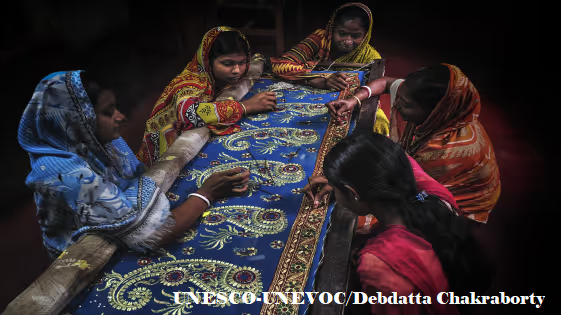
Post-Covid informal manufacturing growth: How states fared
Recently released official data show an expansion in informal manufacturing in India in the post-pandemic period. In this post, Goldar and Aggarwal conduct a cross-state analysis and highlight that Bihar led the growth story in terms of the number of enterprises and employment generation. An additional notable trend is of the feminisation of industrial labour. Financial assistance by the government helped support the recovery, particularly in rural areas.
Share of manufacturing in India’s total employment: No mean performance
Available jobs data show only a modest increase in the share of manufacturing in India’s total employment in the last 50 years. In this post, Bishwanath Goldar highlights that the outsourcing of services used by manufacturing has grown speedily over time, due to the splintering of services from manufacturing. If this is accounted for, the performance of manufacturing in job creation is not as dismal as indicated by the data.
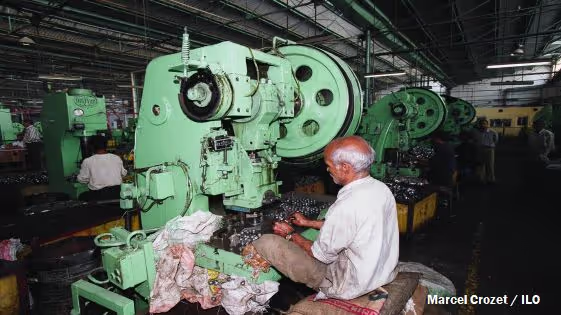
Formalisation of informal manufacturing enterprises in India
Employment in India’s organised manufacturing sector has grown rapidly since 2004. This article finds that about 15% of this growth can be attributed to the formalisation of previously informal enterprises, and expects that, as the new labour code is implemented, the output and employment of relatively bigger informal manufacturing establishments will rise significantly, with concomitant gains in productivity. The productivity potential of such informal enterprises needs to be adequately exploited with investment in ICT and other fixed assets.