
.svg)
.svg)
%201.svg)
%201.svg)
.svg)

.svg)
.svg)
Debayan Pakrashi

Dr Debayan Pakrashi is an Associate Professor of Economics at the Indian Institute of Technology (IIT) Kanpur. He is an applied microeconomist interested in behavioural, health and economic development. Prior to joining the Behavioural Science Centre at the University of Stirling as a post-doctoral researcher, he was an Australian Research Council (ARC) Research Scholar, working on the Rural-Urban Migration in China and Indonesia (RUMiCI) project at the University of Queensland, funded by the Australian Research Council, the Ford Foundation, the World Bank, and the German Labour Institute. He received the Dean’s Award for Outstanding Research Higher Degree Thesis and the Australian Alumni Excellence Award India under the Young Achiever category for his work in 2015. Currently, he is working on several research projects in India and Bangladesh with leading experts in the field of behavioural economics and impact evaluation.
.svg)

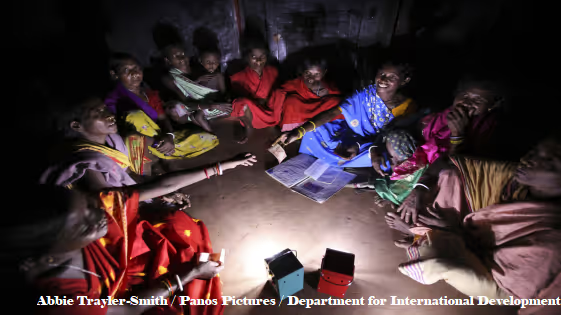
Powering progress: How reliable community electrification boosts women’s autonomy
While there has been significant progress in expanding access to grid electricity in India, the reliability of electricity remains a concern. Based on five national-level datasets spanning over a period of almost two decades., this article shows that improved reliability of electricity at the community level is beneficial for women’s empowerment in terms of mobility, participation in household decision-making, health autonomy, and safety.


कोविड-19 और मानसिक स्वास्थ्य: टेलीकाउंसलिंग के माध्यम से महिलाओं की मानसिक स्थिति में सुधार लाना
कोविड-19 जैसी सार्वजनिक स्वास्थ्य आपात स्थिति के कारण परिवार में निम्न सामाजिक-आर्थिक स्थिति, देखभाल की अधिक जिम्मेदारियां, और जीवन-साथी द्वारा हिंसा के खतरे के चलते महिलाओं में मानसिक स्वास्थ्य की समस्याएं उत्पन्न होती हैं। ग्रामीण बांग्लादेश में किये गए एक क्षेत्रीय अध्ययन के आधार पर, यह लेख दर्शाता है कि संसाधन के अभाव वाले सेटिंग्स में कम लागत वाला टेलीकाउंसलिंग हस्तक्षेप महिलाओं के मानसिक स्वास्थ्य में प्रभावी रूप से सुधार ला सकता है।
Covid-19 and mental health: Improving women’s mental well-being via telecounselling
Public health emergencies such as Covid-19 disproportionally cause mental health problems among women due to factors such as their inferior socioeconomic position in the household, greater care responsibilities, and risk of intimate partner violence. Based on a field study in rural Bangladesh, this article shows that a low-cost telecounselling intervention can effectively improve women’s mental health in resource-poor settings.

भेदभाव में लिंग-जाति अंतर्विरोध: क्या मरीज़ डॉक्टर की सामाजिक पहचान की परवाह करते हैं?
भारत में सामाजिक पहचान पर आधारित भेदभाव व्यापक रूप में फैला होने की वजह से, भेदभाव में जाति-लिंग अंतर्विरोध के अध्ययन हेतु एक अनूठी सेटिंग उपलब्ध होती है। यह लेख, उत्तर प्रदेश में किये गए एक क्षेत्रीय प्रयोग के आधार पर दर्शाता है कि मरीज द्वारा महिला डॉक्टरों की तुलना में पुरुष डॉक्टरों को पसंद किये जाने के कारण जाति-संबंधी पूर्वाग्रह इस लिंग संबंधी भेदभाव को और बढ़ा सकते हैं। भारत में निम्न-जाति के पेशेवरों की बढ़ती हिस्सेदारी को देखते हुए, यह लिंग-जाति अंतर्विरोध पेशेवरों के बीच लैंगिक असमानताओं को बढ़ा सकता है।
Gender-caste intersectionality in discrimination: Do patients care about doctor’s social identity?
Due to widespread prevalence of discrimination based on social identity, India provides a unique setting for studying caste-gender intersectionality in discrimination. Based on a field experiment in Uttar Pradesh, this article shows that when patients prefer male doctors over female doctors, caste-related prejudices can worsen this gender discrimination. Given the increasing share of low-caste professionals in India, this gender-caste intersectionality can exacerbate gender disparities among professionals.

Using personalised information delivery to improve uptake of emergency government benefits
Although many governments introduced additional benefits as part of existing welfare schemes for Covid-19 relief, there is often a significant gap between the introduction of, and access to these benefits. Based on a field experiment in Kanpur in Uttar Pradesh, this article shows that simple, low-cost, information provision interventions can improve the accuracy of households' beliefs about the entitlements they are eligible for and increase the amounts they actually receive, improving beneficiaries’ food security and well-being.
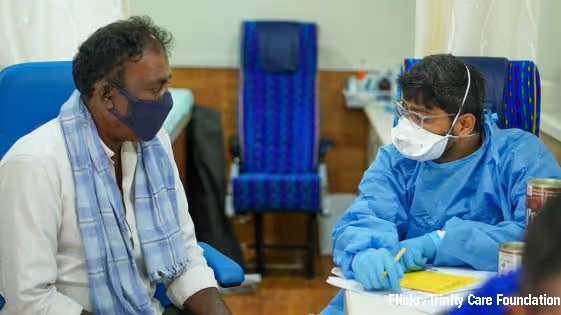
Covid-19: Addressing stigma and misconceptions
Throughout the Covid-19 pandemic in India, there has been stigmatisation of patients and their families, and discriminatory attitudes towards marginalised groups as well as frontline workers. Based on an experiment conducted in Uttar Pradesh during June-August 2020, this article shows that providing reliable and focussed information on the transmission of the Virus can play an important role in addressing associated misconceptions, stress, and stigma.

Can microcredit improve food security among the rural poor?
A core objective of microcredit in Bangladesh is to make the rural poor more food secure. To what extent has this been achieved? Analysing household data from Bangladesh, this column finds that participants of microcredit programmes are more food secure, with improved calorie availability, reduced child stunting and better maternal nutritional status. However, programme participation in itself does not improve dietary diversity.