
.svg)
.svg)
%201.svg)
%201.svg)
.svg)

.svg)
.svg)
Debraj Ray
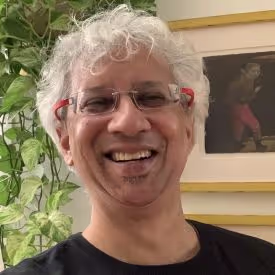
Debraj Ray is the Silver Professor, Faculty of Arts and Science, and Professor of Economics, New York University. Ray works in the areas of development economics and game theory. He is a Fellow of the Econometric Society, a Guggenheim Fellow, and a Fellow of the Society for Advancement in Economic Theory. He is on the Board of Directors of the Bureau for Research in the Economic Analysis of Development (BREAD). He received the Deans Award for Distinguished Teaching at Stanford and the Gittner Award for Teaching Excellence at Boston University. He holds an honorary degree from the University of Oslo, and was a Co-Editor of the American Economic Review.
.svg)

क्या एक व्यापक लॉकडाउन का कोई उचित विकल्प है?
कोविड-19 के खिलाफ भारत की लड़ाई में, हम दो विकल्पों में से अनिवार्यत: एक का चयन कर रहे हैं, एक ओर सामाजिक दूरी और दूसरी ओर लोगों को अपनी आजीविका से वंचित करना। सामान्य तथा अनिवार्य लॉकडाउन की अस्थिरता को स्वीकार करते हुए, देबराज रे और सुब्रमण्यन एक प्रस्ताव रखते हैं जिसके तहत युवाओं को कानूनी रूप से काम करने की अनुमति दी जाती है और अंतर-पीढ़ी संचरण से बचने के लिए उपायों के केंद्र को घरों पर स्थानांतरित कर दिया जाता है।


Covid-19: Is there a reasonable alternative to a comprehensive lockdown?
In India’s battle against Covid-19, we are inevitably confronted by the choice between social distancing on the one hand, and denying people their livelihood on the other. Recognising the unsustainability of a general, mandatory lockdown, Ray and Subramanian put forth a proposal whereby the young are legally permitted to work and the locus of measures to avoid intergenerational transmission is shifted to the household.

Analysing worker responses to a contract change
Higher-powered incentives are generally believed to increase worker productivity. In the context of an Indian tea plantation, this column examines a contract change wherein baseline wages were increased and incentive piece rates were lowered or kept unchanged. It finds that output increased by 20-80% in the following month but fell to original levels thereafter. Possible explanations for the observed impact are explored.
Monkeying with the rupee
In this article, Debraj Ray discusses the sharp depreciation of the rupee and the ongoing outflow of foreign capital from India. Further, he refutes claims that the costs associated with the Food Security Bill are having a negative impact on the Indian currency.
Covid-19 and other diseases: An ‘Animal Farm’ perspective
Debraj Ray and S Subramanian contend that despite the apparent sentiment of ‘we are all in this together’, the global burdens of Covid-19 and the global benefits of anti-Covid-19 policy have been skewed against the poorer nations of the world, and within nations, against the poor and the vulnerable.
Gender Differences in Health Investments: Evidence from Health Care Providers in India
A central feature of many developing countries is the presence of significant gender differentials in health outcomes. One potential factor which can account for this is that females seek treatment later than males.

Response to the Bhagwati-Panagariya rejoinder on MNREGA
In a recent article, Abreu et al. refuted the Bhagwati-Panagariya argument for phasing out MNREGA in favour of cash transfers. In this article, Abreu et al. respond to claims in a rejoinder by Bhagwati-Panagariya, regarding net benefits of MNREGA employment, the self-selection feature of the programme, and rural asset creation.
Star Wars
Debraj Ray gets to the heart of the growth versus redistribution debate and argues that a sectoral imbalance in growth is inevitable. While occupational choice is an important way to deal with this, it is slow and imprecise. Action on the part of the government may be critical to even things out.

DUET: Towards employment as a universal right
Debraj Ray contends that we should push forward with the agenda of employment as a universal right, and DUET would move that needle. He discusses two aspects of the proposal – keeping track of workers, and keeping track of projects.

The universal basic share and social incentives
In the previous article in the series, Debraj Ray proposes a simple amendment of the universal basic income called the universal basic share. In this article, Debraj Ray and Karl Ove Moene (University of Oslo), discuss how the universal basic share combines social considerations of fairness with incentives for the collective good.
The universal basic share
Debraj Ray, Professor of Economics at NYU, proposes a simple amendment of the universal basic income – what he calls the ‘universal basic share’. The idea is to commit a fixed fraction of the gross domestic product to the provision of a basic income for all.
(Mis)Leading attack on MNREGA
Bhagwati and Panagariya have argued for phasing out MNREGA in favour of cash transfers. In this article, Abreu et al. contend that the argument is based on inflating the costs of the programme and deflating the benefits. While they do not claim that all is well with MNREGA, they believe it needs better governance, not slow suffocation.
Please weight
The latest wealth index by New World Wealth that looks at multimillionaires has ranked India eighth in the global rich list. This article contends that looking at absolute numbers may be misleading. Accounting for population and economic differences across countries, it shows that while India does not stand out in terms of income going to the top 1%, it does in terms of income going to the top 0.1%.

I4I@10 | First Ashok Kotwal Memorial Lecture: The future of development
What is the 'fourth' fundamental law of capitalism? Will capital ‘inherit the earth’? Has the pandemic quickened the intuitive appeal of the capital-labour substitution? Should sovereign funds be based on corporate wealth, not just natural resources? Would Universal Basic Income work in a relatively poor country like India? In the first annual Ashok Kotwal Memorial Lecture, Professor Debraj Raj talks about the future of development, and the contribution of labour, capital and automation in growth. After a quick introduction, he dispels the notion of balanced growth by showing that, far from being constant, the share of labour is falling, over time, across countries, and within sectors. Presenting employment elasticities of different sectors, and labour shares for many economies, he establishes the ubiquity of capital-labour substitution. We see GDP growth has outpaced employment growth in India too, even though there is an abundance of cheap labour. ...

Parikshit Ghosh speaks with Debraj Ray
In this podcast, Parikshit Ghosh (Member of the I4I Editorial Board & Associate Professor, Delhi School of Economics) speaks with Debraj Ray (Julius Silver Professor, Faculty of Arts and Science, and Professor of Economics, New York University) on the rise of Trump and how it relates to the upsurge of inequality in the US and the ‘American dream’ narrative; implications of the process of automation for the relative shares of capital and labour as factors of production; the idea of committing a share of gross domestic product for the provision of a universal basic income; and the challenges involved in addressing inequality of wealth.