
.svg)
.svg)
%201.svg)
%201.svg)
.svg)

.svg)
.svg)
Fatema Patel

Fatema Patel provides research, data analytics, stakeholder engagement, and grand management support for 3ie’s projects related to women’s empowerment, livelihoods, and adolescent development in India.
Prior to joining 3ie, Fatema was a Research Associate at Yale University’s Inclusion Economics India Centre (Previously, EPoD India), on a large-scale randomised controlled trial related to women’s access to mobile phones. While based in Raipur, Chhattisgarh in India, she was engaged in intervention implementation, research design, and managing field and remote data collection exercises. She has also assisted on research studies sanctioned by the Government of Maharashtra, Centre for Monitoring Indian Economy, and the Mann Deshi Foundation – the latter being an impact assessment of the Covid-19 pandemic on women-owned micro-enterprises in the non-agricultural sector. She has teaching experience through her engagement as a teaching assistant at the Meghnad Desai Academy for Economics.
Fatema is the 2020 Gold Medallist of the Master of Arts, Economics programme at the University of Mumbai. In addition to research, she is interested in leveraging data tools for social good.
.svg)

पीढ़ी-दर-पीढ़ी बुनाई : ग्रामीण भारत में पारिवारिक व्यवसायों में उत्पादकता लाभ
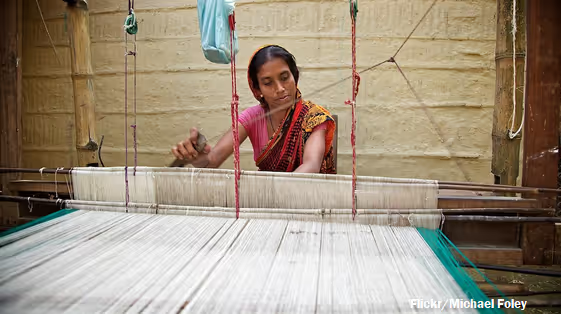
हर साल 12 फरवरी को मनाए जाने वाले राष्ट्रीय उत्पादकता दिवस का उद्देश्य अर्थव्यवस्था में उत्पादकता, नवाचार और निपुणता के महत्त्व पर ज़ोर देना है। इसी सन्दर्भ में प्रस्तुत इस लेख में पारिवारिक स्वामित्व वाले बुनाई उद्यम की चर्चा की गई है। आंध्र प्रदेश और तेलंगाना में बुनाई का कार्य अक्सर एक पारिवारिक उद्यम है। 1,800 से अधिक परिवारों के डेटा का उपयोग करते हुए, हैममेकर एवं अन्य द्वारा किया गया मिश्रित-विधियों का मूल्याँकन यह दर्शाता है कि पीढ़ी-दर-पीढ़ी बुनाई व्यवसाय में जुटे परिवार बुनाई कार्य में अधिक कमाते हैं और केवल एक पीढ़ी के बुनकरों वाले परिवारों की तुलना में उनकी पारिवारिक आय अधिक होती है। हालाँकि, पाया गया कि उत्पादकता के ये लाभ पूरे परिवार में समान रूप से वितरित नहीं होते हैं, क्योंकि वे उन महिला बुनकरों के लिए विस्तृत एजेंसी के रूप में तब्दील नहीं होते जो इन व्यवसायों का हिस्सा होती हैं।


Weaving through generations: Productivity gains in family-owned businesses in rural India
In Andhra Pradesh and Telangana, weaving is often a family enterprise. Using data from over 1,800 households, this ongoing mixed-methods evaluation by Patel et al. shows that households with multi-generational weaving businesses earn more in weaving revenue and have greater household incomes relative to households with only one generation of weavers. However, it notes that these gains in productivity are not equally distributed across the household, as they do not translate into greater agency for the women weavers who are part of family-owned businesses.
Supporting women weavers: Learnings from producer companies
The lack of market demand and low earnings, as well as competition from power looms, has led to declining participation of artisans in India's handloom industry. In this note, Dang et al. share some insights gained through conversations with women weavers and other members of the weaving community, which reveal the need for greater technical and management training and provision of suitable working conditions for weavers to ensure the long-term sustainability of weaving enterprises.