
.svg)
.svg)
%201.svg)
%201.svg)
.svg)

.svg)
.svg)
Karan Singhal

Karan Singhal is currently working as a researcher at Indian Institute of Management Ahmedabad on topics in urban governance, education and early childhood, as part of an IIMA and UNICEF partnership. Previously, he led a project on understanding the impact of the '25% mandate' or Section 12(1)(c) provision of the Right to Education Act in Ahmedabad, and has also worked on issues related to inequality, budgetary expenditure, and gender. He studied economics at Centre for Development Studies, Trivandrum and Symbiosis School of Economics, Pune.
.svg)

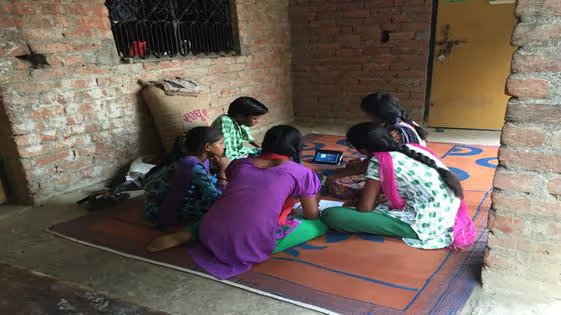
Low-tech and teacher support interventions during school closures
School closures during Covid-19 significantly impacted early childhood education, especially in households without sufficient parental engagement. Using data from households affiliated with Balwadis and preschools in Mumbai and Pune, Vernekar et al. find that those with access to a structured educational technology programme reported higher engagement levels. This effect was even greater for households that also received teacher support. They make a case for using such ed-tech programmes for blended schooling to minimise learning inequalities in case of future shocks.


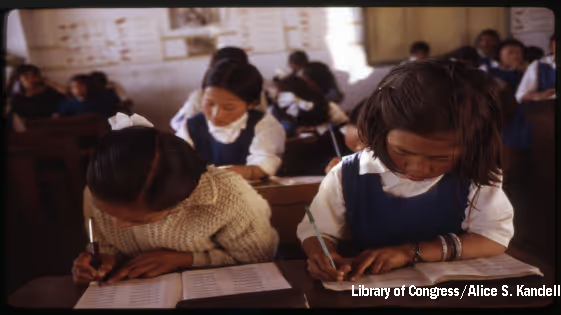
ग्रामीण भारत में गणित सीखने में लैंगिक अंतर
विकसित देशों में साक्ष्य के बढ़ते दायरे यह संकेत देते हैं कि गणित सीखने संबंधी परिणामों में महिलाओं के लिए प्रतिकूल स्थिति बनी रहती है और इसके संभावित कारण सामाजिक कारक, सांस्कृतिक मानदंड, शिक्षक पूर्वाग्रह और माता-पिता के दृष्टिकोण आदि से संबंधित होते हैं। यह लेख भारत के राष्ट्रीय स्तर के प्रतिनिधिक आंकड़ों का उपयोग करते हुए, विभिन्न आयु वर्गों में गणित सीखने में मौजूद लैंगिक असमानता को दर्शाता है और यह भी दर्शाता है कि समय के साथ इसके कम होने के कोई प्रमाण भी नहीं मिलते हैं।
Gender difference in mathematics learning in rural India
A growing body of evidence in developed countries has indicated that female disadvantage prevails and persists in mathematics learning outcomes, with the likely causes being social factors, cultural norms, teacher bias, and parental attitudes, among others. Using nationally representative data from India, this article shows that a gender gap exists in mathematics – across age groups, and with no evidence of convergence over time.

Understanding school choices under RTE’s 25% mandate
Section 12(1)(c) of the Right To Education Act mandates non-minority status private schools to reserve at least 25% seats for the disadvantaged and weaker sections of the society. This article analyses the impact of the mandate on changing school choices of relatively disadvantaged households based on a sample of over 1,600 households in urban Ahmedabad. It finds that the mandate expanded choice of schools for the participating eligible households.
Barriers in accessing applications under RTE quota in Gujarat
In the school year 2017-18, Gujarat shifted from a paper-based system at the district level to an online system at the state level, for applications under the Right to Education Act. In this note, researchers at IIM Ahmedabad demonstrate that unless the required technological infrastructure is adequately developed, a complete shift to digitisation adversely affects the most vulnerable populations.
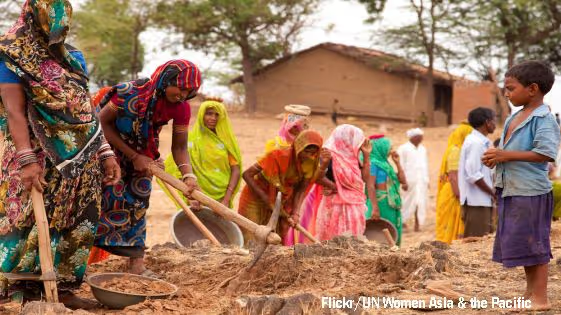
कोविड-19: बिहार की सरकारी योजनाएँ कमजोर आबादी की सहायता कितने अच्छे से कर रहीं हैं?
कोविड-19 महामारी और उससे जुड़े लॉकडाउन का तत्काल प्रतिकूल प्रभाव ऐसे प्रवासी श्रमिकों और उनके परिवारों पर काफी अधिक देखा गया जिनकी अपने मूल गांवों में सरकारी योजनाओं तक पहुंचने की क्षमता अनिश्चित थी। जून-जुलाई 2020 में बिहार के ग्रामीण क्षेत्रों में किये गए एक सर्वेक्षण से प्राप्त आंकड़ों का विश्लेषण करते हुए सरीन एवं अन्य यह पाते हैं कि प्रवासियों के परिवारों को भोजन में कटौती करने और मानसिक स्वास्थ्य के मुद्दों से पीड़ित होने की संभावना अधिक थी, भले ही उन्होंने गैर-प्रवासी परिवारों की तुलना में अधिक आय होने की जानकारी दी हो।
Covid-19: How well are government schemes supporting Bihar’s vulnerable populations?
The immediate adverse impact of the Covid-19 pandemic and associated lockdown was visibly greater for migrant workers and their households, whose ability to access government schemes in their villages of origin was uncertain. Analysing data from a survey in rural Bihar in June-July 2020, Sarin et al. find that household with migrants were more likely to cut down on food and suffer from mental health issues – even as they reported higher incomes than non-migrant households.