
.svg)
.svg)
%201.svg)
%201.svg)
.svg)

.svg)
.svg)
Karan Babbar

Karan Babbar is an Assistant Professor at Jindal Global Business School (JGBS), OP Jindal Global University. He holds a Ph.D. from the Indian Institute of Management, Ahmedabad. His research areas encompass various topics, including gender, health policy, health economics, health psychology, and development economics.
Karan has gained valuable experience as a consultant with the Center for Social Norms and Behavioral Dynamics at the University of Pennsylvania. Additionally, he has worked as a Software Engineering Analyst for Accenture Services Private Limited. Notably, he has been honoured with the Regunath Research Fellowship, which acknowledges his significant contributions to the field. He has also received funding from the National Commission of Women to conduct the Women's Safety Survey in Faridabad.
.svg)

गर्भनिरोधक संबंधी निर्णयों के घरेलू हिंसा पर प्रभाव : निर्णय और गतिशीलता
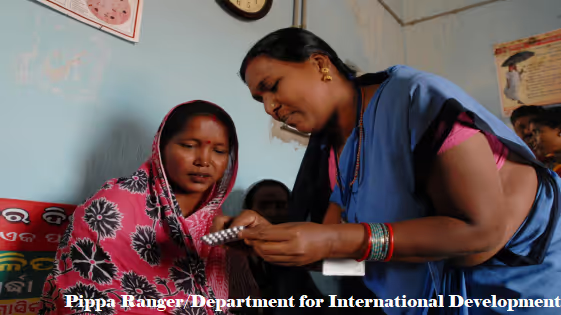
महिलाओं की परिवार में अपनी बात रखने की शक्ति और रोज़गार व शिक्षा के रूप में उनके सशक्तीकरण को, अन्तरंग-साथी द्वारा उनके प्रति हिंसा (इंटिमेट पार्टनर वायलेंस- आईपीवी) की घटनाओं के कम होने और बढ़ जाने, दोनों के सन्दर्भ में दर्ज किया गया है। राष्ट्रीय परिवार स्वास्थ्य सर्वेक्षण (एनएफएचएस-5) के नवीनतम सर्वे के डेटा का उपयोग करते हुए, इस लेख में यह जाँच की गई है कि किसी महिला के गर्भनिरोधक उपयोग के फैसले अन्तरंग-साथी द्वारा उसके प्रति हिंसा (आईपीवी) को कैसे प्रभावित करते हैं। यह लेख दर्शाता है कि गर्भनिरोधकों के उपयोग का स्वतंत्र रूप से निर्णय लेने पर महिला को शारीरिक, यौन और भावनात्मक हिंसा का अधिक खतरा होता है।


Decisions and dynamics: Unpacking the impact of contraceptive decisions on domestic violence
Women’s empowerment in the form of intra-household bargaining power, employment, and education have been documented to both reduce and increase the prevalence of intimate partner violence (IPV). Using data from the latest wave of the National Family Health Survey (NFHS-5), this article investigates how a woman’s contraceptive use decisions could affect IPV, and shows that independently deciding to use contraceptives puts her at a greater risk of physical, sexual, and emotional violence.